Polygon Formula Definition, Symbol, Examples (original) (raw)
Last Updated : 23 Jul, 2025
**Polygons are closed two-dimensional shapes made with three or more lines, where each line intersects at vertices. Polygons can have various numbers of sides, such as three (triangles), four (quadrilaterals), and more.
In this article, we will learn about the polygon definition, the characteristics of the polygon, the types of polygons and others in detail.
Table of Content
- Polygon Definition
- Polygon Formulas
- Types of Polygons
- Properties of Polygon
- Solved Examples on Polygon Formula
Polygon Definition
A polygon is a two-dimensional, closed shape with three or more straight sides. The name of a polygon indicates how many sides it has. For example, a triangle has three sides and a quadrilateral has four sides.
Characteristics of Polygon
Polygons have the following characteristics:
- **Closed shape: Polygons are closed shapes, meaning they have no open ends.
- **Plane shape: Polygons are made of straight lines.
- **Two-dimensional: Polygons have length and width, but no other dimensions.
- **Interior angles: Polygons have angles inside them. A regular polygon has all its interior angles equal to each other.
- **Exterior angles: The exterior angle is the supplementary angle to the interior angle. The sum of the exterior angles of a polygon must be 360°.
Polygon Formulas
Different polygon formulas are added in the table below:
| Sum of Interior Angles of a Polygon | (n-2)×180° |
|---|---|
| Interior Angle of a Regular Polygon | {(n-2)×180°}/n |
| Exterior Angle of a Regular Polygon | 360°/n |
| Perimeter of an n-sided Regular Polygon | n × s |
| Area of an n-sided Regular Polygon | (n × s × Apothem)/2 = (Perimeter × Apothem)/2 = (l/2)×tan(180°/n) |
where,
- ****"n"** is Number of Sides
- ****"s"** is Length of Each Side
- ****"l"** is Apothem Length
Types of Polygons
Below are some types of polygons based on the number of sides of a polygon,
| Number of Sides | Name of Polygon | Figure |
|---|---|---|
| 3 | Triangle |  Triangle Triangle |
| 4 | Quadrilateral |  Quadrilateral Quadrilateral |
| 5 | Pentagon |  Pentagon Pentagon |
| 6 | Hexagon |  Hexagon Hexagon |
| 7 | Heptagon |  Heptagon Heptagon |
| 8 | Octagon |  Octagon Octagon |
| 9 | Nonagon |  Nonagon Nonagon |
| 10 | Decagon |  Decagon Decagon |
Based on measure of angles and the sides of a polygon, they are classified into the following types
- Regular polygon
- Irregular polygon
- Concave polygon
- Convex polygon
- Equilateral polygon
- Equiangular Polygon
**Regular Polygon
A polygon is said to be a regular polygon if it has all the interior angles and the sides are of the same measure. The regular polygon are shown in the image added below:

Regular Polygon
**Irregular Polygon
A polygon is said to be a irregular polygon if it has all the interior angles and the sides have different values. The irregular polygon are shown in the image added below:
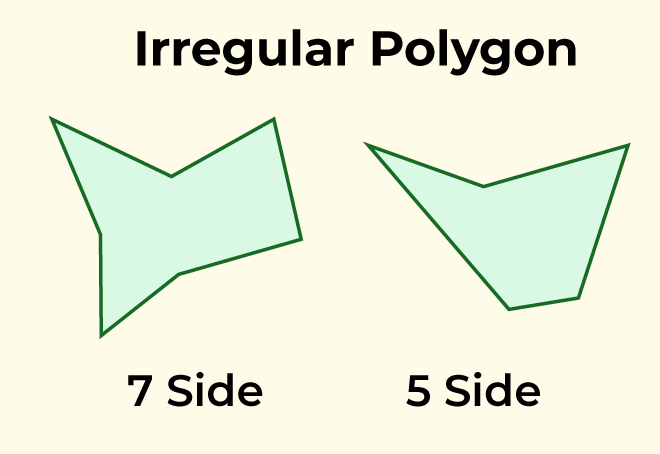
Irregular Polygon
**Concave Polygon
A concave polygon is a polygon that has at least one interior angle greater than 180 degrees, i.e., a reflex angle. The concave polygon are shown in the image added below:

Concave Polygon
**Convex Polygon
A convex polygon is a polygon that has all the interior angles of a polygon less than 180 degrees. The convex polygon are shown in the image added below:

Convex Polygon
**Equilateral Polygon
An equilateral polygon is a polygon whose all sides measure the same.
**Equiangular Polygon
An equiangular polygon is a polygon whose all angles measure the same.
Properties of Polygon
Various properties of polygon are:
- Sum of the interior angles of a polygon depends on the number of sides.
- Number of vertices in a polygon is equal to the number of sides.
- Sum of the exterior angles in any polygon is always 360 degrees.
- A polygon can be either convex (all interior angles are less than 180 degrees) or concave (at least one interior angle is greater than 180 degrees).
- A polygon is regular if all its sides and angles are congruent (equal); otherwise, it's irregular.
**Article Related to Polygon Formula:
Solved Examples on Polygon Formula
Let's solve some example problems based on the Polygon Formulas.
**Example 1: Calculate the perimeter and value of one interior angle of a regular heptagon whose side length is 6 cm.
**Solution:
Polygon is an heptagon. So, number of sides (n) = 7
Length of each side (s) = 6 cm
We know that,
Perimeter of the heptagon (P) = n × s
P = 7 × 6
= 42 cm
Now, find each interior angle by using the polygon formula,
Interior Angle = [(n-2)180°]/n
= [(7 - 2)180°]/7
= (5 × 180°)/7
= 128.57°
Therefore, perimeter of the given heptagon is 42 cm and the value of each internal angle is 128.57°.
**Example 2: Calculate the measure of one interior angle and the number of diagonals of a regular decagon.
**Solution:
Polygon is a decagon. So, number of sides (n) = 10
Now, to find each interior angle by using the polygon formula,
Interior Angle = [(n-2)180°]/n
= [(10 - 2)180°]/10
= (8 × 180°)/10
= 144°
We know that,
Number of diagonals in a n-sided polygon = n(n-3)/2
= 10(10 - 3)/2
= 10(7)/2 = 35.
Therefore, value of each internal angle of a regular decagon is 144° the number of diagonals is 35.
**Example 3: Calculate the sum of interior angles of a hexagon using the polygon formula.
**Solution:
Polygon is a hexagon. So, number of sides (n) = 6
We know that,
Sum of interior angles of a polygon = (n-2)×180°
= (6-2)×180°
= 4×180° = 720°.
Hence, sum of interior angles of a hexagon is 720°.
**Example 4: Calculate the measures of one exterior angle and the perimeter of a regular pentagon whose side length is 9 inches.
**Solution:
Polygon is a pentagon. So, number of sides (n) = 5
We know that,
Length of each side (s) = 9 inches
We know that,
Perimeter of the pentagon (P) = n × s
P = 5 × 9
= 45 inches
Each exterior angle of a regular polygon = 360°/n
= 360°/5 = 72°.
Hence, measures of one exterior angle and the perimeter of a regular pentagon are 72° and 45 inches, respectively.