Power of Iota (original) (raw)
Last Updated : 23 Jul, 2025
The nature of a quadratic equation’s roots depends entirely on the value of its **discriminant. When the discriminant is negative, the equation has **complex roots, which involve the imaginary unit **iota (i).
The imaginary unit, denoted as i, is defined as: **i = √-1
**For example, consider the quadratic equation x2 + x + 1 = 0.
Using the Quadratic Formula: x = \frac{-b\pm\sqrt{b^2-4ac}}{2a}
Here, the discriminant (b2 − 4ac) is negative, leading to a square root of a negative number. In such cases, we use **iota to express the solution, as: **i = √−1
Thus, the concept of i allows us to work with numbers beyond the real number system, forming the foundation of **complex numbers.
**Fundamental Powers of i
- **i 1 = i
- **i 2 **= −1
- **i 3 **= −i
- **i 4 **= 1
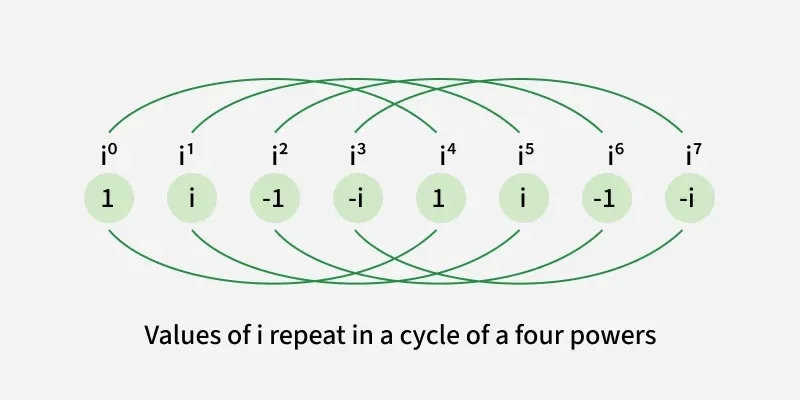
**Cyclic Nature of i
Observing the powers above, we notice that they repeat every four steps. This means that for any integer exponent n:
in = i(n mod 4)
where n mod gives the remainder when n is divided by 4.
**Generalization of Higher Powers of i
For any integer n:
- If n ≡ 0 mod 4, then in = 1
- If n ≡ 1 mod 4, then in = i
- If n ≡ 2 mod 4, then in = −1
- If n ≡ 3 mod 4, then in = −i
**Examples
- **i 10
- Find 10 mod 4 = 2
- Since i2 = −1 , we get i10 = −1
- **i 23
- Find 23 mod 4 = 3
- Since i3 = −i
- **i 100
- Find 100 mod 4 = 0
- Since i4 = 1, we get i100 = 1
**Note: The results will always be one of **1, i, −1, or **−i.
Important Formulas Power of Iota
Different powers of Iota are shown below, this table shows the calculations and results for the powers of the imaginary unit i.
| Power of i | Calculation | Result |
|---|---|---|
| i0 | 1 | 1 |
| i1 | i | i |
| i2 | i2 = -1 | = -1 |
| i3 | = i × i2 = i × -1 | = -i |
| i4 | = i2 × i2 = -1×-1 | = 1 |
| i5 | = i × i4 = i × 1 | = i |
| i6 | = i × i5 = i × i = i2 | = -1 |
| i7 | = i × i6 = i × -1 | = -i |
| i8 | = ((i)2)4 = (-1)4 | = 1 |
| i9 | = i × i8 = i × 1 | = i |
| i10 | = i × i9 = i × i = i2 | = -1 |
**This signifies that i repeats its values after every 4th power. We can generalize this fact to represent this pattern (where n is any integer), as,
- i4n = 1
- i4n+1 = i
- i4n+2 = -1
- i4n+3 = -i
Solved Examples of Power of Iota
**Example 1: Simplify i 517
**Solution:
After dividing power of 'i' by 4 remainder is 1
= i517
= i1
= i
**Example 2: Solve i 2095
**Solution:
After dividing power of 'i' by 4 remainder is 3
= i2095
= i2
= -i
**Example 3: Solve i 2346
**Solution:
After dividing power of 'i' by 4 remainder is 0
= i23456
= i0
= 1
**Example 4: Solve i 324770
**Solution:
After dividing power of 'i' by 4 remainder is 2
i324770
= i2
= -1
**Example 5: Find the value of i -3927
**Solution:
i-3927 = 1/i3927 {∵ a-m = 1/am}
= 1/i3After dividing power of 'i' by 4 remainder is 3
= 1/-i {∵ i3 = -i}
= -(-i) {∵ 1/i = -i}
= i
Practice Problems on Power of Iota
**Question 1: Find the value of i-432
**Question 2: Find the value of i-12
**Question 3: Find the value of i26
**Question 4: Find the value of i-512
**Question 5: Find the value of i1024
**Question 6: Find the value of i-2048
**Question 7: Find the value of i121
**Question 8: Find the value of i233
**Related Article: