Value of i (original) (raw)
Last Updated : 23 Jul, 2025
The value of **i is a fundamental concept in mathematics, particularly in the field of complex numbers. Known as the imaginary unit or **iota, it represents numbers that are not real but are an essential part of the mathematical system. The concept of **i arose to handle situations involving the square root of negative numbers, which can't be calculated in the real number system.
The value of i is defined as:
**i = √-1 and i × i = i 2 = -1
Since the value of √-1 can't be calculated, it is represented by the term 'i'.
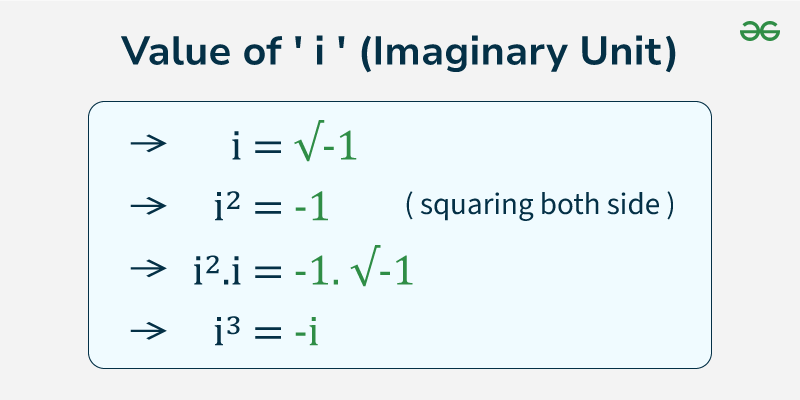
**Value of iota 'i' in Complex Numbers
In complex numbers, **i is used to represent the imaginary part. A complex number is generally written as:
z = a + ib
where **a and **b are real numbers
ib denotes the complex part
If the number z is purely imaginary then x = 0 and if the number z is real then y = 0.
Geometrical Interpretation of i
Let us see how we can graphically represent a complex number in the complex plane:

Complex numbers in the complex plane
The number can be in one of the four quadrants depending on the sign of real numbers x and y. We know that a number can have a complex part and real part. The real part decides whether point lies on positive or negative side of x axis and at what distance from y-axis. In contrast, the complex part denotes whether point lies on positive or negative side of y axis and at what distance from x-axis. Let us see each case and the corresponding quadrant.
| Quadrant | X coordinate | Y coordinate |
|---|---|---|
| 1st Quadrant | positive | positive |
| 2nd Quadrant | negative | positive |
| 3rd Quadrant | negative | negative |
| 4th Quadrant | positive | negative |
Absolute Value of i
When we refer to the absolute value of a number, it is the modulus value of the number. We know that the absolute value of both 1 and -1 is 1 therefore, we the absolute value of i is 1.
The absolute value of complex numbers can be term as:
****|z| = √ (a** 2 **+ b 2 )
For the imaginary unit i, which can be represented as 0 + i,
z = 0 + i.1 , a = 0 and b = 1
****|z| = √ (a** 2 **+ b 2 )
∴ |z| = |i| = 1
**So, the absolute value of i is ∣i∣ =1.
What is Value of Powers of i (i2, i3, i4...)?
Now let us manipulate the properties of i and see what happens when we repeatedly multiply the number 'i'. Note that if we take the square of any real number, the value always comes out to be positive which is not the case with the complex number 'i'. Let us see this from the table.
| Power(n) | Expression | Value |
|---|---|---|
| -3 | 1/i3 = 1/(-1 × i) = 1/-i = i | i |
| -2 | 1/i2 = 1/-1 = -1 | -1 |
| -1 | 1/i = -i | -i |
| 0 | i0 = 1 | 1 |
| 1 | i | i |
| 2 | i2 = -1 | -1 |
| 3 | i3 = -i | -i |
| 4 | i4 = i2 × i2 = -1 × -1 = 1 | 1 |
| 5 | i5 = i2 × i2 × i = -1 × -1 × i = i | i |
| 6 | i6= i2 × i2 × i2 = -1 × -1 × -1 = -1 | -1 |
**Read More: Power of iota
General Results
From the above table, we can generalize that i is a cyclic expression that repeats its value after four intervals which can be given by
- i4n = 1
- i4n+1 = i
- i4n+2 = -1
- i4n+3 = -i
Properties of i
Let us take a look at some properties of i
- The square of i i.e. i2 is equal to -1 therefore, the value of i is √-1.
- i and -i can be described as the square roots of the number 1.
- The conjugate of i is -i and both have the same absolute value of 1.
- The powers of i form a cyclic pattern of four values namely i, -i, 1, and -1.
- i is one of the complex fourth roots of unity others being -1, 1, and -i.
- When plotted on a complex plane, i can be plotted at point (1, 0) on the x-axis.
**Related Articles:
Solved Examples of the Value of i
**Example 1: Evaluate the value of expression √-6
**Solution:
We have √-6
√-6 = √-1 · √6
Since √-1 = i
∴ √-6 = i√6
**Example 2: Find the value of √49 + √-8
**Solution:
√-8 = √-1 .√8
since √-1 = i and √8 = 2√2
∴ √-8 = 2i√2
Also we know **√49 = 7
Hence, √49 + √-8 = 7 + 2i√2
**Example 3: Find the value of x + y if x = √49 + √-8 and y = -2i√2.
**Solution:
√-8 = √-1 .√8
since √-1 = i and √8 = 2√2∴ √-8 = 2i√2
∴ √49 + √-8 = 7 + 2i√2 ( As **√49 = 7)
∴x = 7 + 2i√2Given y = -2i√2
∴ x + y = 7 + 2i√2 - 2i√2
∴ x + y = 7
**Example 4: Find the quadrant where x = √36 + √-4 lies on a complex plane.
**Solution:
x = √36 + √-4
∴x = 6 + 2i (As √36 = 6 and √-4 = 2i
∴ real part = 6 and imaginary part = 2
Since both the real and imaginary parts are positive, x lies in the 1st quadrant.
**Example 5: Find the value of x × y if x = √49 + √-8 and y =√49 - √-8.
**Solution:
√-8 =√-1 .√8
since √-1 = i
∴√-8 = 2i√2
∴√49 + √-8 = 7+ 2i√2
∴ x = 7+ 2i√2Similarly, y = 7- 2i√2
x × y = (7+ 2i√2) × ( 7- 2i√2)
∴ x × y = 49 - ( 2i√2)2
∴x × y = 49 - (-8)(As (2√2)2 = 8 and i2 = -1)
∴x × y = 49 + 8 = 57