Quadrants in Geometry (original) (raw)
Last Updated : 11 Feb, 2026
A quadrant is defined as a region in space that is divided into four equal parts by two axes, namely the X-axis and the Y-axis in the Cartesian Plane. These two axes intersect each other at 90°, and the four regions so formed are called the four quadrants, namely the I-quadrant, II-quadrant, III-quadrant, and IV-quadrant.
The Cartesian plane, formed by the X and Y axes, is split into four quadrants, each with distinct characteristics:
- **First Quadrant: Located in the upper right, both x and y-coordinates are positive. This quadrant represents points in the top-right portion of the plane.
- **Second Quadrant: Situated in the upper left, the x-coordinate is negative, and the y-coordinate is positive. This quadrant covers points in the top-left part of the plane.
- **Third Quadrant: Positioned in the lower left, both x and y-coordinates are negative. Points in the bottom-left area of the plane fall into this quadrant.
- **Fourth Quadrant: Found in the lower right, the x-coordinate is positive, and the y-coordinate is negative. This quadrant includes points in the bottom-right portion of the plane.
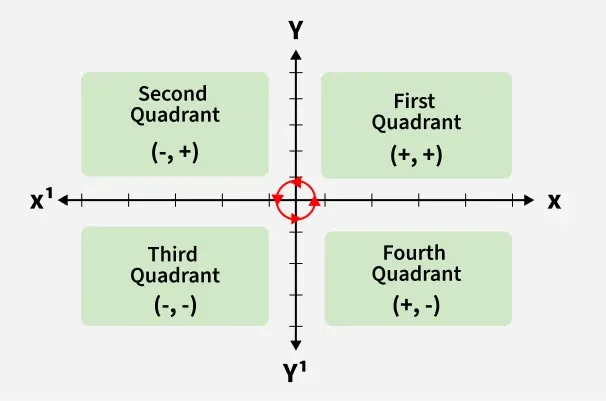
The quadrants are numbered in an anti-clockwise direction, starting from the upper right. The point where the X and Y axes intersect is called the origin, with coordinates (0, 0), indicating zero values for both x and y. Understanding these quadrants helps locate points within the Cartesian plane.
Origin
The starting point on a graph, known as the origin and shown as (0, 0), is where the horizontal x-axis and the vertical y-axis intersect. This means that at the origin, the values for both x and y are zero. It serves as a reference point for locating other points on the graph. In the image added above point O shows the origin.
Abscissa and Ordinate in Quadrants
When dealing with coordinates in a Cartesian plane, each point is represented as a pair (a, b) where:
- **a is the x-coordinate or the **abscissa.
- **b is the y-coordinate or the **ordinate.
To figure out where a point is without plotting, pay attention to the signs of the x-coordinate (abscissa) and y-coordinate (ordinate).
**1. Quadrant I: a > 0, b > 0 (both coordinates are positive)
- Example: Points (3, and 4) are in the first quadrant.
**2. Quadrant II: a < 0, b > 0 (abscissa is negative, ordinate is positive)
- Example: Point (−3, 4) is in the second quadrant.
**3. Quadrant III: a < 0, b < 0 (both coordinates are negative)
- Example: Point (−3, −4) is in the third quadrant.
**4. Quadrant IV: a > 0, b < 0 (abscissa is positive, ordinate is negative)
- Example: Point (3, −5), as seen in the example, is in the fourth quadrant.
**Note:- The abscissa shows the horizontal distance from the Y-axis. A positive abscissa means to the right, and in our example, abscissa = 3 means go right from the origin along the x-axis by 3 units.
The ordinate indicates the vertical distance from the origin. A negative ordinate means to go down from the origin along the y-axis. In the example, ordinate = -5 means go down by 5 units.
Sign Convention in Quadrants
Sign conventions in the quadrants can be easily understood using the image added below,
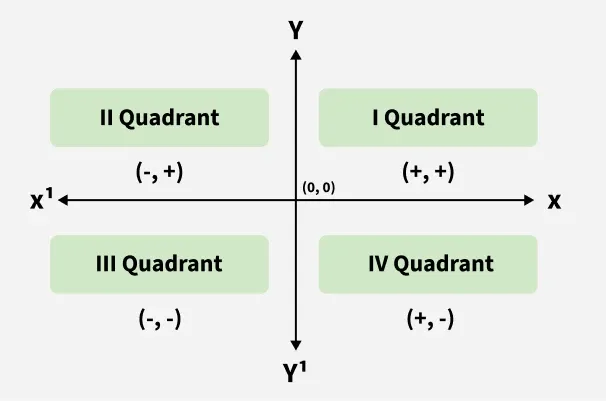
In the XY plane, as we move from left to right along the x-axis, the x-coordinate increases. Similarly, along the y-axis, moving from bottom to top results in an increase in the y-coordinate. The XY plane is divided into four quadrants, each with specific sign conventions for x and y coordinates:
| Quadrant | x-coordinate | y-coordinate |
|---|---|---|
| 1st Quadrant | Positive (+) | Positive (+) |
| 2nd Quadrant | Negative (-) | Positive (+) |
| 3rd Quadrant | Negative (-) | Negative (-) |
| 4th Quadrant | Positive (+) | Negative (-) |
Therefore, points in the 1st quadrant have positive values for both x and y, those in the 2nd quadrant have a negative x and a positive y, the 3rd quadrant has both negative x and y values, and the 4th quadrant has a positive x and a negative y.
Plotting Points on Quadrants
In a Cartesian plane, points are identified by the x-axis and y-axis. These points are denoted as (a, b), where 'a' is the x-coordinate (abscissa), and 'b' is the y-coordinate (ordinate). To position a point in a quadrant, we consider the signs of these coordinates. The values of x and y represent how far the point is from the x-axis and y-axis, respectively.
**For example, plot the point (2, -5) on the Cartesian plane. Analyzing the sign of the coordinates reveals that the point is in the 4th quadrant. It will be 2 units away from the x-axis (to the right) and 5 units away from the y-axis (down), using the origin as a reference point.
.PNG)
Trigonometric Functions in Different Quadrants
The values of various trigonometric functions in different quadrants can be learned by studying the table added below as,
| Quadrant | Sin | Cos | Tan | Cosecant | Secant | Cotangent |
|---|---|---|---|---|---|---|
| 1st Quadrant | + | + | + | + | + | + |
| 2nd Quadrant | + | - | - | + | - | - |
| 3rd Quadrant | - | - | + | - | - | + |
| 4th Quadrant | - | + | - | - | + | - |
The above table can be remembered easily with the mnemonic " **Add **Sugar **To **Coffee"
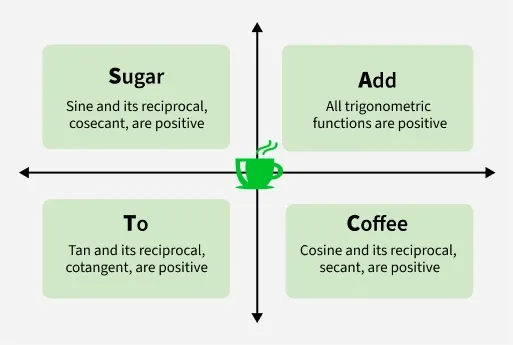
Where
- **Add => **All trigonometric functions are positive in the first quadrant eg.,( Sin, Cos, Tan, Cosec, Sec, Cot).
- **Sugar => **Sine and its reciprocal, **cosecant, are positive in the second quadrant.
- **To => **Tan and its reciprocal, **cotangent, are positive in the third quadrant.
- **Coffee => **Cosine and its reciprocal, **secant, are positive in the fourth quadrant.
**Related Articles:
Solved Examples of Quadrants in Geometry
**Example 1: Plot the point A (3, -4) and identify its Quadrant.
**Solution:
Point A is located at coordinates (3, -4). Since the x-coordinate is positive (3) and the y-coordinate is negative (-4), Point A lies in Quadrant IV.
**Example 2: Plot the point P (-5, 2) and determine its quadrant
**Solution:
Coordinates of point P are (-5, 2). To determine the quadrant, we examine the signs of the x and y coordinates.
- X-coordinate is -5, indicating a position to the left of the origin.
- Y-coordinate is 2, indicating a position above the origin.
Therefore, since the x-coordinate is negative and the y-coordinate is positive, point P is located in Quadrant II.
Point P (-5, 2) is situated in Quadrant II of the Cartesian plane.
Practice Problems on Quadrants
**Problem 1: Plot the point (1, -1) and identify its quadrant.
**Problem 2: Find three points on the x-axis and determine their quadrants.
**Problem 3: If a point lies on the y-axis with coordinates (0, -3), which quadrant is it in?
**Problem 4: Locate the points Q (2, 2), R (-2, -2), and S (0, 0) and check for collinearity.
**Problem 5: Plot the point (-4, -3) and explain in which quadrant it is situated.