Real Functions: Definition, Properties and Examples (original) (raw)
Last Updated : 23 Jul, 2025
**Real Function is a function which deals with real numbers as input and output values. In other words, a real function is a special type of relation between two sets of real numbers which follow some important properties. Values from one set called domain map to another set called range. A function is generally denoted as f(x), where x denotes the input of the function__._ There are different types of functions such as algebraic functions, trigonometric functions, exponential functions, logarithmic functions, etc.
In this article, we will discuss the definition of a real function, its examples, domain and range of real functions, their properties, arithmetic operations on real functions, solved numerical examples and related frequently asked questions.
Table of Content
- What is a Real Function?
- Examples of Real Functions
- Domain and Range of Real Functions
- Properties of Real Functions
- Operations on Real Functions
- Examples on Real Functions
- Real Functions - Practice Problems
What is a Real Function?
A **real function is a type of function that accept real values as input and return real values as output in other words Real function is a kind of mapping between two sets of **real numbersnamely from set A to set B that follows some important properties mentioned below:
- All elements of set A are associated with elements in the set B.
- Each element of set A is associated with a unique element in the set B.
A function from set A to set B is written as f: A → B, **where set A is the domain of the function, i.e. **set of input values and set B is called the **codomain **of the function which consists of the output values of the function. The range of the function is a subset of the codomain.
The Domain and range of Real functions is always a subset of Real Numbers.
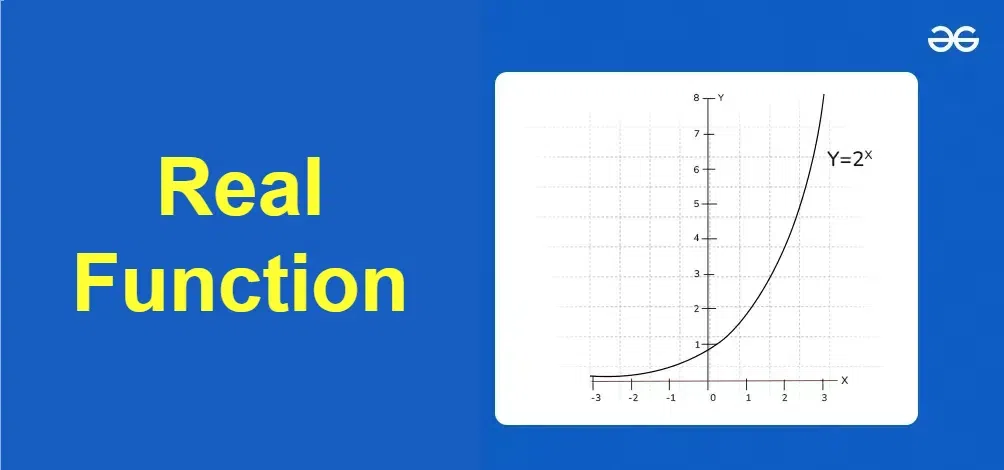
Real Functions
Examples of Real Functions
Examples of different kinds of real functions are discussed as follows.
- **Algebraic Functions: x2+3, 1/x2, 2x +3, 4x3, etc.
- **Trigonometric Functions****:** sin x, cos x, tan x, sec x, etc.
- **Logarithmic Functions: log x, log (2x+3), 2log x, etc.
- **Exponential Functions****:** ax, ex, 2x+3, etc.
- **Modulus Function****:** |x|, |2x+3|, etc.
Domain and Range of Real Functions
- **Domain of a real function is the set of real numbers for which the function gives real numbers as output. In other words, it is said that it is **set of real number for which the function is defined.
- **Range of a real function is the **set of output values obtained by substituting input values from the domain into the function. In simple words, it is **the set of output values of a function.
Properties of Real Functions
Various properties of a real function are:
- Domain and range of a real function are properly defined.
- Monotonicity or constancy of a real function is certain.
- Input and output values of a real function are always real numbers.
- There is an unique element in the range of function for each element in the domain.
- A line parallel to the Y-axis cuts the graph of a real function at most once.
Operations on Real Functions
Various arithmetic operations can be performed on real functions following certain rules. Each arithmetic operation on real functions is discussed as under.
Addition of two real functions
Let f and g be two real functions having domains D1 and D2 respectively. Then, there sum (f + g) is defined as a real function with domain D1 ∩ D2, i.e.
****(f + g)(x) = f(x) + g(x)**
Subtraction of Real Function
Let f : D1 → R and g : D2 → R be two real functions. Then, subtraction of function g from function f is defined as a real function (f-g) with domain as D1 ∩ D2, i.e.
****(f - g)(x) = f(x) - g(x)**
Multiplication of Real Function by a Scalar
Let f: D → R be a real function and k be a scalar (real number). Then, their multiplication k.f is defined as a real function with domain as D, i.e.
**k.f(x) = k×f(x)
Multiplication of Two Real Functions
Let f: D1 → R and g : D2 → R be two real functions. Then, their product f.g is a real function with domain as D1 ∩ D2, i.e.
****(f.g)(x) = f(x) × g(x)**
Division of Two Real Functions
Let f: D1 → R and g : D2 → R be two real functions. Then, their quotient f/g is defined as a real function with domain as D1 ∩ D2 excluding the input values where g(x) ≠ 0, i.e.
****(f/g)(x) = f(x)/g(x)**
**People Also Read:
Examples on Real Functions
**1: Find the domain for the function given as f(x) = √(x²-4).
Here we have, f(x) = √(x²-4)
We know that, square root is defined only for non negative numbers.
Thus, for f(x) to be defined, x²-4 ≥ 0 (x+2)(x-2) ≥ 0
By using the rule of inequality,
We get, x ? (-∞, -2] U [2, ∞)
Hence, the set above defines the domain of the given function.
**2: Add the functions defined as f(x) = x² and g(x) = sin x. Also, find the domain of the function obtained after the addition.
We know that, (f+g)x = f(x) + g(x)
Thus, we get, (f+g)x = x² + sin x
Function obtained above will have the domain as intersection of domains of the functions added.
Here, domains of f(x) and g(x) are the set of real numbers.
So, (f+g)x would also have the domain as a set of real numbers.
**3: For function f(x) = 2x 2 - 4x + 11. Find f(x + 2).
Given,
f(x) = 2x2 - 4x + 11
f(x + 2) = 2(x + 2)2 - 4(x + 2) + 11
= 2{x2 + 4 + 4x} - 4x - 8 + 11
= 2x2 + 8 + 16x - 4x - 8 + 11
= 2x2 + 12x + 11
Practice Problems on Real Functions
**1: Find the domain for the function given by f(x) = sin (√x).
**2: Find the domain for the reciprocal of the function given as g(x) = x² - 3x +2.
**3: Find the roots of the function given as f(x) = x² - 4.
**4: Add the functions given as f(x) = sin x and g(x) = √x. Also, find the domain of the function obtained as a result of addition.
**5: Find the roots of the function given by g(x) = x² - 5x + 6.