Sample Size Formula (original) (raw)
Last Updated : 23 Jul, 2025
The sample size formula in statistics is used to determine how large a sample should be to achieve results that are representative of the population. The formula varies depending on the type of data and the statistical analysis required.
The formula to calculate the sample size for a survey or study depends on several factors, including the desired confidence level, the margin of error (confidence interval), the population size, and the expected proportion of the attribute being measured.

Sample Size Formula
In the field of statistics, the sample size is defined as the number of observations used to calculate population estimates for a specific population. In other words, it refers to the number of individual samples utilized in a data study. It uses the difference between the population and the sample to calculate the correct sample size. It is the process of selecting a group of people from a population to estimate the characteristics of the entire population, known as sampling. It is denoted by the symbol n.
Table of Content
- Sample Size Formula
- Sample Size Formula for Estimating a Population Mean
- Sample Size Formula For Estimating a Population Proportion
- Sample Size Formula For Finite Population Correction
- How to use Sample Size Formula?
- Examples Using Sample Size Formula
Sample Size Formula
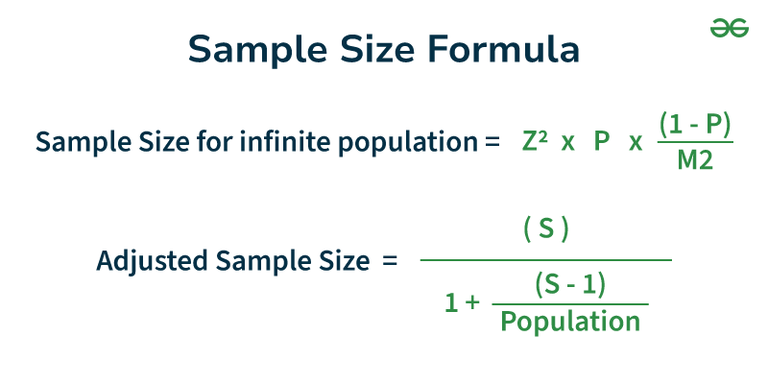
For a smaller sample size, the concept of the T distribution is used in place of normal distribution. Specifically, this distribution is used when the value of the sample size is less than 30. In this test, we utilize the t statistic to test the null hypothesis using both one-tailed and two-tailed tests if the population variance is unknown and the sample size is small. It is also known as adjusted sample size.
**A = n / (1 + (n - 1)/P)
Where,
- A is the adjusted sample size,
- n is the sample size,
- P is the population size.
For infinite population size, the formula is expressed in terms of z-value and error margin.
**n = Z 2 p(1 - p)/m 2
Where,
- n is the sample size,
- Z is the z-value,
- p is the proportion of population (generally taken as 0.5),
- m is the margin of error.
Sample Size Formula for Estimating a Population Mean
To estimate a population mean with a certain level of confidence, the sample size can be determined using:
n= [(Z.σ)/E]2
Where:
- nnn = required sample size
- ZZZ = Z-value (the number of standard deviations from the mean in a standard normal distribution corresponding to the desired confidence level, e.g., 1.96 for 95% confidence)
- σ\sigmaσ = population standard deviation
- EEE = margin of error (the maximum acceptable difference between the sample mean and the population mean)
Sample Size Formula For Estimating a Population Proportion
To estimate a population proportion with a certain level of confidence, the sample size can be calculated using:
n = [Z2.p.(1-p)/E2]
Where:
- nnn = required sample size
- ZZZ = Z-value (for the desired confidence level)
- ppp = estimated proportion of the population (if unknown, 0.5 is used for maximum variability)
- EEE = margin of error
Sample Size Formula For Finite Population Correction
When the population size is finite and relatively small, the sample size formula can be adjusted using the finite population correction (FPC):
nadjusted = [n/(1+(n-1)/N)]
How to use Sample Size Formula?
To compute the necessary sample size, it's essential to first determine several values before applying them to the right formula. Here are the steps to achieve this:
**Step 1: Identifying Key Values Key values such as the population size need to be determined. This value represents the total count of individuals within a specific demographic. For larger studies, an approximate population size may be used, while precision is crucial for smaller groups to ensure statistical significance.
**Step 2: Determining Margin of Error or Confidence Interval The margin of error, a critical metric in research, indicates the allowable error within a study. It is expressed as a percentage that illustrates how closely the sample results reflect the true values of the overall population. A smaller margin typically requires a larger sample to maintain accuracy.
**Step 3: Setting the Confidence Level The confidence level correlates closely with the margin of error, measuring the certainty with which a sample represents the entire population within the chosen margin of error. Common confidence levels include 90%, 95%, and 99%, with higher levels indicating greater accuracy but necessitating larger samples.
**Step 4: Specifying the Standard Deviation measures response variability within a study. Researchers often use 0.5 (50%) as a conservative estimate to ensure the sample size is adequate to represent the population accurately under the chosen confidence level and interval.
**Step 5: Calculate the Z-score The Z-score, linked to the confidence level, indicates the number of standard deviations a selected value is from the population mean. This value is usually memorized by researchers for commonly used confidence levels due to its consistent application across studies:
- Confidence Level 80%: Z-score 1.28
- Confidence Level 85%: Z-score 1.44
- Confidence Level 90%: Z-score 1.65
- Confidence Level 95%: Z-score 1.96
- Confidence Level 99%: Z-score 2.58
These steps outline the theoretical framework for calculating sample sizes, vital for ensuring the reliability and accuracy of study results.
Examples Using Sample Size Formula
**Problem 1: Calculate the adjusted sample size for a sample size of 300 and a population of 50000.
**Solution:
We have,
n = 300
P = 50000
Using the formula we have,
A = n / (1 + (n - 1)/P)
= 300 / (1 + 299/50000)
= 300/1.00598
= 298.216
**Problem 2: Calculate the adjusted sample size for a sample size of 100 and a population of 25000.
**Solution:
We have,
n = 100
P = 25000
Using the formula we have,
A = n / (1 + (n - 1)/P)
= 100 / (1 + 299/25000)
= 100/1.001196
= 99.88
**Problem 3: Calculate the adjusted sample size for a sample size of 76 and a population of 2000.
**Solution:
We have,
n = 76
P = 2000
Using the formula we have,
A = n / (1 + (n - 1)/P)
= 76 / (1 +75/2000)
= 76/1.0375
= 73.25
**Problem 4: Calculate the population size if the adjusted sample size is 102.2 for a sample size of 104.
**Solution:
We have,
A = 102.2
n = 104
Using the formula we have,
A = n / (1 + (n - 1)/P)
=> 102.2 = 104 / (1 + 103/P)
=> 1 + 103/P = 1.01
=> 103/P = 0.01
=> P = 10300
**Problem 5: Calculate the sample size for z-value as 1.5 and the margin of error as 4.2%.
**Solution:
We have,
z = 1.5
m = 4.2% = 0.042
p = 0.5
Using the formula we have,
n = Z2p(1 - p)/m2
= (1.5)2 × 0.5 × (1 - 0.5)/(0.042)2
= 0.5625/0.001764
= 318.87
**Problem 6: Calculate the sample size for z-value as 1.2 and the margin of error as 3.5%.
**Solution:
We have,
z = 1.2
m = 3.5% = 0.035
p = 0.5
Using the formula we have,
n = Z2p(1 - p)/m2
= (1.2)2 × 0.5 × (1 - 0.5)/(0.035)2
= 0.36/0.001225
= 293.877
**Problem 7: Calculate the z-value if the sample size is 250 and the margin of error is 3.2%.
**Solution:
We have,
n = 250
m = 3.2% = 0.032
p = 0.5
Using the formula we have,
n = Z2p(1 - p)/m2
=> Z2 = nm2/(p(1 - p))
=> Z2 = 250 × (0.032)2 / (0.5 × 0.5)
=> Z2 = 0.256/0.025
=> Z2 = 10.24
=> Z = 3.2
**Must Read