Exploring Forces (original) (raw)
Last Updated : 23 Jul, 2025
**A force is a push or pull upon a body of any mass resulting from the body's interaction with another body. Whenever there is an interaction between two bodies, there is a force upon each of the bodies. This article will discuss what force is, exploring forces, types of forces, and the effect of forces.
What is Force?
When you push a door to open it, you are applying force to move it from one position to another. Whether it's pushing, pulling, or even lifting, force is the reason why objects move or change their shape.
**Definition: Force can be defined as a **push or a pull on an object of any mass and on any surface.

P
For any force applied there is a **change in motion, state, shape, size, etc. of an object. The force has both **magnitude and direction, as it is a vector quantity. It can be measured using a spring balance by placing the object at its hook end.
Forces are either long-range or short-range order. Electrostatic forces are long-range forces as well as the gravitational force is also long-range force.
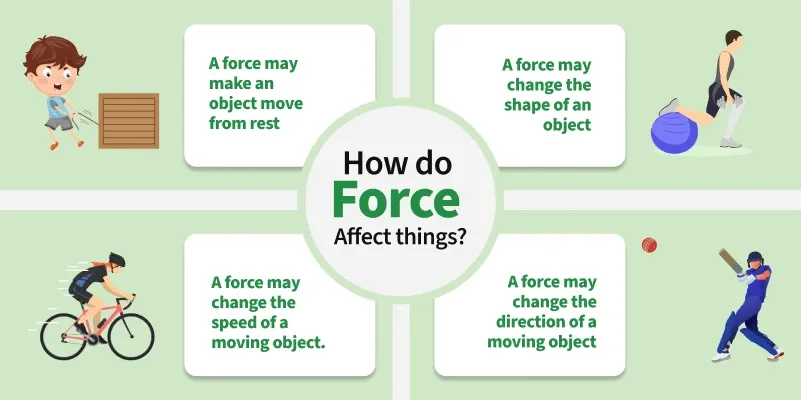
Exploring Forces
A force can change the motion of an object, i.e. a force can make a stationary body move; it can make a moving object stop; it can increase or decrease the speed of the moving body.
Forces in the same direction
- The Forces which are applied to an object in the same direction always get added to one another.
- If two forces are acting on an object in the same direction, then the net force is equal to the sum of the two forces on it.
- In this case, it always results in a stronger force than either of the individual forces alone.
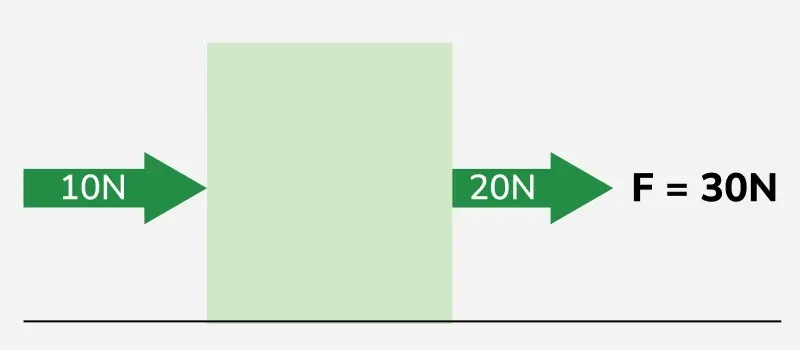
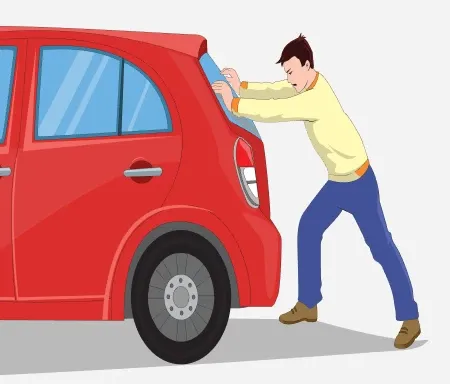
**Example, A Person pushing a heavy car in the same direction.
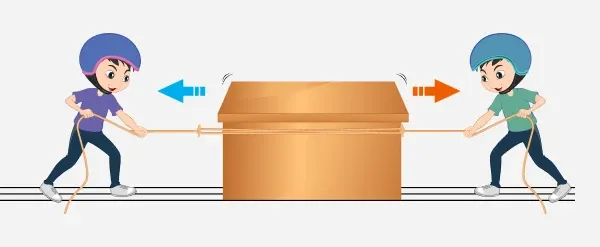
Forces in the opposite direction
When two forces act on an object in opposite directions, the net force is the difference between the magnitudes of the forces, and it will be in the direction of the larger force.
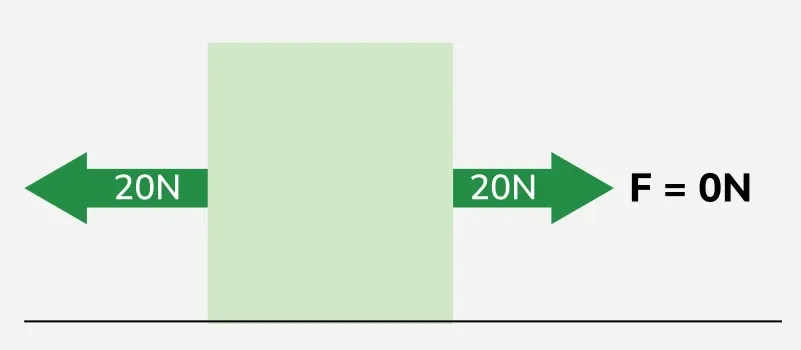
**Examples, Two people pushing a heavy load in the opposite direction.
**Effect of Force
**A Force can Change the State of Motion
A change in either the speed of an object, or in the direction of motion, or both, is described as a change in its **state of motion.
**A Force can Change the Shape of an Object
The shape of an object can be changed using force. We use it to obtain the required shape of the object in some cases.
Types of Forces
There are two types of Forces:
**1. Contact Force
A contact force is a force that happens when two things touch each other.
**Example, When you push a table, the force you apply to the table is a contact force because you are physically touching it.
Furthermore, there are two types of contact forces;
2. Non-Contact Forces
A non-contact force is a force that acts on an object without touching it.
**Example, When you drop a ball, it falls to the ground because gravity is pulling it down, even though gravity is not touching the ball.
**Also check, Balanced forces and Unbalanced forces.
Interesting Facts
- Forces are responsible for the structure and properties of matter.
- Gravitational , Magnetic , Electrostatic forces can act on objects without physical contact.
- Force is an invisible influence that can induce changes in an object's motion or shape.
Solved Questions on Force
A constant force acts on an object with a mass of 5 kg for 2 seconds. The velocity of the object increases from 3 m/s to 7 m/s. What is the force applied?
Using the Formula ,
**a=Δv/ Δt
**So,
**a = 4 m/s / 2 sec = 2m/s2
**Now, apply Newton's Second Law (F = ma) to find the force:
F= 5kg × 2 m/ s2 = 10 N
So, the force applied is **10 N.
A 4 kg ball is pushed with a constant force and its speed increases from 2 m/s to 6 m/s in 4 seconds. What is the force applied?
Using the Formula,
**a=Δv/ Δt
**So,
**Δv= 6m/s - 2 m/s= 4 m/s
**So,
**a = 4 m/s / 4sec = 1m/s2
**Now, use Newton's Second Law:
**F = m × a
F = 4 kg × 1 m/ s2 = **4 N
So, the force applied is **4 N.
Conclusion
Forces govern the motion of objects, whether through contact (like friction) or at a distance (like gravity). To apply force effectively, it is essential to understand both its magnitude (the amount of force) and its direction. When force is applied in the opposite direction, the net force acting on an object is the difference between the two forces.