What is Magnetic Force? Definition, Formula, Applications, and Examples (original) (raw)
Last Updated : 23 Jul, 2025
Magnetic force is an invisible force that draws in or pushes away objects, similar to how magnets pull metals like iron. This occurs because of the magnetic characteristics of tiny particles within materials.
Magnets have two poles, North and South****,** that either attract or repel depending on their alignment. This force is used in many technologies, like motors and compasses.
This article focuses on the concepts of magnetic force, including magnetic fields, forces on moving charges and current-carrying wires, and the applications of magnetic force. It also covers methods for measuring magnetic field strength.
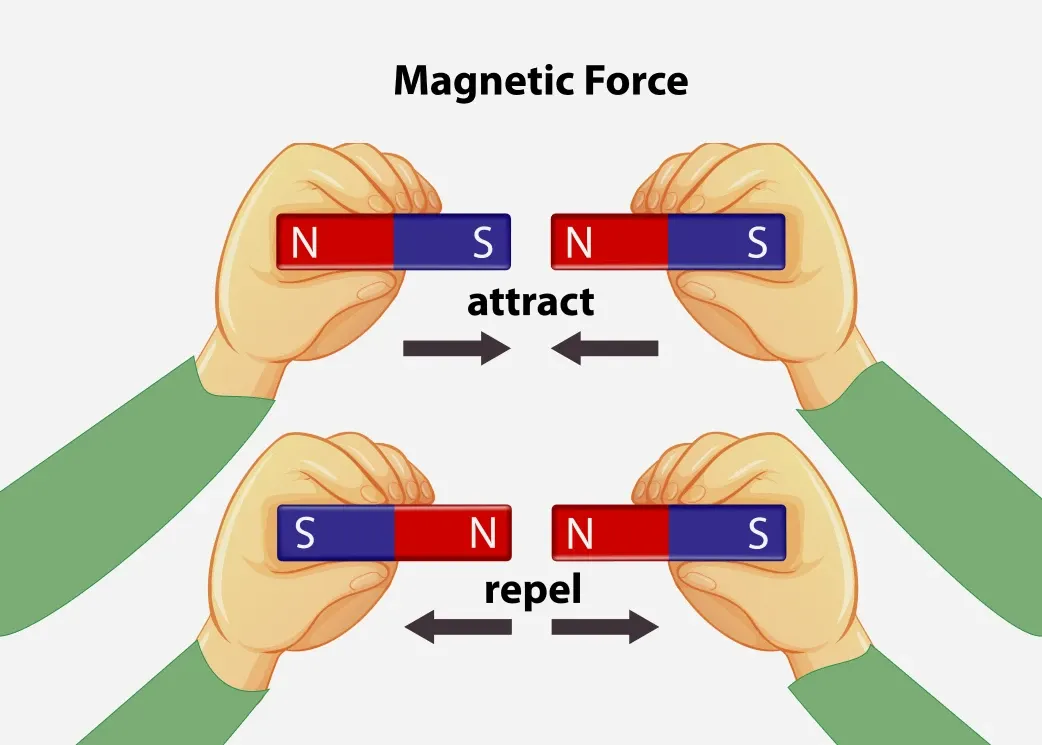
Magnetic Force
What is Magnetic force?
When a point charge '**q' is placed in an environment with both a magnetic field '**B(r)' and an electric field '**E(r)' the total force on the charge can be expressed as the combination of the electric force and the magnetic force acting on it (**F electric + F magnetic ).
Magnetic Force can be defined as:
Magnetic force can be explained as the effect one moving charge has on another due to the magnetic field created by the first charge.
Magnetic Lines of force
Magnetic lines of force are curved paths used to visualize a magnetic field. The density of these lines at a particular point corresponds to the strength of the magnetic field in that area. The direction of the magnetic force at any point is tangent to the curve at that specific location.
Properties of Magnetic Lines of Force:
- They begin at the North Pole and end at the South Pole of a magnet.
- They form continuous loops throughout the magnet.
- Magnetic lines of force pass through iron more readily than through air.
- Two magnetic lines of force cannot cross each other.
- They tend to contract along the length of the magnet.
- They tend to spread out laterally.
How to Find Magnetic Force?
The magnitude of the magnetic force depends on the amount of charge and how fast each object is moving, as well as the distance between them.
We can express the magnetic force using a mathematical formula:
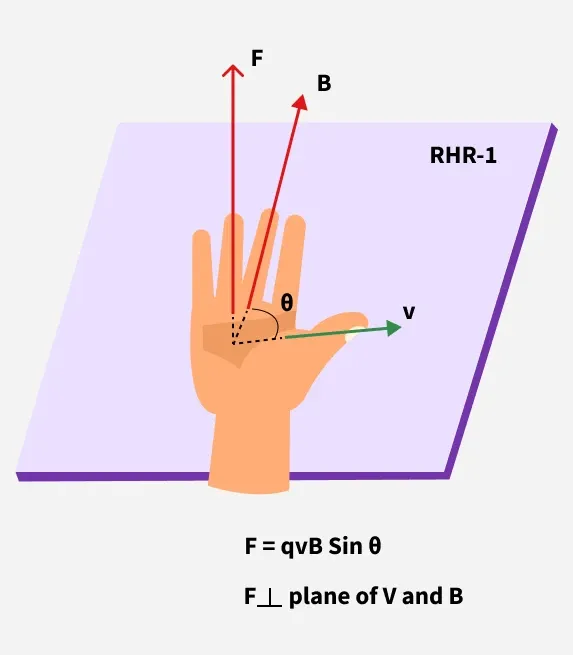
**F = q [ E(r) + v ×B(r) ]
This force is called the **Lorentz Force. It's the combined effect of the electric and magnetic forces on a point charge because of electromagnetic fields. The way the electric and magnetic fields interact has the following characteristics:
- The strength of the magnetic force depends on the charge of the particle, how fast it's moving, and the strength of the magnetic field it's in.
- The strength of the magnetic force is found by calculating the cross product of the velocity and the magnetic field, represented by **q [ v × B ].
- This force acts at a right angle to both the direction of the velocity and the magnetic field, and you can figure out its direction using the Right-hand thumb rule.
- When the charges are not moving (static), there is no magnetic force acting on them.
**Magnetic Force On a Current Carrying Conductor
- When an electric current flows through a conductor (like a wire), it creates a magnetic field around the conductor.
- This magnetic field interacts with any external magnetic field that is present.
- The conductor experiences a force due to the interaction between its own magnetic field and the external magnetic field.
- This force is affected by several factors, including the magnitude of the current, the length of the conductor, the strength of the magnetic field, and the angle between the magnetic field and the current.
When the conducting rod is placed in an external magnetic field of magnitude **B, the force applied on the mobile charges or the electrons can be given as:
**F = **I **× **L × B × sin ( θ)
**Where,
- **F is the magnetic force on the conductor
- **I is the current flowing through the conductor
- **L is the length of the conductor that is within the magnetic field
- **B is the strength of the external magnetic field
- **θ is the angle between the direction of the magnetic field and the direction of the current.
Force Between Parallel Conductors (Ampere's law)
Ampere's Law helps us understand the force between two long, straight wires that carry electric currents. Imagine you have two wires placed parallel to each other. When an electric current flows through these wires, it creates a magnetic field around each wire.
These magnetic fields interact with each other, and this interaction causes a force between the wires.
Now, depending on the direction of the currents:
- If the currents are flowing in the **same direction, the wires will attract each other.
- If the currents are flowing in **opposite directions, the wires will repel each other.
The strength of this force depends on the amount of current in each wire, the space separating the wires, and the type of material surrounding the wires. The greater the current and nearer the wires , the more stronger the force between them.
Torque on a current loop in a magnetic field
- When an electric current passes through a wire loop within a magnetic field, the magnetic field applies forces on various sections of the loop, leading to its rotation.
- The strength of the torque depends on the magnetic field strength, the current, the loop's area, and the angle between the loop and the magnetic field.
- In basic terms, Torque is the rotational force generated when a wire loop carrying current is placed in a magnetic field.
**Magnetic Field due to a Current
To understand how currents generate magnetic fields, we explore key concepts like the Biot-Savart Law, magnetic fields from straight wires and circular loops, and the behavior of magnetic fields in solenoids and toroid's:
Biot-Savart Law
The Biot-Savart Law describes how a moving electric current creates a magnetic field. Imagine a tiny piece of wire carrying an electric current. This tiny piece generates a small magnetic field around it.
The Biot-Savart Law helps us figure out how strong and in what direction this magnetic field is at any point in space, depending on where you are relative to the wire.
- The closer you are to the current, the stronger the magnetic field.
- The magnetic field gets weaker the further you go from the current.
- The direction of the magnetic field depends on the direction of the current and where you are relative to the wire.
Magnetic field due to a straight current- carrying wire
- When an electric current flows through a straight wire, it creates a magnetic field around the wire.
- The magnetic field forms concentric circles around the wire.
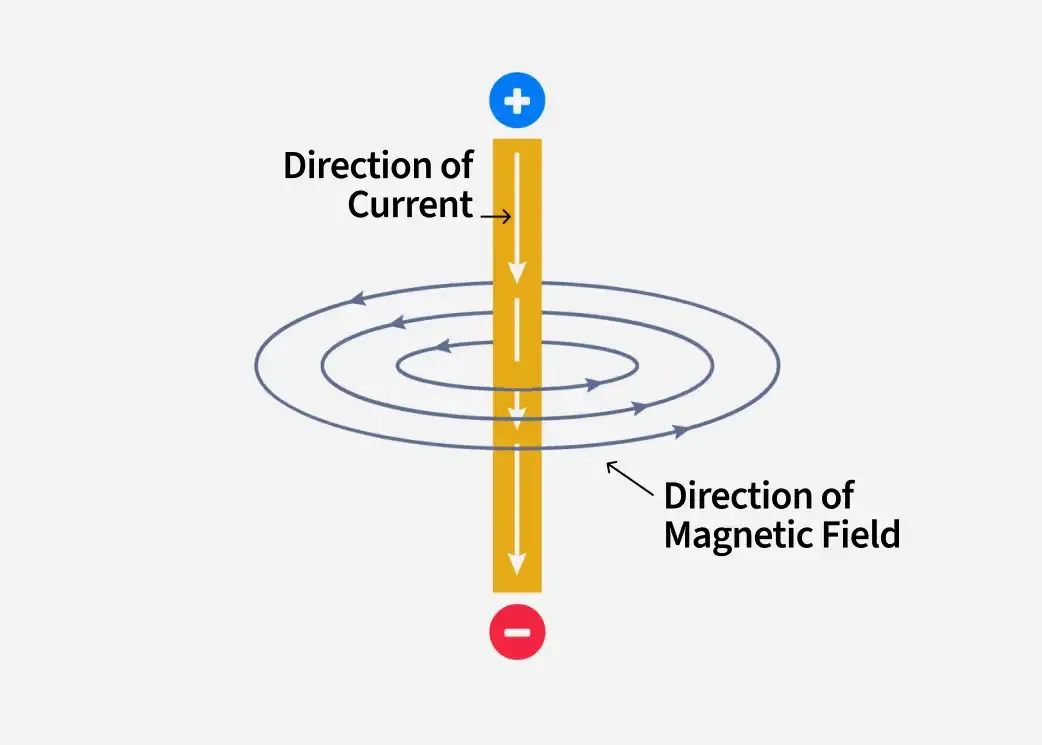
Magnetic field due to a straight current- carrying wire
- The closer you are to the wire, the stronger the magnetic field, as you move further away, the field gets weaker.
- The direction of the magnetic field depends on the direction of the current, and you can use your right hand to figure it out: if you point your thumb in the direction of the current, your fingers curl around the wire in the direction of the magnetic field.
Magnetic field due to a circular loop
- When an electric current flows through a circular loop of wire, it creates a magnetic field that behaves like a bar magnet.
- The magnetic field forms loops that go through the center of the circular loop, similar to how the Earth has magnetic poles.
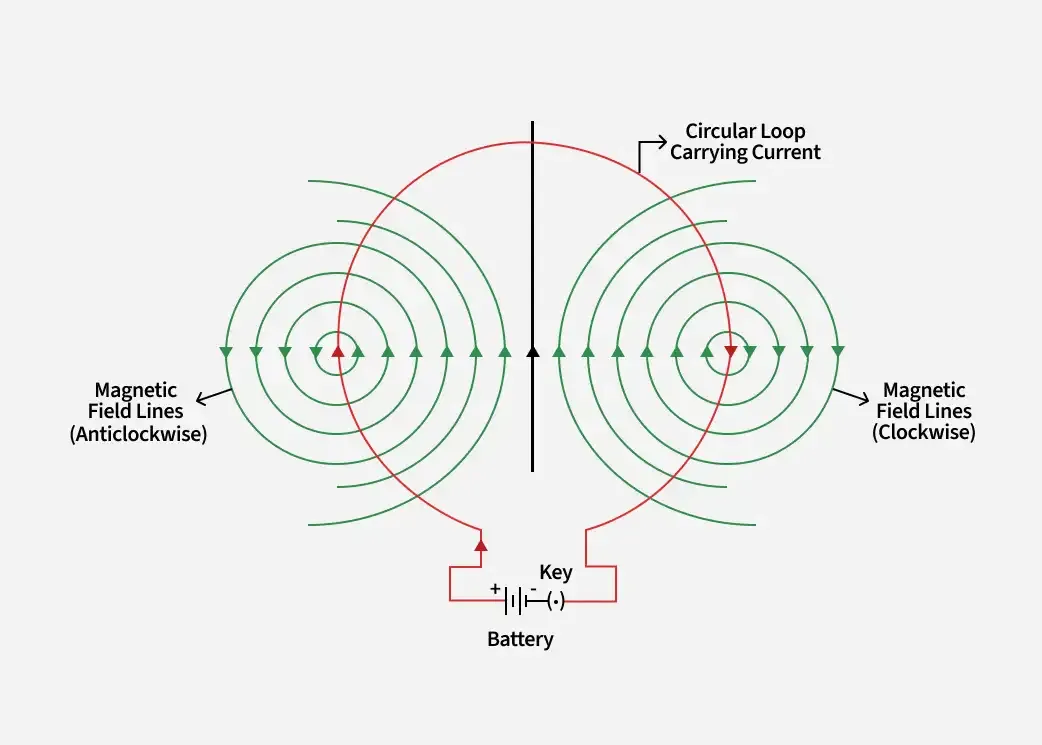
Magnetic field due to a circular loop
- The strength of the magnetic field is strongest at the center of the loop and gets weaker as you move further away
- The direction of the magnetic field is determined by the direction of the current in the loop, and it can be found using the Right-hand rule.
Solenoid and Toroidal magnetic fields
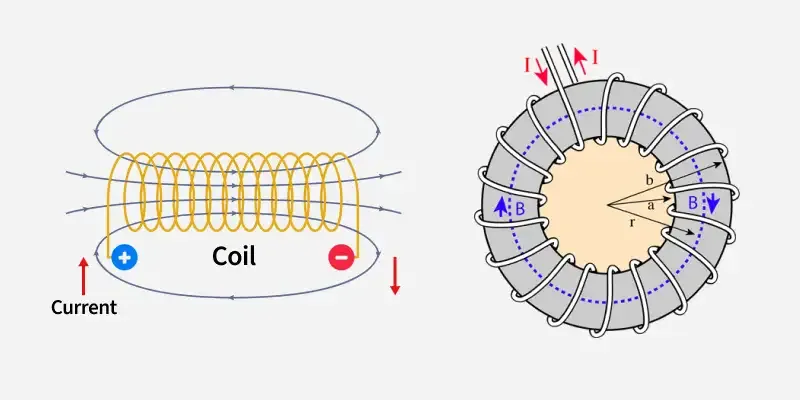
Solenoid and Toroidal magnetic fields
- **A solenoid that is shown in first picture consists of a lengthy coil of wire , and when electricity passes through it creates a magnetic field similar to that of a bar magnet, with a clear north and south pole.
- The magnetic field lines inside the solenoid are straight and strong, while outside, they form loops.
- The more turns in the coil and the stronger the current, the stronger the magnetic field inside the solenoid.
- A **toroid that is shown in second picture is a solenoid shaped into a ring (like a donut). The current flows through the wire wound around the ring, creating a magnetic field that stays inside the donut shape.
- The field is strong and concentrated inside the toroid, and it does not leak outside, making it more contained compared to a solenoid.
Application of Magnetic Force
- **Electric Motors: Magnetic forces are used to make motors run, powering everything from household appliances to electric cars.
- **Magnetic Levitation : Magnets are used to lift and propel trains without touching the tracks, making them move faster and smoother.
- **Refrigerator Magnets: A simple example where magnets are used to hold things like notes or photos on the fridge.
- **Speakers and Headphones: Magnets are used to produce sound by making a speaker's diaphragm move in response to electrical signals.
- **Generators: Magnets are key in producing electricity in generators by moving magnets through coils of wire.
Method of Measuring Magnetic field Strength
- **Magnetometer – A device that directly measures magnetic field strength, commonly used in scientific and industrial applications.
- **Compass Method – A easy technique to sense a magnetic field , the needle aligns with the field but does not measure its strength.
- **Gaussmeter – A specific device that measures magnetic fields in **Gauss or Tesla, often used in laboratories and industry.
- **Coil and Galvanometer (Induction Method) – Moving a magnet through a coil generates an electric current, which helps estimate field strength.
- **Smartphone Magnetometer Apps – Many smartphones have built-in magnetometers that can detect and display magnetic field strength in microteslas (µT).
- **Fluxgate Magnetometer – A highly sensitive instrument used for detecting weak magnetic fields, such as those in space and geophysics.
- **Electromagnetic Force on a Current-Carrying Wire – By measuring the force exerted by a magnetic field on a wire with an electric current, the field strength can be calculated.
Solved Examples
1. Imagine a straight wire carrying a current placed in a magnetic field. We want to calculate the force on the wire.
Solution:
**Given:
- **Current, I = **5 A (the current flowing through the wire)
- **Length of the wire, L = **0.3 m (the length of the wire placed in the magnetic field)
- **Magnetic field, B = **2 Tesla (the strength of the external magnetic field)
- **Angle, θ = **90° (the wire is placed perpendicular to the magnetic field)
**We have a formula,
**F = I × L × B × sin(θ)
**Where,
- **I = 5 A
- **L = 0.3 m
- **B = 2 T
- **θ = 90° (sin(90°) = 1)
**Now calculate the force = 5 A × 0.3 m × 2 T × sin(90°)
→F = 5 × 0.3 × 2 × 1
⇒ F = **3 N
2. A straight wire of length 0.5 m carries a current of 2 A. The wire is placed perpendicular to a magnetic field of strength 0.4 T. Calculate the magnetic force acting on the wire.
Solution:
The magnetic force on a current-carrying wire is given by the formula:
F=I⋅L⋅B⋅sin(θ)
Where:
- **I = 2 A (current),
- **L = 0.5 m (length of the wire),
- **B = 0.4 T (magnetic field strength),
- **θ = 90° (since the wire is perpendicular to the field, sin(90°) = 1).
Now, substitute the values into the formula:
F= 2A × 0.5m × 0.4T ×1F=0.4N
The magnetic force on the wire is **0.4 N.
3. A proton (charge =1.6×10⁻¹⁹C) is moving with a velocity of of 2×10⁵ m/s2 perpendicular to a magnetic field of strength 0.3 T. Calculate the magnetic force acting on the proton.
Solution:
The magnetic force on a charged particle is given by:
F=q⋅v⋅B⋅sin(θ)
Where:
**q = 1.6×10⁻¹⁹C (charge of the proton),
**v = 2×10⁵ m/s2 (velocity of the proton)
**B = 0.3 T (magnetic field strength),
**θ = 90° (since the proton is moving perpendicular to the magnetic field, sin(90°) = 1).
Now, substitute the values into the formula:
F=(1.6×10⁻¹⁹C)×(2×10⁵m/s)×(0.3T)×1
F=9.6×10⁻¹⁵N
The magnetic force on the proton is **9.6×10 −15 **N.
4. A cyclotron is used to accelerate a proton with charge 1.6×10⁻¹⁹C moving at a velocity of 5×10⁶ m/s in a magnetic field of 0.2 T. Calculate the magnetic force acting on the proton.
Solution:
The magnetic force on the proton is given by the formula:
F=q⋅v⋅B⋅sin(θ)Where:
- **q = 1.6×10⁻¹⁹ C (charge of the proton),
- **v = 5×10⁶ m/s (velocity of the proton),
- **B = 0.2 T (magnetic field strength),
- **θ = 90° (since the velocity is perpendicular to the magnetic field, sin(90°) = 1).
Now, substitute the values into the formula:
F=(1.6×10⁻¹⁹C)×(5×10⁶m/s)×(0.2T)×1
F=1.6×10⁻¹²N
The magnetic force on the proton is **1.6×10⁻¹² N.
5. Imagine you are holding a charged particle (such as an electron) within a magnetic field, and you want to know the force acting on it. Given:Charge of the particle, q = +3 μC (microcoulombs) = 3 × 10⁻⁶ C, Electric field, E(r) = 0 V/m (we’ll assume no electric field is present in this example), Velocity of the particle, v = **4 m/s, Magnetic field, B(r) = **2 Tesla.
We have a formula ,
F = q[E(r) + v × B(r)]
Since the electric field E(r) is 0, the equation simplifies to:
F = q(v × B(r))
Where ,
q = 3 × 10⁻⁶ C
v = 4 m/s
B = 2 TThe cross product v × B (for simplicity, we assume they are perpendicular to each other):
v × B = v × B × sin(90°) = v × B = 4 m/s × 2 T = 8 m/s·T
Now calculate the force,
→ F = 3 × 10⁻⁶ C × 8 m/s·T
⇒ F = 24 × 10⁻⁶ N = 24 μN (micronewtons)
So, The force acting on the charged particle due to the magnetic field is **24 μN (micronewtons)
Conclusion
In conclusion, Magnetic force is the attraction or repulsion that occurs between electrically charged particles due to their motion. It is the fundamental force behind phenomena like the operation of electric motors and the attraction of magnets to iron. This force depends on factors like the strength of the magnetic field, the **current, the **length of the conductor, and the angle between the conductor and the field. The force can be calculated using formulas, and it plays a crucial role in the working of devices like motors and generators.