Hydrostatic Pressure (original) (raw)
Last Updated : 23 Jul, 2025
Hydrostatic pressure can be stated as the pressure exerted by a fluid at equilibrium at a given point within the fluid, due to the force of gravity. Hydrostatic pressure is proportional to the depth measured from the surface as the weight of the fluid increases with a downward force applied.
The fluid pressure can be caused by gravity, acceleration, or forces when in a closed container. Consider a container filled with water or any other fluid along with a ball in the bottom. Now consider the ball from the top of the container. There is the pressure exerted by the layer of water acting on the ball. As we move down from the top of the container to the bottom, the pressure exerted by the top layer on the ball adds up. This phenomenon is responsible for more pressure at the bottom of the container.
Table of Content
- Hydrostatic Pressure Definition
- Hydrostatic Pressure Formula Derivation
- Buoyancy and its Effects
- Hydrostatic Pressure Vs Osmotic Pressure
- Applications of Hydrostatic Pressure
- Examples on Hydrostatic Pressure
Hydrostatic Pressure Definition
Hydrostatic Pressure also called fluid pressure can be defined as the pressure on a given object on the surface of a closed container or in the fluid. Gravity, acceleration, or forces outside the container, are the factors that cause the pressure.
Pressure is a scalar quantity that is stated as force per unit area. Here force acts in the direction perpendicular to the surface. Depending on the context of use, there are several units in which pressure can be measured.
**Pressure = Force/ Area
**P = F / A
where:
- **P is the Pressure
- **F is the Force
- **A is the Area
Unit of pressure is **N/m 2 or Pa (Pascal).
Hydrostatic Pressure Formula Derivation
Let us derive the formula for Pressure on an object submerged in a fluid.
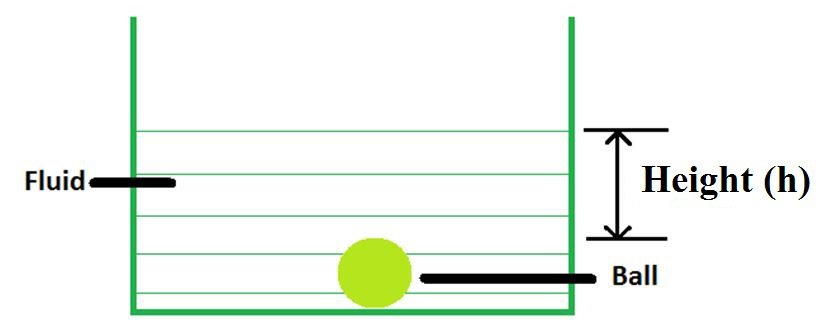
We know that,
Pressure = Force/Area = F/A & Force = mass x acceleration = m × g (acceleration due to gravity)
So: Pressure = F/A = mg/A ……………. (1)
Now Density = Mass/Volume;
So, Mass= Density x Volume ……………. (2)
From equation 1 & 2,
Pressure = (Density × Volume × Acceleration)/Area
P = (ρ × g × v)/A
**P = ρ × g × h
where:
- h = v/A = Height of Fluid above Object
- ρ (rho) is Density of Fluid,
- g is Acceleration of Gravity
Pressure on an object submerged in a fluid is:
**P = ρ g h
Buoyancy and its Effects
Buoyancy is a phenomenon caused due to buoyant force that tenses an object to float. When you put an object in a liquid, an upward force is exerted on the object by the liquid, this force is equal to the weight of the liquid that has been displaced. The amount of liquid that has been displaced depends upon the density and the volume of the object immersed in the liquid.
Buoyancy can be defined as an upward force exerted on an object that is completely or partially submerged in liquid. The unit of the buoyant force is **Newton.
**It depends upon two factors:
- Amount (Volume) of liquid displaced by object
- Density of the object, **F b = ρ g V
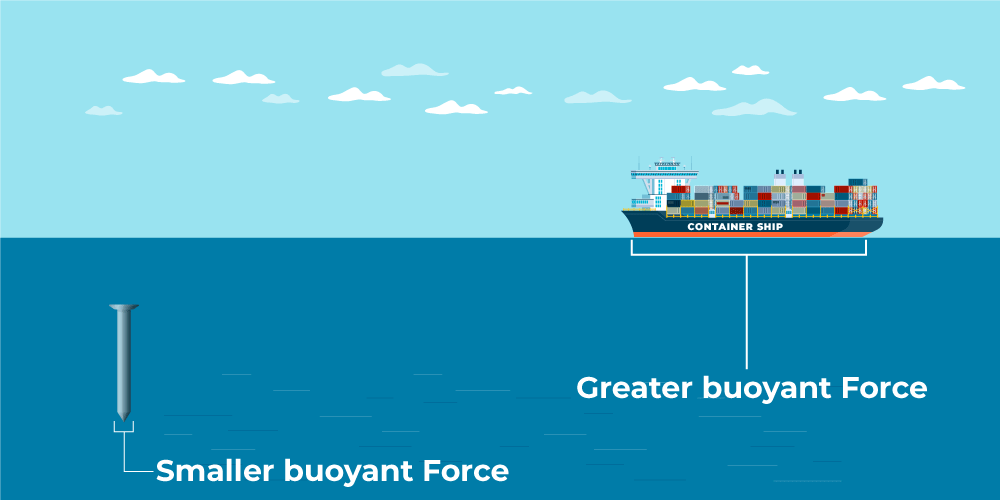
Iron nail is very less in volume so, it displaces a very less amount of water. It causes less buoyant force in the upward direction therefore it sinks. Whereas ships have more volume and displace more water, therefore it causes greater buoyant force in the upward direction by water and it floats.
Hydrostatic Pressure Vs Osmotic Pressure
The comparison of hydrostatic pressure and osmotic pressure is added in table below:
| Feature | Hydrostatic Pressure | Osmotic Pressure |
|---|---|---|
| **Definition | Pressure exerted by a fluid at rest due to the weight of the fluid above it. | Pressure required to stop the flow of solvent into a solution through a semipermeable membrane. |
| **Formula | P = ρgh | Π = i⋅C⋅R⋅T |
| **Measurement Units | Pascal (Pa)BarmmHg | Pascal (Pa)atmmmHg |
| **Dependence | DepthFluid densityGravitational Force | Solute concentrationTemperatureVan't Hoff factor |
| **Application | Engineering (dams, submarines)MeteorologyHydraulics | Biology (cell behavior)Medicine (intravenous fluids, dialysis)Chemistry (solution processes) |
| **Characteristics | Increases linearly with depthActs in all directions at a given depthIndependent of fluid composition | Increases with higher solute concentrationAffects solvent movement across semipermeable membranesDepends on solute particles and their dissociation |
| **Measurement Method | Directly measured with pressure gauges or calculated | Measured indirectly through effects of osmosis or calculated using formulas |
**Applications of Hydrostatic Pressure
Some application of Hydrostatic Pressure are:
- **Engineering: In the design of dams, submarines, and underwater structures, engineers must account for hydrostatic pressure to ensure structural integrity.
- **Meteorology: Hydrostatic pressure principles are used in weather prediction models to understand atmospheric pressure changes with altitude.
- **Medicine: In medical applications, such as blood pressure measurements, hydrostatic pressure concepts help understand pressure variations in the circulatory system.
**Read More:
Examples on Hydrostatic Pressure
**Example 1. A scuba driver is diving 10 meters below the surface of the ocean. Find the pressure on the driver assuming the standard atmospheric conditions. Use the density of sea water = 1.03 X 10 3 kg/m 3 and the atmospheric pressure of 1.01 x 10⁵ N/m 2 .
**Solution:
Pfluid = r g h
= (1.03 x10³ kg/m3) (9.8 m/s2) (10 m)
= 1.09 × 10⁵ N/m2.
Ptotal = Patmosphere + Pfluid
= (1.01 × 10⁵) + (1.09 × 10⁵) Pa
= 2.10 × 10⁵ Pa (Pascal)
**Example 2. At a point in a pond pressure of water is 1.03 x10 5 . What is the depth of that point from the surface of water?
**Solution:
Pfluid = r g h
= (1.03 x10³ kg/m3) (10 m/s2) (10 m)
= 1.03 x 10⁵ N/m2.
**Example 3. **We have a swimming pool that is 3 meters in depth. Calculate the amount of pressure at the bottom of the swimming pool.
**Solution:
Pfluid = r g h
= (1.03 × 10³ kg/m3) (9.8 m/s2) (3 m)
= 3.63 × 10⁴ N/m2.
Ptotal = Patmosphere + Pfluid
= (1.01 × 10⁵) + (3.63 × 10⁴) Pa
= 1.37 × 10⁵ Pa (Pascal)
**Example 1. We have a swimming pool that is 3 meters in depth. Calculate the amount of pressure at the bottom of the swimming pool.
**Solution:
Pfluid = r g h
= (1.03 × 10³ kg/m3) (9.8 m/s2) (3 m)
= 3.63 × 10⁴ N/m2.
Ptotal = Patmosphere + Pfluid
= (1.01 × 10⁵) + (3.63 × 10⁴) Pa
= 1.37 × 10⁵ Pa (Pascal)
**Example 2. Weight of an object in the air is 200 N. The object is placed in a liquid. Increase in volume of liquid is 2.5 m 3 . If specific weight of the liquid is 10 N/m 3 , what is the weight of the object in liquid?
**Solution:
Object’s weight in liquid = object’s weight in air – buoyant force
Object’s weight in liquid = 100 N – buoyant force
Fb = ρ g V
The density of liquid is 1 kg/m3
Fb = ρ g V
= (1 kg/m3)(10 m/s2)(2.5 m3)
= 25kg m/s2
= 25 N
Object’s weight in fluid = 200 N – 25 N = 175N
**Example 3. **An object that is having volume of 40 cm3and the mass of object is 72 g. Density of water is 1 gcm -3 . Will this object float on water or sink in water?
**Solution:
Density = Mass/Volume
= 72/40 = 1.8
Density of object is more than density of water, so object will sink in the water.
**Also, Check