What is Conductor ? (original) (raw)
Last Updated : 23 Jul, 2025
Electric conductors are materials that allow electric charge to flow through their atomic structure as electrons. Insulators that obstruct the flow of electrons, and conductors allow the charged particles to move freely. In this article we will explore conductors along with conductor examples and types. We will also discuss the difference between conductor and insulator and properties, applications, advantages and disadvantages of conductor.
Table of Content
- What is Conductor?
- Types of Conductors
- How Conductors Work
- Skin Effect in Conductors
- Key Characteristics
- Advantages and Disadvantages
- Applications
- Conductors Vs Insulators
What is Conductor?
Conductors are the materials that allow current to flow through it. In other words, the materials through which an electric charge can flow is called as conductors. The effectiveness of the conductor is measured with the help of its electrical conductivity, which measures how quickly electrons may travel through the substance.
Conductor Examples
The figure shows some of the examples of electrical conductors.

Electrical conductors
What are Insulators?
Insulators are the materials that restricts current to flow through it. In other words, the materials through which electric charge cannot flow is called as insulators.
Insulator Examples
The glass, rubber, plastic, wood etc. is some insulators examples.
Types of Conductors
There are mainly three types of electric conductors:
- Metals
- Semiconductors
- Ionic Solutions
- Ohmic Conductors
- Non Ohmic Conductors
1. Metals
They are the type of substance which is characterized by their ability to conduct electricity. They are malleable and shiny in their appearance. They are found on the periodic table's left side which include elements such as iron, copper, gold, aluminum, etc.
**Important Characteristics of Metals
- **Conductivity: Metals have large number of free electrons which moves freely to conduct the electricity.
- **Malleability: This means that metals can be easily beaten into thin sheets without breaking. They can be hammered, rolled, and stretched to form various shapes.
- **Ductility: It means that the metals can be drawn into these wires without breaking.
- **Luster: It means shine. Metals have the property or ability to reflect light off their smooth surface.
- **Melting and boiling points: Metals generally have high melting point and boiling points due to strong metallic bonds between them.
**Examples of Metals
Some of the examples of metals are Copper, Aluminum, Silver, Gold, Brass, Iron etc.
2. Semiconductors
A semiconductor is a type of material with qualities that are midway between those of conductors like metals and insulators like non-metals. They have distinct electrical behavior that makes them ideal for a wide range of electronic applications such as transistors, diodes, integrated circuits, etc. Semiconductors are of two types i.e. p-type ( majority charge carriers are holes) and n-type semiconductor (majority charge carriers are electrons) as seen in the figure below.

P and N type semiconductor
**Important characteristics of Semiconductors
- **Conductivity: Their conductivity is in between conductors and insulators. Their conductivity can be modified using doping.
- **Doping: It means adding impurities into a semiconductor to improve or modify its electrical properties. There are two types of doping i.e. p-type or n-type.
- **Temperature: Electric properties of a semiconductor depend on the temperature. When there is a rise in the temperature, the number of available electrons or holes increases which leads to a change in conductivity.
- **Optical properties: Semiconductor materials can absorb and emit light at particular energy levels which makes them useful for the applications like LEDs and diodes.
**Examples of Semiconductors
Some of the examples of semiconductors are Silicon, Germanium, Gallium Arsenide.
3. Ionic Solutions
Ionic solutions are the solutions that contain ions and charged particles that dissolved in a solvent. They are also known as electrolyte solutions. The solution can conduct electricity due to the presence of the ions. These ions can move freely and can carry the electric charges. Ionic solution plays an important role in electrochemistry, biology and, material science.
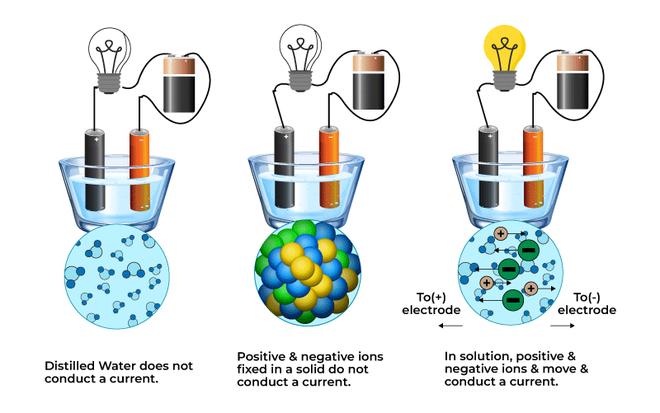
Different types of solutions
As seen in the above figure, distilled water (A) does not have any ions to conduct electricity. The second condition (B) has the ions, but they are fixed, hence do not conduct electricity. The last condition (C) has the free moving ions and hence the bulbs glow.
**Important characteristics of Ionic Solutions
- **Ions: They are the atoms or molecules with a net electric charge. Positively charged ions are known as cations, and negatively charged ions are known as anions.
- **Conductivity: They are a good conductor of electricity because of the presence of free electrons or ions in a solution or electrolyte. Conductivity depends on the concentration of ions in the solution and their mobility.
- **Ion dissociation: When an ionic compound dissolves in a solvent such as water, the positive and negative ions dissociate and gets surrounded by the water. This process is known as ionization.
**Examples of Ionic Solutions
Some of the examples of ionic solutions are Sodium Chloride (NaCl), Hydrochloric acid (HCl), Sodium Hydroxide (NaOH).
4. Ohmic Conductors
It is one of the type of conductors which works on the principle of ohm's law, is called ohmic conductors. Therefore, voltage applied is directly proportional to the current flow.
The formula for Ohm's law is given below :
**V=IR
**Examples of Ohmic Conductors
Some of the examples of ohmic conductors are aluminium, silver and copper.
5. Non - Ohmic Conductors
It is one of the type of conductors which works don't follows ohm's law, is called non - ohmic conductors.
**Examples of Non - Ohmic Conductors
Some of the examples of non - ohmic conductors are thermistors and photoresistors.
How Conductors Work
The solid materials have two types of bands: conduction band and valence band. In conductors both the valence and conduction band do not have any energy gap which makes electrons flow from valence band to conduction band with less voltage. When a voltage is applied to the conductors the electrons flow and the electricity flows in reverse direction. The below diagram represents the energy bands in conductors.

Energy Bands in Conductors
Skin Effect in Conductors
Skin effect is a phenomenon that occurs at **high frequencies, where the distribution of electric charge or current become non-uniform. It means that the current near the surface is more as compared to the inside core of the material. This leads to less current flow inside the core. It is depicted in figure given below.
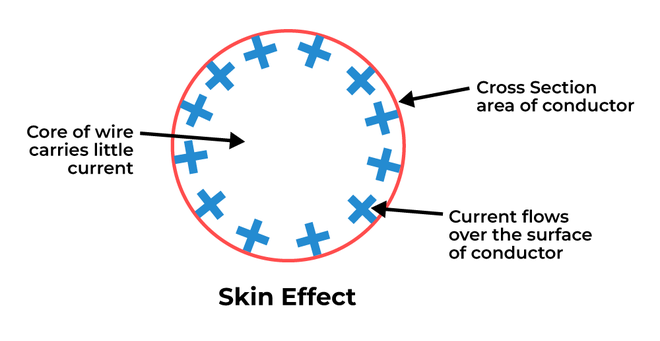
Skin effect in a Conductor
Causes of Skin Effect
It is caused by the interactions between the AC and the magnetic field generates around the conductor. As the frequency increase, the change in the magnetic field induces an opposing electric field within the conductor. This opposing electric field restricts current penetration into the interior of the conductor, causing the current to concentrate near the surface.
**Key points
- Skin effect increases the effective resistance
- Higher the frequency, stronger the skin effect
- Non-uniform current distribution
To solve the problem caused by the skin effect, we can use conductors with larger diameters or hollow conductors.
Key Characteristics of Conductor
The properties of conductor include:
- Conductors allow electric charges to flow through them easily hence having high electrical conductivity and low resistivity.
- Many conductors can efficiently transfer heat through them. This property is called thermal conductivity.
- Conductors are malleable and ductile.
- Conductors like aluminum develop a protective oxide layer on their surface which helps them from corrosion. So, conductors are corrosion resistant.
- Due to the mobility of their free electrons, conductors have electrochemical properties.
Temperature's Effect on Conductivity
The temperature and conductivity of the material are inversely proportional to each other. Temperature increase decrease the conductivity of the material. The increased temperature restricts the smooth flow of electrons resulting in the decrease of conductivity.
Resistors, Semiconductors and Superconductors
Below we will discuss resistors, semiconductors and superconductors.
**Resistors: Resistors holds electric current but not like conductors.
**Semiconductors: In different conditions semiconductors acts as good and bad conductors both.
**Superconductors: Superconductors are materials that have superconductivity is called superconductors.
Advantages and Disadvantages of Conductor
Some advantages and disadvantages of conductors are given below.
Advantages of Conductor
Some advantages of conductors are:
- It allows the efficient flow of electric current.
- It allows effective heat transfer.
- The voltage drop across the conductor is low which ensures that the supply voltage remains the same.
- They can take part in electrochemical reactions because of the mobility of free electrons.
Disadvantages of Conductor
Some disadvantages of conductors are:
- Many conductors can corrode or oxidize when exposed to moisture which leads to the degradation in performance.
- Some conductors like gold and silver are very costly and increase the overall cost of the device despite of the fact that they are the best conductors.
- Heavy metals like copper, can be heavy and bulky. It can lead to a weight increment of the device.
- At high frequencies conductors can exhibit increased resistance due to the skin effect. So, this limits their application at a high frequency.
Electrical Conductor Applications
There are lots of applications for conductors in the present world. Some of the applications are:
- Conductors are used in electric wiring.
- Power transmission uses conductors.
- Conductors like copper are also used in motors and generators
- Conductors are also used as heating elements.
- It is also used in batteries.
- Aerospace technology
- Conductors are used to construct antennas.
Difference Between Conductors and Insulators
The table below represents the difference between conductors and insulators.
| Characteristics | Conductors | Insulators |
|---|---|---|
| Definition | The materials that allow current flow through it is known as conductor. | The materials that do not allow current flow through it is known as insulator. |
| Examples | Aluminum, Copper etc. | Wood, paper, plastics etc. |
| Electric Charge | Electric charge is present. | Electric charge is absent. |
| Resistance | Its resistance is low. | Its resistance is high. |
| Thermal Conductivity | Its thermal conductivity is high. | Its thermal conductivity is low. |
Conclusion
From the above discussion we can conclude that conductors are the materials that allow electric charge to flow through it. The types of conductors include metals, semiconductors and ionic solution. We have also discussed about the difference between conductor and insulator.