Newton's First Law of Motion (original) (raw)
Last Updated : 9 Apr, 2026
Newton's First Law, also known as the Law of Inertia, states that
"An object at rest will remain at rest, or an object in motion will remain in motion at a constant speed and in the same Direction, unless any external force is applied on that object."
Inertia is the natural tendency of an object to keep doing exactly what it is already doing. There are three types of inertia:
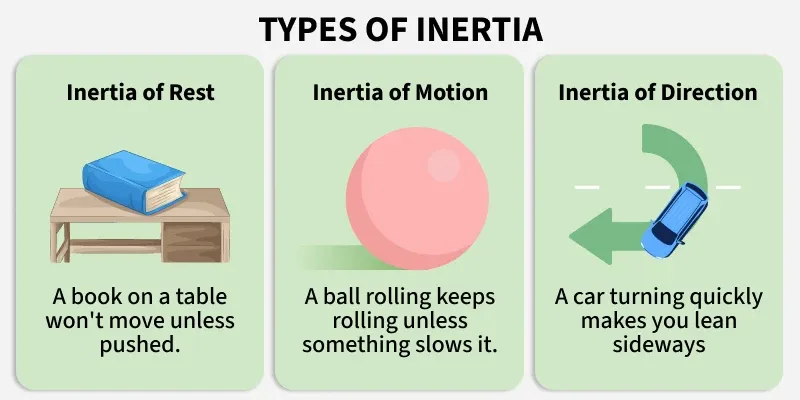
- Inertia of Rest: The object stays still unless moved.
- Inertia of Motion: The object in motion stays in motion.
- Inertia of Direction: The object keeps moving in the same direction.
Formula
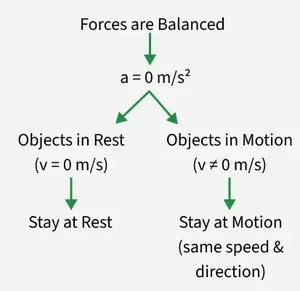
When velocity is constant, meaning if no net force acts, an object stays at rest or moves at a steady speed in a straight line (constant velocity), or mathematically as \overrightarrow{\rm v}= constant when forces balance
Fnet = 0 or
∑F = 0 where ∑= sum of all the forces/ Net Forces
**Why Is This Law Important?
Understanding Newton’s First Law helps us explain many real situations:
- Why do you feel pushed back in a bus when it suddenly starts?
- Why a football stays still until someone kicks it.
- Why it’s hard to stop a rolling ball unless someone pushes it.
This law tells us that motion doesn’t change on its own and without a force, things just keep doing what they’re already doing.
**Difference Between Force and Net Force
Force refers to a push or pull that can cause an object to change its state of motion or shape. Force is measured in a unit called Newton (N).
For an object of mass '**m' and the external force applied is ****'F',** then the acceleration produced is ****'a';** the relation between them is,
F = m × a
The S.I. unit of force is the Newton (N).
Net force is the vector sum of all the forces acting on an object after all individual forces have been combined. The net force determines the overall effect on the object’s motion.
**Forces can be categorized as follows:
- **Balanced Forces: The forces are said to be balanced forces if they nullify one another and their resultant force is equivalent to zero.
- **Unbalanced forces: When two opposite forces acting on a body move a body in the direction of the greater force or forces, which bring a motion in a body, they are called unbalanced forces.
Read More: Balanced and Unbalanced Forces
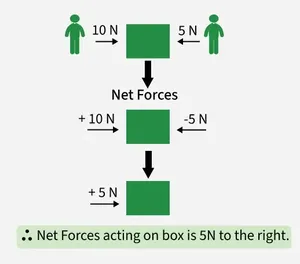
**For Example, If a person pushes a box with a force of 10 N to the right, and another person pushes the same box with a force of 5 N to the left, What would the Net Resultant force and in which Direction ?
Net Force = 10N(right) + (−5N)(left)
Net Force = 10N − 5N = 5N
∴ The net force acting on the box is 5 N to the right and the box moves towards Right.
**Real-World Examples
Newton's first law of motion examples can be observed in numerous everyday situations around us:
Key Takeaway
**Some Misconceptions About Newton’s First Law
**A force is required to keep an object moving: This is not true. According to Newton’s First Law, an object in motion continues moving at a constant speed in a straight line unless acted upon by an external force. Objects stop due to friction or air resistance.
**The law applies only to moving objects: Newton’s First Law applies to both objects at rest and objects in motion. An object at rest will remain at rest unless a force acts on it.
**Heavier objects fall faster because of inertia: Inertia resists changes in motion but does not determine the speed of falling objects. In the absence of air resistance, all objects fall at the same rate.
**Objects naturally come to rest on their own: Objects do not stop moving by themselves. They stop because external forces such as friction or air resistance act on them.
**Inertia is a force: Inertia is not a force. It is a property of matter that describes an object’s resistance to changes in its state of motion.
Related Articles:
**Solved Examples - Newton's First Law of Motion
**Example 1: What net force is required to keep a 100 kg object moving with a constant velocity of 10 m/s?
Newton’s First Law states that an object in motion continues in motion unless acted upon by a net force. If friction is absent, no force is needed to keep an object moving at constant velocity. A net force is required only to change the object’s motion.
So, the net force is equal to 0 N.
**Example 2: A person is traveling in an airplane at a constant speed of 500 mph. Another person is traveling in their car at a constant speed of 50 mph. Determine who experiences a larger acceleration in both cases.
Since both the persons are traveling at a constant speed, the acceleration of both the persons is zero.
Thus, neither of the person experiences any acceleration.
Since the acceleration is zero, then there is no net force acting on both the persons.
**Example 3: A ball rolls off the back of a train going 50 mph. Neglecting air friction, what is the horizontal speed of the ball just before it hits the ground?
Newton’s First Law states that an object in motion continues in motion unless acted by an external force. Neglecting air resistance, no external force acts on the ball horizontally after it leaves the train, so its horizontal motion remains unchanged. Gravity affects only the vertical motion.
So, the horizontal speed of the ball is 50 mph.
Unsolved Question
**Question 1. A body is acted upon by four forces: 25 N east, 15 N west, 10 N east, and 20 N west. Find the net force acting on the body and state whether the forces are balanced or unbalanced.
**Question 2. A block is moving with a constant velocity of 18 m/s on a rough surface. A force of 40 N is applied forward, and friction acts backward. Find the magnitude of the frictional force acting on the block.
**Question 3. Three forces act on an object: 12 N north, 9 N south, and 5 N east. Calculate the resultant force (magnitude and direction).
**Question 4. A car is moving at a constant velocity. The engine provides a forward force of 500 N, while air resistance and friction oppose the motion. Find the total resistive force acting on the car.
**Question 5. An object is subjected to forces of 30 N east and 40 N north. Another force is applied such that the object remains in equilibrium. Find the magnitude and direction of the third force required.