Newton's Second Law of Motion (original) (raw)
Last Updated : 24 Apr, 2026
Newton's Second Law of Motion is a fundamental principle that explains how the velocity of an object changes when it is subjected to an external force. This law is important in understanding the relationship between an object's mass, the force applied to it, and its acceleration.
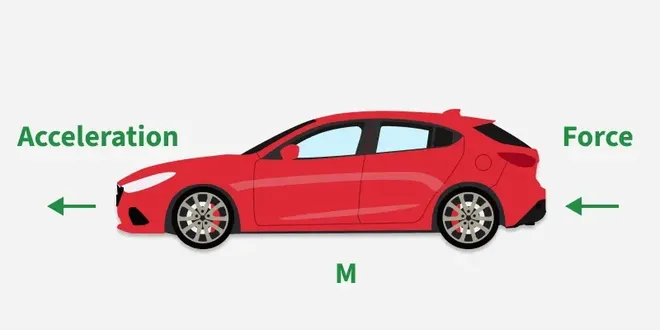
Forces causes Acceleration
Newton's Second Law of Motion states that:
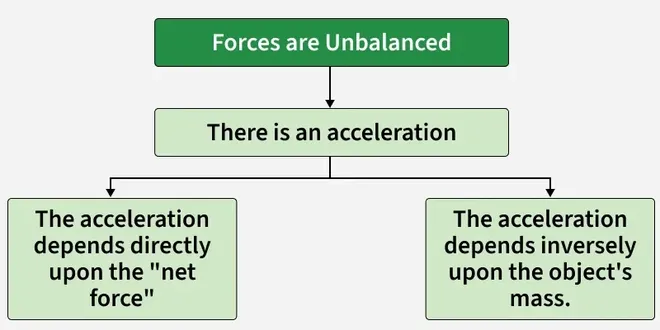
"The acceleration of an object is directly proportional to the net force acting on it and inversely proportional to its mass."
**Physical Significance of Newton's 2nd Law of Motion
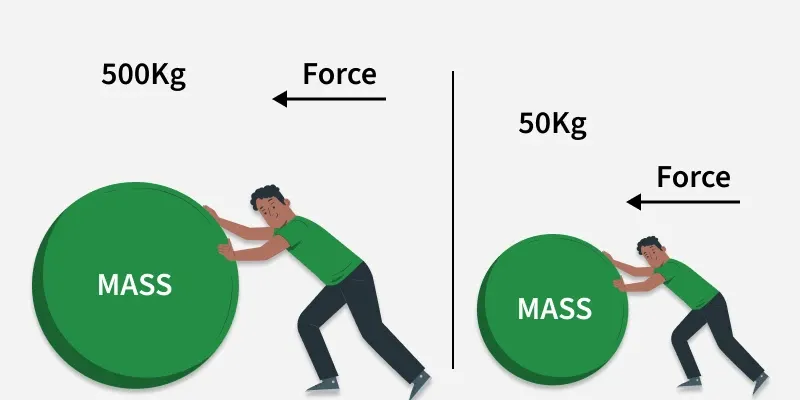
The amount of acceleration depends on the object's mass; heavier objects require more force to accelerate the same amount as lighter objects.
Mathematical Expression of Newton's Second Law
The second Law of Motion is also called the Quantitative Law of Motion because it quantitatively describes force.
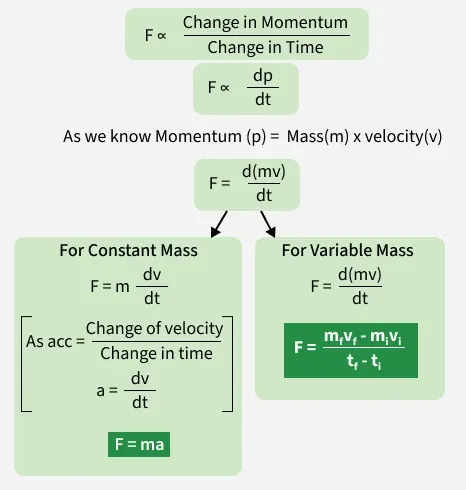
In his mathematical formulation, Newton defined his Second Law of Motion as:
\text{Force} \propto \dfrac{\text{Change in Momentum}}{\text{Change in Time}}
\vec{F} \propto \dfrac{d\vec{p}}{dt}
\vec{F} \propto m\dfrac{d\vec{v}}{dt}
\vec{F} = \vec{k} \ \vec{m} \dfrac{d\vec{v}}{dt} \hspace{0.6 cm}where(k=1)\newline\vec{F} = \vec{m} \dfrac{d\vec{v}}{dt} \hspace{0.8cm}and\hspace{ 3mm} a=\dfrac{dv}{dt}
\boxed{\vec{F} = \vec{m}.\vec{a}}
where
\vec{F}=Force\newline\vec{m}= mass\newline\vec{a}=acceleration
That is, the applied force of a body is defined as the product of its mass and acceleration. Hence, this provides us with a measure of the force.
Examples of Newton's Second Law of Motion
Conservation of Momentum
The Conservation of momentum states that, in an isolated system, the total momentum remains constant. Momentum is not created or destroyed; it is transferred between objects within the system during interactions like collisions or explosions
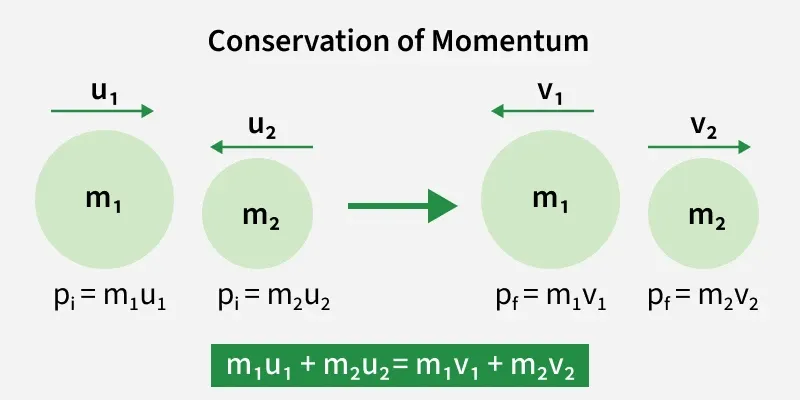
The law of conservation of momentum can be expressed mathematically as:
**General Formula For n-objects
Initial Momentum of all the objects = Final Momentum of all the objects
**For 2-Objects
\boxed{m_1u_1+m_2u_2=m_1v_1+m_2v_2}
where:
- m1 and m2 are the masses of the two objects
- u1 and u2 are their initial velocities before the interaction
- v1 and v2 are their final velocities after the interaction
Misconceptions about Newton's Second Law
- **A force is needed for motion itself
This is not true. According to Newton’s Second Law, a force is required only to change motion (produce acceleration), not to keep an object moving at constant velocity. - **Greater force always produces greater acceleration
This is not always true. Acceleration depends on both force and mass (a=F/m)(a = F/m)(a=F/m); a large mass can result in small acceleration even with a large force. - **Mass and weight are the same
This is incorrect. Mass measures resistance to acceleration, while weight is a force due to gravity; Newton’s Second Law uses mass, not weight. - **Zero acceleration means no forces act on the object
This is false. Zero acceleration means the net force is zero, but multiple forces may still be acting and balancing each other. - **Acceleration can be in a different direction than force
This is false. Acceleration always occurs in the same direction as the net force. - **Newton’s Second Law applies only to moving objects
This is incorrect. The law applies to both moving objects and objects at rest; an object at rest has zero acceleration when net force is zero.
Key Takeaway
**Related Articles:
Solved Examples on Newton's Second Law of Motion
**Example 1: If a bullet of mass 40 gm is shot from an Assault Rifle that has an initial velocity of 80 m/s the mass of the Assault Rifle is 15 kg. What is the initial recoil velocity of the Assault Rifle ?
**Concept Involved: Conservation of Momentum
Given,
Mass of bullet (mb) = 40 gm or 0.04 kg
Mass of the Assault Rifle (mg) = 15 kg
Initial Velocity of Gun (Vg1)= 0m/s (at rest) || Final Velocity of Gun (Vg2) = recoil velocity
Initial Velocity of Bullet (Vb1)= 0m/s (at rest inside gun) || Final Velocity of Bullet (Vb2) = 80 m/s
Therefore, according to the law of conservation of momentum,
(Initial Momentum) Gun & Bullet = (Final Momentum ) Gun & Bullet
MgVg1 + MbVb1= MgVg2 + MbVb2
15 × 0 + 0.04 × 0 = 15 × Vg2+ 0.04 × 80
0 = 15 × Vg2+ 0.04 × 80
⇒ 15 × Vg2 = -3.2
⇒ Vg2 = -3.2 / 15
⇒ Vg2 = -0.21 m/s (Negative Sign Indicates Gun Moves in Direction Opposite to Bullet)
**Example 2: If a heavy truck weighing 2000 kg is running with some velocity. If the driver applies brakes and is brought to rest, after application of brakes the heavy truck goes about 20 m when the average resistance being offered to it is 4000 N. What will be the velocity of the heavy truck engine?
Given:
Mass of truck (m) = 2000 kg
Resistance (F) = - 4000 N [negative as stopping force is applied]
Distance traveled after applying brakes (s) = 20 m.
Final velocity (v) = 0 m/s [as the heavy truck was brought to rest]
To find the initial velocity (?) of the truck, we'll use the equations of motion. The equation relating initial velocity (?) , final velocity (v) , acceleration (a), distance (s) :
v2 = u2 + 2as
Since the truck comes to rest, its final velocity (v) is 0 , We want to find the initial velocity (?).
0 = u2 + 2(-2) x 20
0 = u2 -80
u2 = 80
u = √80
u = 8.94m/s
**Example 3:- An object of mass 1 kg travelling in a straight line with a velocity of 10 m s –1 collides with, and sticks to, a stationary wooden block of mass 5 kg. Then they both move off together in the same straight line. Calculate the total momentum just before the impact and just after the impact. Also, calculate the velocity of the combined object.
Given ,
Mass of Block 1 (m1) = 1kg
Mass of Block2 (m2) = 5kg
Initial Velocity of Block1 (u1)=10 m/s || Initial Velocity of Block2 (u2)=0 m/s (at rest)
Final Velocity of Combined Block (1+2)= Vcombined
Conservation of Momentum
m1u1 +m2u2 =m1v1 + m2v2. ( V1 =V2 = Vcombined as they stick together)
1 **× 10 + 5 **× 0 = 1 **× Vcombined **+ 5 × Vcombined
10= Vcombined**× (1+ 5). {Taking Vcombined common}
Vcombined = 10/ 6
Vcombined = 1.667 m/sec
**Example 4: A mini truck of 2500 kg with a velocity of v runs head-on with a big truck of 5000 kg with a velocity of −v. Which truck will experience the greater force? Which experiences the greater acceleration?
According to the Newton's second law of motion,
F = ma
⇒ a = F / m
Mini truck and the big truck experience equal and opposite forces. But since the mini truck has a smaller mass it will experience greater acceleration than the big truck.
Hence, the truck with greater mass's acceleration will be decreased.
**Example 5: What will be the net force needed to accelerate a 1000 kg car at 8 m/s 2 ?
Given,
Acceleration of car (a) = 8 m/s2
Mass of car (m)= 1000 kg
Therefore, using the formula for the applied force as,
F = m × a
⇒ F = 1000 kg × 8 m/s2
⇒ F = 8000 N
Practice Problems - Newton's Second Law of Motion
Problem 1: An astronaut with a mass of 70 kg is on the Moon, where gravity is about 1/6th that of Earth's. Calculate the astronaut's weight on the Moon and the force required to accelerate them at 5 m/s².
Problem 2: A rocket with a mass of 1,000 kg is launched into space. If it experiences a constant thrust force of 10,000 N, what will be its acceleration?
Problem 3: A motorcar of mass 1200 kg is moving along a straight line with a uniform velocity of 90 km/h. Its velocity is slowed down to 18 km/h in 4 s by an unbalanced external force. Calculate the acceleration and change in momentum. Also calculate the magnitude of the force required.
Problem 4: A 8000 kg engine pulls a train of 5 wagons, each of 2000 kg, along a horizontal track. If the engine exerts a force of 40000 N and the track offers a friction force of 5000 N, then calculate: (a) the net accelerating force and (b) the acceleration of the train.