Planets in our Solar System (original) (raw)
Last Updated : 25 May, 2026
A planet is a large, nearly spherical celestial body that orbits a star, such as the Sun, and does not produce its own light.
- It has enough gravity to maintain its round shape and has cleared its orbital path of most surrounding debris.
- Planets can be composed of rock, gas, or ice, and they vary greatly in size, atmosphere, temperature, and other physical features.
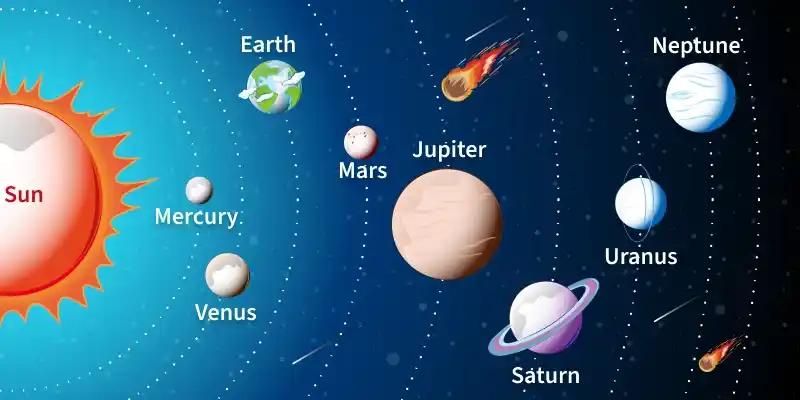
8 Planets in our Solar System
**The Solar System Consists of Eight Unique Planets:
1. Mercury
- Mercury is the smallest planet and the closest to the Sun, completing one revolution in about 88 days.
- Its size is slightly larger than Earth’s Moon, and it has no moons.
- Due to the absence of a significant atmosphere, it experiences extreme temperature variations.
- Surface temperatures range from about 100 K at night to 700 K during the day.
2. Venus
- Venus is the brightest planet visible from Earth and is often called Earth’s twin due to its similar size and mass.
- It has no moons or rings and rotates in a retrograde (clockwise) direction.
- A day on Venus is longer than its year, and strong winds reach speeds up to 360 km/h.
- With an atmosphere containing about 96% carbon dioxide, Venus is the hottest planet, having an average surface temperature of about 735 K.
3. Earth
- Earth is the third planet from the Sun and the only known planet that supports life.
- Its atmosphere is mainly composed of nitrogen (78%) and oxygen (21%).
- About 71% of its surface is covered with liquid water, supporting diverse climates and ecosystems.
- Earth completes one orbit in 365.25 days and experiences seasons due to its 23.5° axial tilt.
4. Mars
- Mars, known as the Red Planet, gets its reddish color from iron oxide on its surface.
- It has a thin atmosphere mainly composed of carbon dioxide and experiences cold, dry conditions.
- Mars has two small moons, Phobos and Deimos, and a day lasts about 24.6 hours.
- The planet has polar ice caps and experiences massive dust storms that can cover the entire planet.
5. Jupiter
- Jupiter is the largest planet in the Solar System and rotates rapidly, completing one rotation in about 10 hours.
- Its atmosphere is mainly hydrogen and helium, with colorful cloud bands and the Great Red Spot, a storm lasting over 350 years.
- Jupiter has 79 known moons, including Ganymede, the largest moon in the Solar System.
- It has faint rings and the strongest magnetic field of any planet.
6. Saturn
- Saturn is the second-largest planet and is famous for its extensive ring system made of ice and dust.
- Its atmosphere consists mainly of hydrogen and helium with strong winds and storms.
- Saturn has 82 known moons, with Titan being the largest.
- A day on Saturn lasts about 10.7 hours, and its low density means it could float in water.
7. Uranus
- Uranus is the seventh planet from the Sun and rotates on its side with an axial tilt of about 98°.
- It is classified as an ice giant, composed mainly of hydrogen, helium, and methane.
- The methane in its atmosphere gives Uranus its blue-green color.
- Uranus has 27 known moons and a faint ring system, and it experiences extreme seasons lasting about 42 years.
8. Neptune
- Neptune is the eighth and farthest planet from the Sun and appears blue due to methane in its atmosphere.
- It has the strongest winds in the Solar System, reaching speeds up to 2,100 km/h.
- Neptune has 14 known moons, with Triton being the largest, and it also has faint rings.
- A year on Neptune lasts about 165 Earth years, and it emits more heat than it receives from the Sun.
**Did you know?
- Venus has a day longer than its year, taking **243 Earth days to rotate once and **225 Earth days to orbit the Sun.
- Pluto's orbit is highly tilted and elliptical, causing it to occasionally cross inside Neptune's orbit without colliding due to a gravitational resonance.
- Pluto, which was the outermost planet, is now a dwarf planet. Pluto, in August 2006, was removed as a planet by the International Astronomical Union (IAU)
- Mars has seasons like Earth, but they last longer due to its longer orbit, with each season lasting about twice as long.
Theories of the Solar System
There are two major theories related to the Solar System, these are
1. Nebular Hypothesis of Laplace
The Nebular Hypothesis, proposed by Pierre Simon de Laplace in 1796, suggests that the Solar System originated from a large cloud of gas and dust. According to this theory, the Sun’s momentum plays a crucial role in the system's formation. When the theory is applied to the known orbital velocities of the planets, it implies that the Sun must have originally rotated about **50 times faster than it currently does. Additionally, Laplace theorized that the rings surrounding the early Sun would eventually condense into planets.
- Proposed by Pierre Simon de Laplace in 1796.
- Suggests the Sun’s momentum influences the formation of the Solar System.
- Implies the Sun must have originally spun much faster than it does now.
- Predicts that rings around the Sun would condense into planets.
2. Planetesimal Hypothesis of Chamberlin & Moulton
The Planetesimal Hypothesis, formulated by Forrest R. Moulton and Thomas C. Chamberlin in 1900, offers another theory on the formation of the Solar System. According to this hypothesis, planets were created by the gradual accumulation of small, solid particles known as "planetesimals" that orbited the Sun. Over time, these planetesimals collided and merged to form the planets we see today.
- Developed by Forrest R. Moulton and Thomas C. Chamberlin in 1900.
- Suggests planets formed from the accumulation of small particles, or planetesimals.
- These planetesimals orbited the Sun and gradually combined to create planets.
How to remember the Order of Planets in our Solar System?
**The planets in our solar system can be remembered by placing them in an order in various ways. Some of these are:-
- Planets in Order From the Sun
- Planets in Order by Their Size
- Planets in Order by Their Number of Moons
Planets in order from the Sun
The Solar System is a fascinating arrangement of planets orbiting our star, the Sun, at varying distances. To measure these vast distances, astronomers use a unit called the "astronomical unit" (AU), which represents the average distance between Earth and the Sun. Here’s a look at the planets and how far they are from the Sun, in increasing order:
- **Mercury – 0.39 AU from the Sun
- **Venus – 0.72 AU from the Sun
- **Earth – 1.00 AU from the Sun
- **Mars – 1.52 AU from the Sun
- **Jupiter – 5.20 AU from the Sun
- **Saturn – 9.54 AU from the Sun
- **Uranus – 19.20 AU from the Sun
- **Neptune – 30.06 AU from the Sun
**⁛ The closer a planet is to the Sun, the faster it orbits, and each one’s unique position gives it its own fascinating characteristics.
Planets in order by their Size
Another interesting way to look at the planets is by comparing their sizes, from the biggest to the smallest. Here's how the eight planets are ranked by their diameter:
- **Jupiter – 43,441 miles (69,911 kilometers)
- **Saturn – 36,184 miles (58,232 kilometers)
- **Uranus – 15,759 miles (25,362 kilometers)
- **Neptune – 15,299 miles (24,622 kilometers)
- **Earth – 3,959 miles (6,371 kilometers)
- **Venus – 3,761 miles (6,052 kilometers)
- **Mars – 2,460 miles (3,390 kilometers)
- **Mercury – 1,516 miles (2,440 kilometers)
**⁛ The planets vary greatly in size, with Jupiter standing as the giant of our Solar System, far exceeding the size of the others.
Planets in Order by Their Number of Moons
Another interesting way to compare the planets is by looking at how many moons each one has. Here’s how the eight planets rank based on their number of moons:
- **Saturn – 146 moons
- **Jupiter – 95 moons
- **Uranus – 27 moons
- **Neptune – 14 moons
- **Mars – 2 moons
- **Earth – 1 moon
- **Venus – 0 moons
- **Mercury – 0 moons
As you can see, Saturn has the most moons by far, while Venus and Mercury have none.