Potential Energy of a Spring (original) (raw)
Last Updated : 25 May, 2026
A spring is used in almost every mechanical aspect of our daily lives, from the shock absorbers of a car to a gas lighter in the kitchen. Springs are widely used because they can be deformed and then return to their original shape. Whenever a spring is stretched or compressed, it exerts a force in the opposite direction of the displacement. This happens because the spring always tries to return to its unstretched position.
This force is described by Hooke’s law and is key to understanding the energy stored in a spring, known as elastic potential energy.
Hooke's law
A force is needed to stretch or compress an elastic object like a spring or rope. The object resists the change, exerting a force in the opposite direction called the restoring force. According to Hooke’s law, this force is proportional to the displacement x from the natural length.
F = − kx
Here, k is the spring constant, and the negative sign indicates that the force opposes the displacement.
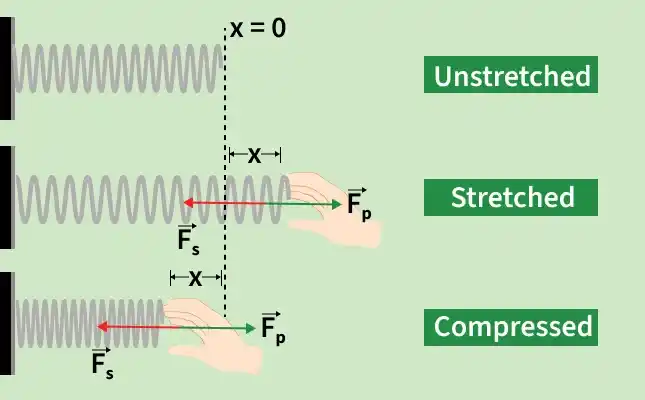
So, whenever a spring is stretched downwards, the force is exerted upwards and vice versa.
Elastic Potential Energy
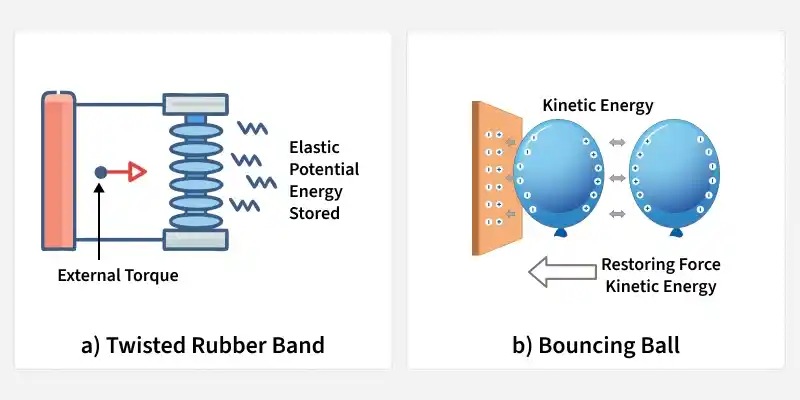
Elastic potential energy is the energy stored in an object when it is stretched or compressed. This energy stays stored while the object is deformed, and when the force is removed, the object returns to its original shape, and the stored energy changes into other forms of energy. Examples of objects storing elastic potential energy include:
- A stretched or compressed spring.
- A twisted rubber band.
- A bouncy ball compressed at the moment it strikes the wall and bounces back.
**Calculating the potential energy stored in the spring
Hooke's law mentioned above, states how the restoring force in the spring varies as the net displacement from the mean position of the spring. Considering the net displacement to be \Delta x and the restoring force being denoted by F,
F = -kx
This force is a conservative force, and conservative forces have potential energies associated with them. It is known that the work done is defined as the product of force and displacement.
W = F.x
For a variable force F, and the net displacement x,
W = \int^{x}_{0}Fdx
Now at the displacement x, for an infinitesimally small-displacement \Delta x and force F,
dW = Fdx
⇒ dW = -kxdx
Integrating the above equation for the total work done,
dW = kxdx
⇒∫dW = ∫kxdx
⇒ W = \frac{kx^2}{2}
So, this is the total work done for the displacement x. This work done is stored as potential energy in the spring. This fact can also be verified through the force versus displacement graph for the spring. The area under the curve in the force-displacement graph gives the elastic potential energy stored in the spring.
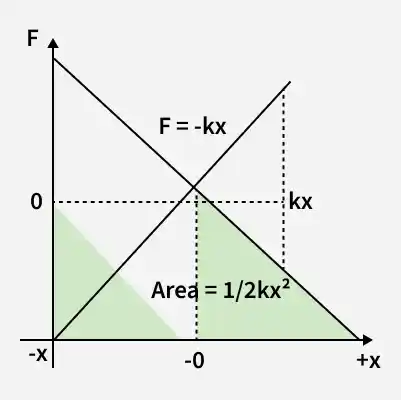
The area under the curve = Area of the shaded region of the curve
= \frac{1}{2} \times base \times height
= \frac{1}{2} \times x \times (kx)
= \frac{1}{2}kx^2
Both of the approaches give the same answer.
Thus, elastic potential energy stored in spring with “x” displacement is given by,
P.E = \frac{1}{2}kx^2
Sample Problems
**Question 1: Find the elastic potential energy stored in the spring with k = 50 N/m when the spring is compressed by 0.2m.
**Answer:
Given: k = 50 N/m and x = 0.2m
Now, elastic potential energy stored in the spring is given by,
\frac{1}{2}kx^2
Plugging the values in the above formula,
P.E = \frac{1}{2}kx^2
⇒ P.E = \frac{1}{2}(50)(0.2)^2
⇒ P.E = \frac{1}{2}(50)(0.04)
⇒ P.E = 1 J
**Question 2: Find the elastic potential energy stored in the spring with k = 100 N/m when the spring is compressed by 0.1m.
**Answer:
Given: k = 100 N/m and x = 0.1m
Now, elastic potential energy stored in the spring is given by,
\frac{1}{2}kx^2
Plugging the values in the above formula,
P.E = \frac{1}{2}kx^2
⇒ P.E = \frac{1}{2}(100)(0.1)^2
⇒ P.E = \frac{1}{2}(100)(0.01)
⇒ P.E = 0.5 J
**Question 3: Find the elastic potential energy stored in the spring with k = 100 N/m when the spring is stretched to 0.1m from its natural length of 0.5m.
Answer:
Given: k = 100 N/m and xi = 0.1m and xf = 0.5m
Let the displacement x be given by,
x = 0.5 – 0.1
⇒x = 0.4m
Now, elastic potential energy stored in the spring is given by,
\frac{1}{2}kx^2
Plugging the values in the above formula,
P.E = \frac{1}{2}kx^2
⇒ P.E = \frac{1}{2}(100)(0.4)^2
⇒ P.E = \frac{1}{2}(100)(0.16)
⇒ P.E = 8 J
**Question 4: Find the elastic potential energy stored in the spring with k = 100 N/m when the spring is stretched to 0.5m from its natural length of 1 m.
**Answer:
Given: k = 100 N/m and xi = 1 m and xf = 0.5m
Let the displacement x be given by,
x = 1 – 0.5
⇒x = 0.5m
Now, elastic potential energy stored in the spring is given by,
\frac{1}{2}kx^2
Plugging the values in the above formula,
P.E = \frac{1}{2}kx^2
⇒ P.E = \frac{1}{2}(100)(0.5)^2
⇒ P.E = \frac{1}{2}(100)(0.25)
⇒ P.E = 12.5 J
**Question 5: A spring with spring constant k = 100 N/m was initially compressed by x = 0.4m, after that, it was released and stopped at x = 0.2m compression. Find the work done by the restoring force in this process.
**Answer:
Given: k = 100 N/m and xi = 0.4m and xf = 0.2m
The work done will be given by the difference in potential energy of the spring at these two instances.
Elastic potential energy stored in the spring is given by,
\frac{1}{2}kx^2
At x = 0.4m
Plugging the values in the above formula,
P.Ei = \frac{1}{2}kx^2
⇒ P.Ei = \frac{1}{2}(100)(0.4)^2
⇒ P.Ei = \frac{1}{2}(100)(0.16)
⇒ P.Ei = 8 J
At x = 0.2m
Plugging the values in the above formula,
P.Ef = \frac{1}{2}kx^2
⇒ P.Ef = \frac{1}{2}(100)(0.2)^2
⇒ P.Ef = \frac{1}{2}(100)(0.04)
⇒ P.Ef = 2 J
W.D = -(P.Ef - P.Ei)
⇒W.D = -2 + 8
⇒W.D = 6J
**Question 6: A spring with spring constant k = 20 N/m was initially compressed by x = 0.5m, after that, it was released and stopped at x = 0.1m compression. Find the work done by the restoring force in this process.
**Answer:
Given: k = 20 N/m and xi = 0.5m and xf = 0.1m
The work done will be given by the difference in potential energy of the spring at these two instances.
Elastic potential energy stored in the spring is given by,
\frac{1}{2}kx^2
At x = 0.5m
Plugging the values in the above formula,
P.Ei = \frac{1}{2}kx^2
⇒ P.Ei = \frac{1}{2}(20)(0.5)^2
⇒ P.Ei = \frac{1}{2}(20)(0.25)
⇒ P.Ei = 2.5 J
At x = 0.1m
Plugging the values in the above formula,
P.Ef = \frac{1}{2}kx^2
⇒ P.Ef = \frac{1}{2}(20)(0.1)^2
⇒ P.Ef = \frac{1}{2}(20)(0.01)
⇒ P.Ef = 0.1 J.
W.D = -(P.Ef - P.Ei)
⇒W.D = -0.1 + 2.5
⇒W.D = 2.4J
Unsolved Problem
**Question 1: A spring with a spring constant k = 80 N/m is stretched by 0.3 m. Find the elastic potential energy stored in the spring.
**Question 2: A spring with k = 60 N/m is compressed by 0.25 m. Calculate the work done by the restoring force when the spring returns to its natural length.
**Question 3: A spring with spring constant k = 120 N/m is stretched from 0.1 m to 0.4 m. Determine the elastic potential energy stored in the spring at the stretched position.
**Question 4: Two springs, one with k1 = 50 N/m and the other with k2 = 100 N/m, are connected in series and compressed by 0.2 m in total. Find the total elastic potential energy stored in the system.
**Question 5: A spring with k = 200 N/m is initially compressed by 0.3 m. It is then further compressed by 0.2 m. Calculate the work done by the spring during the second compression.
**Question 6: A spring has a spring constant k = 150 N/m. It is stretched from its natural length to 0.5 m and then released. If the spring hits a stop at 0.3 m displacement, calculate the work done by the spring during this motion.