Introduction To Malware Analysis (original) (raw)
Last Updated : 18 May, 2026
Malware analysis is the process of examining malicious software to understand its behavior, purpose, origin and impact. It involves studying different types of threats such as viruses, ransomware, spyware and malvertising to identify how they operate and spread.
- **Behavioral Analysis and Threat Intelligence: Understands how malware communicates, steals data and avoids detection.
- **Identification of Attack Vectors: Detects delivery methods like phishing emails, infected websites and malicious downloads.
- **Support for Incident Response and Digital Forensics: Helps trace infections, analyze damage and recover from attacks.
- **Enhancement of Security Tools and Detection Mechanisms: Improves antivirus software, intrusion detection and endpoint security systems.
Stages of Malware Analysis
Malware analysis is typically carried out in four structured stages, each providing deeper insight into how a malicious program operates and impacts a system.
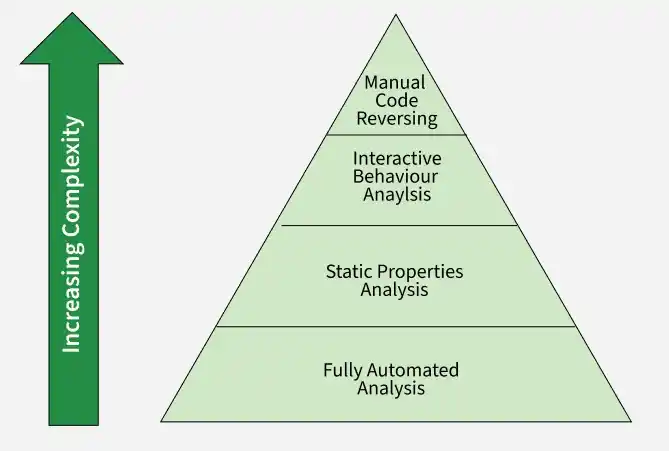
Stages Of Malware Analysis
1. Static Properties Analysis
This stage focuses on examining a malware file without executing it. Analysts inspect elements such as file hashes, headers, embedded strings, and metadata to gather initial intelligence. Since no execution is required, this method is quick, safe and useful for identifying basic indicators of compromise.
- **Signature and Pattern Identification: Static analysis helps detect known malware families by comparing file signatures, byte patterns and cryptographic hashes with existing threat databases.
- **Safe Preliminary Investigation: Since the malware is not executed, analysts can safely inspect suspicious files without risking system infection or unintended payload activation.
- **Detection of Hidden Indicators: Examining embedded URLs, registry keys, API calls and suspicious strings can reveal possible communication channels, persistence methods and attacker intentions.
2. Interactive Behavior Analysis
In this phase, the malware is executed in a controlled lab environment, allowing analysts to actively interact with it. By observing how it behaves in real time-such as memory usage, system modifications and network activity-security professionals gain a clearer understanding of its functionality and intent.
- **Real-Time Observation of Malware Actions: Analysts can monitor how malware interacts with files, processes, memory and operating system components during execution.
- **Understanding Network Communication: Behavioral analysis reveals whether the malware attempts to contact command-and-control (C2) servers, download payloads or exfiltrate sensitive information.
- **Evaluation of Evasion Techniques: Interactive testing helps identify anti-debugging, anti-VM and sandbox-detection mechanisms commonly used by advanced malware strains.
3. Fully Automated Analysis
Automated tools are used to scan and evaluate suspicious files at scale. This approach focuses on detecting what the malware is capable of doing once it infects a system.
- **Scalable Threat Detection: Automated analysis platforms can process thousands of suspicious files quickly, making them ideal for enterprise-scale cybersecurity operations.
- **Rapid Incident Prioritization: Generated reports help security teams classify threats based on severity, enabling faster response to high-risk malware infections.
- **Integration With Security Infrastructure: Automated systems can integrate with SIEM, EDR and antivirus solutions to improve continuous monitoring and threat intelligence sharing.
4. Manual Code Reversing
This is the most advanced and in-depth stage, where experts analyze the malware’s code line by line. Reverse engineering helps uncover hidden logic, evasion techniques, and the exact mechanisms behind the attack.
- **Deep Understanding of Malware Architecture: Reverse engineering exposes the internal structure, encryption methods, payload execution flow and hidden capabilities of malware.
- **Discovery of Zero-Day Techniques: Manual analysis can uncover previously unknown exploits, custom obfuscation methods and sophisticated attack strategies used by threat actors.
- **Creation of Advanced Defensive Measures: Insights gained from reverse engineering support the development of custom detection signatures, patches and stronger cybersecurity defenses.
Types of Malware Analysis
Malware analysis can be performed using different approaches, depending on the complexity of the threat and the goals of the investigation. Organizations often use one or a combination of these methods either before an attack (proactive defense) or after an incident (incident response).
1. Static Malware Analysis
Static analysis examines suspicious files without executing them, making it a safe and fast method for initial investigation. Analysts study components such as file names, hashes, embedded strings, IP addresses, domains and header information to identify potential threats.
- **Early Threat Classification: Static analysis helps categorize malware into families and threat groups by examining code structure, signatures and embedded artifacts before execution.
- **Efficient Detection of Malicious Indicators: Analysts can identify suspicious domains, registry entries, executable sections and encoded payloads that may indicate malicious intent.
- **Low-Risk Security Assessment: Because the malware remains inactive during inspection, organizations can safely analyze suspicious files without affecting production systems or network environments.
2. Dynamic Malware Analysis
Dynamic analysis involves running the malware in a controlled sandbox environment to observe its behavior in real time. This isolated setup allows security professionals to safely monitor system changes, network activity and interactions with memory or processes.
- **Behavioral Monitoring in Real Time: Dynamic analysis reveals how malware behaves after execution, including file manipulation, privilege escalation, persistence creation and process injection.
- **Detection of Network-Based Threat Activities: This method helps uncover outbound connections, data exfiltration attempts, DNS requests and communication with remote attacker-controlled servers.
- **Analysis of Runtime Evasion Techniques: Running malware in an isolated sandbox helps identify polymorphic behavior, delayed execution tactics and anti-analysis mechanisms used to bypass security tools.
3. Hybrid Malware Analysis
Hybrid analysis combines the strengths of both static and dynamic techniques to deliver a more comprehensive understanding. While dynamic analysis reveals how malware behaves during execution, static analysis helps explain the underlying code and structure behind those actions.
- **Comprehensive Threat Visibility: Hybrid analysis combines code-level inspection with runtime behavior monitoring to provide a complete understanding of malware functionality and impact.
- **Improved Accuracy in Threat Detection: By correlating static indicators with dynamic execution results, analysts can reduce false positives and improve malware classification accuracy.
- **Enhanced Cybersecurity Intelligence: Hybrid techniques generate detailed insights that support threat hunting, advanced malware research, incident response and proactive defense strategies.
- **Process Hacker: Process Hacker provides deep visibility into running processes, services and system resources on a machine.
- **Fiddler: Fiddler captures and inspects network traffic between a system and external servers. It allows analysts to identify malicious communications, suspicious domains and hidden payload downloads.
- **Limon Sandbox: Limon is a sandbox environment designed specifically for analyzing Linux-based malware. It enables safe execution of suspicious files while monitoring their behavior in isolation.
- **PEStudio: PEStudio performs static analysis by scanning files without executing them. It highlights suspicious indicators like hashes and anomalies to quickly identify potential threats.
- **Ghidra: Ghidra is a reverse engineering tool that disassembles malware into readable code. It helps analysts understand the logic, structure and intent behind malicious programs.
- **Cuckoo Sandbox: Cuckoo Sandbox runs malware in an isolated environment to study its behavior. It records system changes and generates detailed reports for further analysis.
- **CrowdStrike Falcon Insight: CrowdStrike Falcon Insight combines behavioral analysis with threat intelligence. It helps identify known and unknown malware by comparing activity with global threat data.
Benefits of Malware Analysis
- **Threat Detection: Malware analysis enables the detection of previously unknown threats, allowing organizations to proactively defend against attacks.
- **Improved Security: By understanding the behavior of malware, organizations can improve their security measures and reduce the risk of infection.
- **Understanding of Attack Techniques: Malware analysis provides insight into the methods and techniques used by attackers, allowing organizations to better prepare for and defend against future attacks.
- **Early Detection: By analyzing malware early in its lifecycle, organizations can mitigate the impact of an attack and reduce the time required to recover from it.
- **Forensics: Malware analysis can provide valuable information for forensic investigations and can aid in the prosecution of attackers.
Limitations of Malware Analysis
- **Time-Consuming: The process of malware analysis can be time-consuming and requires specialized knowledge and tools.
- **Risk of Infection: Conducting malware analysis in an uncontrolled environment can result in the spread of the malware, potentially causing harm to other systems.
- **Cost: Malware analysis requires specialized tools and expertise, which can be expensive for organizations to acquire and maintain.
- **Difficulty: Malware is constantly evolving and the analysis process can be challenging, requiring specialized knowledge and expertise.
- **False Positives: Malware analysis can sometimes result in false positives, leading to false alarms and a loss of confidence in the security measures in place.