Functional Testing Software Testing (original) (raw)
Last Updated : 18 May, 2026
Functional Testing is a type of software testing that verifies whether the application works according to the specified requirements. It focuses on testing features, functions, and user interactions to ensure correct output for given inputs. This testing is performed without considering the internal code structure.
- Validates application behavior from the user and system perspectives
- Supports modern architectures like microservices, APIs, and cloud-based apps
- Can be performed manually or automated within DevOps and CI/CD workflows
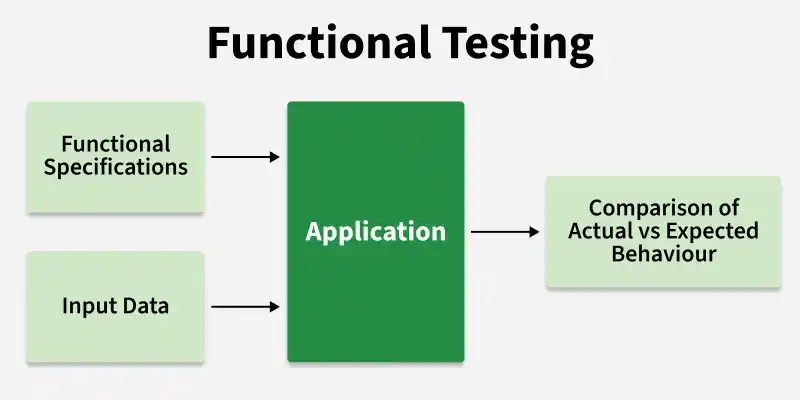
Functional Testing
Functional Testing Process
The functional testing process is a continuous cycle where each step is connected, ensuring the software meets all requirements and quality standards.
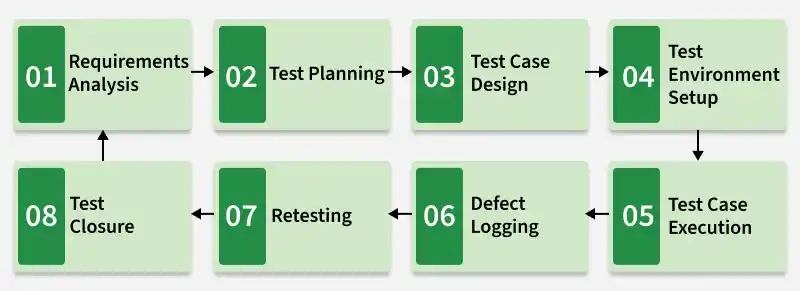
Functional Testing Process
1. Requirement Analysis
Involves understanding and analyzing business and functional requirements to identify testable scenarios and clarify ambiguities.
- Understand business and functional requirements
- Identify testable scenarios
- Remove ambiguities with stakeholders
**Output: Requirement Understanding Document
2. Test Planning
Involves defining the testing strategy, scope, resources, and timeline to ensure effective execution of testing activities.
- Define testing scope, objectives, and strategy
- Select tools, resources, and timeline
- Estimate effort and risks
**Output: Test Plan
3. Test Case Design
Involves creating detailed test cases and preparing data to validate application functionality.
- Create detailed test cases and scenarios
- Prepare test data
- Review and validate test cases
**Output: Test Cases + Test Data
4. Test Environment Setup
Involves setting up the required hardware and software environment for executing test cases.
- Configure required hardware and software
- Deploy application build
- Ensure environment is ready for testing
**Output: Ready Test Environment
5. Test Case Execution
Involves executing test cases and comparing expected results with actual results.
- Execute test cases step-by-step
- Record actual results
- Mark test cases as Pass/Fail
**Output: Test Execution Report
6. Defect Logging
Involves identifying, documenting, and tracking defects found during testing.
- Report bugs with proper details (steps, severity, screenshots)
- Assign defects to developers
- Track defect status
**Output: Defect Report
7. Retesting
Involves verifying that previously reported defects have been fixed correctly.
- Re-execute failed test cases after bug fixes
- Verify defects are resolved
**Output: Verified Fixes
8. Test Closure
Involves completing all testing activities and preparing final reports for stakeholders.
- Ensure all testing activities are completed
- Prepare final test summary report
- Get stakeholder approval
**Output: Test Closure Report
Types of Functional Testing
There are various types of functional Testing which are as follows:
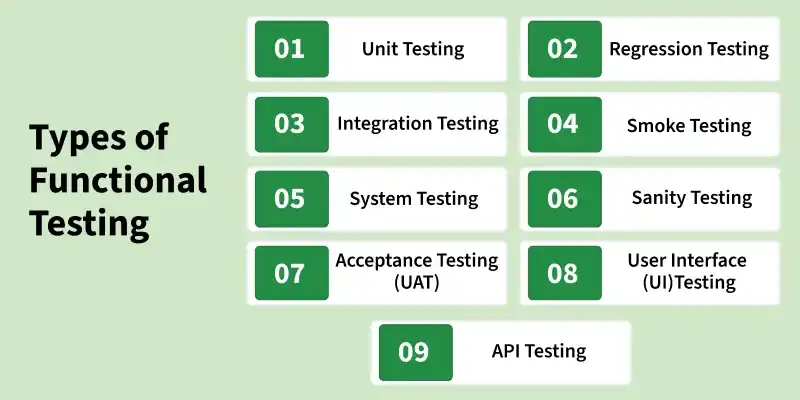
Types of Functional Testing
**1. Unit testing
**Unit testing tests individual functions or modules in isolation to verify correct behavior. Mainly performed by developers during coding.
- Smallest testing level
- Fast execution & easy debugging
- Uses stubs/mocks
2. **Integration Testing
**Integration Testing validates interaction between integrated modules to ensure smooth data flow and communication.
- Detects interface defects
- Checks module interaction
- **Types: Top-down, Bottom-up
3. System Testing
System Testing evaluates the complete system against specified requirements in a production-like environment.
- End-to-end validation
- Covers functional requirements
- Performed by QA team
4. Acceptance Testing (UAT)
Acceptance Testing confirms the system meets business needs and is ready for delivery. Conducted by clients or end users.
- Final validation stage
- Based on real scenarios
- **Types: Alpha, Beta
5. Regression Testing
Regression Testing ensures that recent changes or bug fixes do not impact existing functionality.
- Re-runs old test cases
- Maintains system stability
- Ideal for automation
6. Smoke Testing
Smoke Testing performs a quick check on major functionalities to verify build stability before detailed testing.
- High-level testing
- Covers critical paths
- Done on every build
7. Sanity Testing
Sanity Testing focuses on validating specific functionality after minor updates or bug fixes.
- Narrow but deep testing
- Saves time & effort
- Subset of regression
8. User Interface (UI) Testing
User Interface (UI) Testing verifies that the application’s UI is user-friendly, responsive, and functions correctly.
- Checks layout & design
- Validates user interaction
- Ensures consistency
9. API Testing
API Testing tests backend services to ensure correct request-response behavior and data handling.
- No UI dependency
- Validates business logic
- Checks status codes & data
Types of Functional Testing Techniques
Functional testing techniques are methods used to design test cases and validate that the software works according to requirements.
1. Equivalence Partitioning
Involves dividing input data into groups (valid and invalid) so that testing can be done using one value from each group.
- Divides input data into valid & invalid partitions
- Selects one representative value from each group
- Reduces number of test cases
**Example: Age field (18–60) -> test 17, 30, 61
2. Boundary Value Analysis (BVA)
Involves testing values at the boundaries of input ranges where defects are most likely to occur.
- Focuses on edge values of input ranges
- Tests minimum, maximum, and just inside/outside values
- Helps detect boundary-related errors
**Example: Range 1–100 -> test 0, 1, 2, 99, 100, 101
3. Decision Table Testing
Involves testing different combinations of conditions and their corresponding actions using a table format.
- Used when multiple conditions affect output
- Represents conditions and actions in tabular form
- Covers all possible combinations
**Example: Login with valid/invalid username & password combinations
4. State Transition Testing
Involves testing system behavior based on different states and transitions between those states.
- Focuses on system states and changes
- Validates valid and invalid transitions
- Useful for workflow-based systems
**Example: Login attempts -> success, failure, account lock after multiple attempts
5. Use Case Testing
Involves validating complete end-to-end user scenarios to ensure system functionality.
- Tests real user workflows
- Covers complete process from start to end
- Based on use case documents
**Example: Online shopping -> search -> add to cart -> checkout -> payment
6. Error Guessing
Involves identifying possible defects based on tester’s experience and intuition.
- Based on past experience
- No formal technique or rules
- Focuses on common error-prone areas
**Example: Testing blank fields, special characters, invalid inputs
7. Cause-Effect Graphing
Involves identifying relationships between input conditions (causes) and outputs (effects) to design test cases.
- Shows logical relationship between inputs and outputs
- Converts requirements into graph form
- Helps design optimized test cases
**Example: Login system with conditions:
**Cause 1: Valid Username
**Cause 2: Valid Password
**Effect: Login Successful
**Test Cases:
- Valid Username + Valid Password -> Login Successful
- Invalid Username + Valid Password -> Error
- Valid Username + Invalid Password -> Error
- Invalid Username + Invalid Password -> Error
8. Pairwise Testing
Involves testing combinations of input parameters in pairs to reduce the total number of test cases.
- Tests all possible pairs of inputs
- Reduces test case count significantly
- Maintains good coverage
**Example: Website testing with inputs:
- Browser: Chrome, Firefox
- OS: Windows, Mac
- Network: WiFi, Mobile Data
Instead of testing all combinations (2×2×2 = 8), pairwise reduces cases like:
- Chrome + Windows + WiFi
- Chrome + Mac + Mobile Data
- Firefox + Windows + Mobile Data
- Firefox + Mac + WiFi
**Note: Each pair combination is covered at least once
Tools used for functional testing are as follows:
- **Selenium****:** It is an open-source umbrella project for a range of tools and libraries developed with the aim to support browser automation.
- **QTP****:** QTP, now known as UFT, is a tool designed to perform automated functional testing without the need to monitor the system continuously. without the need to monitor the system in intervals.
- **JUnit****:** It is a unit-testing open-source framework for the Java programming language. It is used by Java developers to write and execute automated test cases.
Scope
Functional testing ensures that an application’s features work as intended according to the specified requirements. It primarily focuses on the following areas:
- **Usability and Navigation: Verifies that users can easily navigate through the application and interact with screens, buttons, forms, and links without confusion.
- **Core Application Features: Ensures that all primary and business-critical functionalities perform correctly under expected conditions.
- **Accessibility Compliance: Confirms that the application is usable by all users, including those with disabilities, and that accessibility features function as intended.
- **Error Handling and Messages: Checks how the application responds to invalid inputs or failures and ensures that appropriate, clear error messages are displayed to users.
Common Challenges & How to Address Them
**Incomplete or Changing Requirements : Frequent requirement changes break test cases and increase rework.
**Solution: Adopt agile test practices, involve QA in sprint planning, and use requirement versioning.
**Test Data Management : Creating realistic test data for all scenarios is time-consuming.
**Solution: Use data generation tools and maintain a centralized test data repository.
**Environment Instability : Flaky environments cause false test failures.
**Solution: Use containerization (Docker) to ensure consistent, reproducible environments.
**Insufficient Test Coverage : Critical scenarios are missed due to time pressure.
**Solution: Use risk-based testing to prioritize high-impact areas and track coverage metrics.
**Automation Maintenance Overhead : Automated scripts break with UI changes.
**Solution: Use page object model (POM) patterns and decouple test logic from implementation details.