Reliability Testing Software Testing (original) (raw)
Last Updated : 4 Jun, 2026
Reliability Testing is a type of software testing that verifies whether an application can perform its intended functions consistently without failures over a specified period of time and under specific conditions. It helps ensure that the software is stable, dependable, and suitable for long-term use.
- Ensures the software operates without failures for a defined duration.
- Identifies issues such as crashes, memory leaks, and performance degradation.
- Improves system stability, availability, and user confidence.
Types of Reliability Testing
Here are the Types of Reliability Testing are follows:
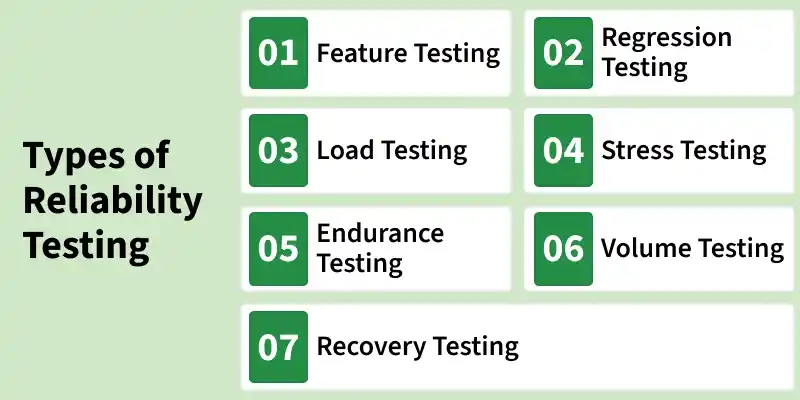
Types of Reliability Testing
- Feature Testing: Verifies that individual software features work correctly and consistently under expected conditions.
- Regression Testing: Ensures that new changes or updates do not negatively affect existing functionality and reliability.
- Load Testing: Evaluates system reliability and performance under expected user loads and workloads.
- Stress Testing: Tests the system beyond normal operating limits to identify its breaking point and stability.
- Endurance Testing: Checks the software's ability to perform reliably over an extended period without degradation.
- Volume Testing: Measures system reliability when handling large amounts of data or database records.
- Recovery Testing: Verifies the system's ability to recover and resume normal operations after failures or crashes.
Reliability Testing Process
Reliability Testing follows a systematic process to ensure that software performs consistently and without failures over time.
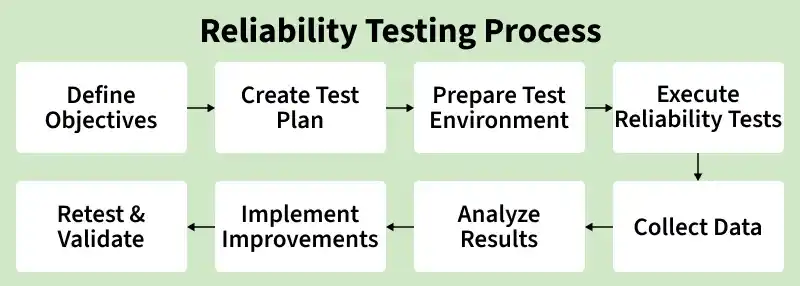
Reliability Testing Process
- **Define Reliability Objectives: Identify reliability goals, performance expectations, and acceptance criteria based on business requirements.
- **Create a Test Plan: Design test scenarios, select testing methods, determine workloads, and define the test environment.
- **Prepare the Test Environment: Set up the hardware, software, tools, and data required for reliability testing.
- **Execute Reliability Tests: Run tests such as load, stress, endurance, and recovery testing to evaluate system behavior.
- **Collect and Measure Data: Record failures, downtime, response times, MTBF, MTTF, and MTTR metrics during testing.
- **Analyze Results: Evaluate the collected data to identify reliability issues, failure patterns, and root causes.
- **Implement Improvements: Fix defects, optimize performance, and enhance system stability based on the analysis.
- **Retest and Validate: Repeat testing to verify that improvements have increased reliability and that objectives are met.
Reliability testing Categories
Reliability Testing is generally divided into three main categories:
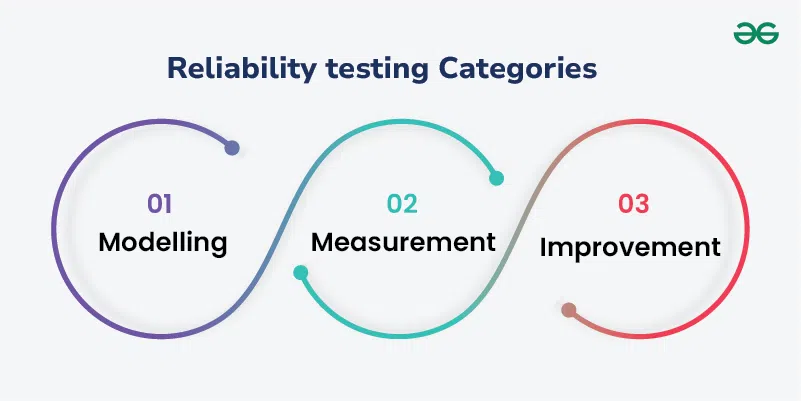
Reliability testing Categories
- **Modelling: Uses mathematical and statistical techniques to predict the reliability and failure behavior of a system before actual testing.
**Example: Estimating the lifespan of a software application based on historical failure data. - **Measurement: Involves executing tests and collecting data to evaluate the actual reliability of the software under different conditions.
**Example: Monitoring system failures and uptime during testing. - **Improvement: Focuses on analyzing reliability issues and implementing changes to enhance system stability and reduce failures.
**Example: Fixing memory leaks or optimizing code to improve long-term performance.
Measurement of Reliability Testing
Measurement is the process of collecting and analyzing data to evaluate how reliably a software system performs under specific conditions. It helps determine the system's failure rate, availability, and overall stability
- **Mean Time Between Failures (MTBF): The average time a repairable system operates successfully between two consecutive failures. It is a key measure of system reliability.
- **Mean Time To Failure (MTTF): The average operating time of a system or component before a failure occurs. It represents the expected time between failures.
- **Mean Time To Repair (MTTR): The average time required to diagnose, fix, and restore a failed system to normal operation.
**Formula:
**MTBF = MTTF + MTTR
Challenges of Reliability Testing
Reliability Testing can be challenging because it requires significant time, resources, and effort to accurately evaluate a system's long-term stability and dependability.
- **Time-Consuming: Reliability testing often requires running tests for extended periods to identify long-term issues.
- **High Cost: Setting up realistic test environments and maintaining testing infrastructure can be expensive.
- **Complex Test Environments: Replicating real-world operating conditions accurately can be difficult.
- **Large Data Requirements: Reliability testing may require large volumes of test data to produce meaningful results.
- **Resource Intensive: Continuous testing consumes considerable hardware, software, and human resources.
- **Difficult Failure Prediction: Some failures occur rarely and may be difficult to reproduce during testing.
- **Changing Requirements: Frequent software updates can affect reliability results and require repeated testing.
- **Specialized Tools Needed: Advanced monitoring and analysis tools are often required to measure reliability metrics effectively.