EventDriven APIs in Microservice Architectures (original) (raw)
Event-Driven APIs in Microservice Architectures
Last Updated : 4 May, 2026
Event-Driven APIs in Microservice Architectures enable microservices to communicate through events rather than direct calls. When something happens in the system, an event is published and other services react to it independently, making the architecture more flexible and resilient.
- Services are loosely coupled, improving maintainability and fault tolerance, and failures in one service don’t immediately impact others.
- Asynchronous event processing enables better scalability and efficient handling of workloads.
Microservice Architecture
Microservice architecture is an approach to system design where a large application is built as a collection of small, loosely coupled, and independently deployable services. Each service, known as a microservice, focuses on a specific business function and can be developed, deployed, and scaled independently of other services.
- Microservices are independent services, each handling a specific business function like authentication, payments, or inventory, and can be developed, deployed, and scaled separately.
- They communicate through lightweight APIs (like HTTP/REST or messaging queues) and often use decentralized data management for better flexibility and scalability.
- This architecture improves autonomy, resilience, and allows different services to use different technologies based on their needs.
Real-World Applications
Real-world examples of Event-Driven APIs are plentiful across various industries and applications. Here are a few notable examples:
**1. E-commerce and Retail
Event-driven systems help online stores and retail businesses respond instantly to customer actions and operational needs.
- **Order Processing: When a customer places an order, an event-driven API can notify inventory management systems to update stock levels, logistics systems to initiate shipping, and accounting systems to process payments.
- **Promotions and Discounts: Events can trigger promotional offers or discounts across various channels based on customer actions or predefined conditions.
**2. Finance and Banking
Financial institutions use event-driven architectures to process transactions and detect issues in real-time.
- **Transaction Processing: Events are generated for each financial transaction, such as deposits, withdrawals, or transfers. These events trigger updates to account balances, transaction histories, and notifications to account holders.
- **Fraud Detection: Real-time events can trigger fraud detection algorithms to analyze transaction patterns and flag suspicious activities for further investigation.
**3. IoT (Internet of Things)
Event-driven APIs allow IoT devices to react to changes and automate processes immediately.
- **Smart Homes: IoT devices generate events for actions like temperature changes, motion detection, or appliance usage. Event-driven APIs can automate responses, such as adjusting thermostat settings or activating security systems.
- **Industrial IoT: Sensors in manufacturing equipment generate events for operational states, maintenance needs, or quality control. Event-driven APIs facilitate real-time monitoring and predictive maintenance.
Importance of APIs in Microservices
APIs (Application Programming Interfaces) are crucial in microservice architectures for several reasons:
- **Communication: APIs provide the means for microservices to communicate with each other. They define the protocols and data formats for exchanging information, enabling services to interact seamlessly.
- **Decoupling: By using APIs, microservices can remain loosely coupled. Changes in one service do not directly impact others as long as the API contracts are maintained, promoting independence and easier maintenance.
- **Scalability: APIs allow microservices to scale independently. Services can be deployed, updated, and scaled without affecting other parts of the system, enhancing overall scalability and resource optimization.
- **Reusability: Well-designed APIs can be reused across different services and applications, reducing duplication of effort and promoting consistency in how business functions are implemented and accessed.
- **Evolvability: APIs enable easier evolution and iteration of microservices. New features can be added, and existing ones can be modified with minimal disruption to the overall system, supporting continuous delivery and deployment practices.
Event-Driven Architecture
Event-Driven Architecture (EDA) is a design pattern where system flow is driven by events like user actions or system messages. Instead of direct requests, components communicate by producing and consuming events to trigger actions. This enables loose coupling and efficient handling of changes across the system.
- This approach promotes loose coupling between components, as they don’t need to know each other's detailed implementation but only the structure and meaning of events they produce or consume.
- Event-driven systems often employ event brokers or message buses to manage the distribution of events and ensure reliable delivery to interested parties.
- This architecture enhances scalability, flexibility, and responsiveness, making it well-suited for real-time applications, complex workflows, and systems that need to integrate diverse and distributed components efficiently.
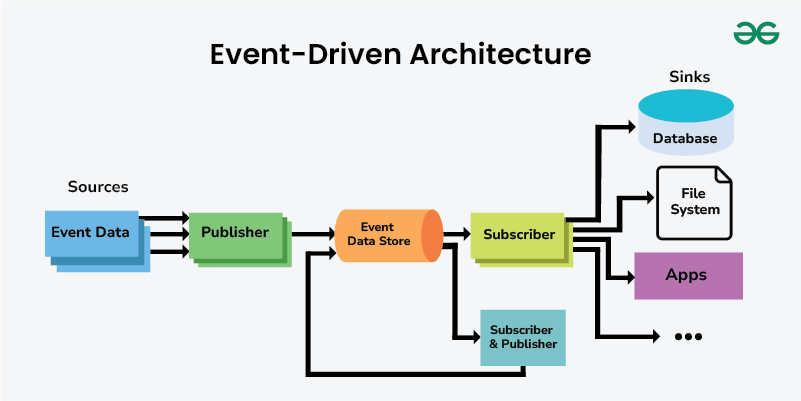
Event-Driven Architecture
Event-Driven APIs
Event-driven APIs enable communication between services using events instead of direct requests. Components publish events, and others subscribe to react to them, supporting loose coupling in event-driven systems.
- In this model, components can publish events when certain actions or state changes occur, and other components can subscribe to those events to react accordingly.
- This asynchronous communication style allows for decoupling between producers (components generating events) and consumers (components reacting to events), promoting scalability, flexibility, and resilience within the system.
- Event-Driven APIs often rely on message brokers or event buses to manage event distribution and ensure reliable delivery to interested parties.
Key Components of Event-Driven APIs
Components of Event-Driven APIs in system design include:
- **Events: These are the core units of information exchanged in an event-driven architecture. Events represent meaningful occurrences or state changes within the system, such as user actions, updates to data, or system alerts.
- **Event Producers: Components or services responsible for generating and emitting events. They encapsulate the logic that detects and triggers events based on specific conditions or actions within the system.
- **Event Consumers: Components or services that subscribe to and process events emitted by producers. Consumers react to events by executing predefined actions, such as updating data stores, triggering workflows, or sending notifications.
- **Event Brokers or Message Brokers: Middleware components that act as intermediaries between producers and consumers. They manage the routing, delivery, and persistence of events, ensuring reliable communication even when producers and consumers operate at different speeds or scales.
- **Event Schema and Contracts: Defined structures or schemas that describe the format and content of events exchanged between components. Establishing clear event schemas ensures consistency and interoperability across different parts of the system.
- **Subscriptions and Topics: Mechanisms used to manage the relationship between event producers and consumers. Subscriptions define which events a consumer is interested in receiving, while topics categorize events based on their type or source, facilitating efficient event routing and filtering.
- **Error Handling and Retry Mechanisms: Strategies implemented to handle failures or disruptions in event processing. This includes mechanisms for retrying event delivery, handling duplicate events, and managing exceptions that may occur during event consumption.
Design Patterns for Event-Driven APIs
Design patterns for Event-Driven APIs in system design provide structured approaches to address common challenges and optimize the implementation of event-driven architectures. Here are several key design patterns relevant to Event-Driven APIs:
- **Publish-Subscribe: This pattern involves producers (publishers) broadcasting events to multiple consumers (subscribers) interested in those events. It promotes loose coupling, as publishers and subscribers are unaware of each other's existence. Implementations often use a message broker to manage subscriptions and event delivery.
- **Event Sourcing: In this pattern, the state of an application is determined by events that have occurred. Instead of storing current state, applications store a sequence of events that can be replayed to rebuild state. This pattern is valuable for auditing, versioning, and rebuilding application state.
- **CQRS (Command Query Responsibility Segregation): CQRS separates read and write operations into distinct services. Write operations, commands trigger events that update state, while read operations (queries) retrieve data from optimized read models. This pattern enhances scalability and performance by tailoring data models to specific use cases.
- **Saga Pattern: Useful for managing long-lived transactions across multiple services, the Saga pattern orchestrates a sequence of local transactions, each triggered by an event. If a transaction fails, compensating actions (reverse transactions) are executed to maintain consistency.
- **Event-Driven Choreography: In contrast to centralized orchestration, choreography allows services to communicate and collaborate through events directly. Each service reacts to events it receives, coordinating actions across the system without a central controller.
- **Event Collaboration: This pattern emphasizes collaboration among services through shared events. Services emit events that other services might use to enrich their own behavior or data, fostering modularity and flexibility.
- **Event Versioning: Ensures compatibility between producers and consumers as event schemas evolve. Techniques such as schema evolution, backward compatibility, and versioned APIs help manage changes in event structure over time.
- **Event-Driven Microservices: Combines microservice architecture with event-driven patterns, emphasizing autonomous services that communicate through events. This approach enhances scalability, resilience, and agility by minimizing direct dependencies and promoting asynchronous communication.
Implementation of Event-Driven APIs
Implementing Event-Driven APIs in system design involves several key steps and considerations to ensure effective communication, scalability, and reliability within a distributed architecture. Here’s a structured approach to implementing Event-Driven APIs:
Step 1: Identify Events and Event Sources
Determine the key actions or state changes in your system that should trigger events.
- Examples include user registration, order placement, or inventory updates.
- Identify the components or services responsible for emitting these events.
Step 2: Define Event Schemas
Ensure events are structured consistently for easy processing and interoperability.
- Define the data format and content of each event.
- Include details like event ID, timestamp, and source information for auditing and tracking.
Step 3: Choose an Event Broker or Message Bus
Select a system to manage event distribution and routing efficiently.
- Examples: Apache Kafka, RabbitMQ, AWS SNS/SQS.
- Configure topics or channels to categorize and route events based on type or source.
Step 4: Implement Event Producers
Develop components that generate events based on triggers or actions.
- Integrate event publishing logic into your application components.
- Ensure events are correctly emitted to the chosen message broker.
Step 5: Implement Event Consumers
Create components that receive and handle relevant events from the broker.
- Implement logic to react to events, such as updating databases, triggering workflows, or sending notifications.
Step 6: Ensure Reliability and Consistency
Implement mechanisms to handle delivery failures and ensure correct processing.
- Use retry policies and dead-letter queues to handle failures.
- Ensure idempotency to prevent issues from duplicate event deliveries.
Step 7: Monitor and Manage Event Flows
Track and optimize event throughput and system performance.
- Use monitoring tools to track latency, throughput, and system health.
- Employ logging and metrics to diagnose issues and optimize workflows.
Step 8: Handle Event Versioning and Evolution
Prepare for changes in event structures without breaking consumers.
- Establish schema versioning practices.
- Ensure backward compatibility when modifying event schemas.
Step 9: Secure Event Communication
Protect events and data during transmission and access.
- Implement authentication, authorization, and encryption.
- Use access controls to restrict sensitive event access.
Step 10: Scale and Optimize Event-Driven Architecture
Design your system to handle growth and high event volumes.
- Distribute event processing across multiple instances or services.
- Optimize workflows to reduce latency and maximize throughput.
Step 11: Testing and Validation
Verify that your event-driven system works reliably under all conditions.
- Conduct unit, integration, and end-to-end testing of event flows.
- Test event handling under high volumes and failure scenarios.
Impact on Performance and Scalability
Event-Driven APIs in microservices improve performance and scalability by efficiently handling workloads and maintaining responsiveness through asynchronous processing, partitioning, load balancing, and horizontal scaling.
- **Asynchronous Communication: Enables independent service interaction, improving responsiveness and reducing bottlenecks while allowing non-blocking processing.
- **Scalability (Partitioning): Distributes events across partitions to support parallel processing and horizontal scaling of consumers.
- **Load Balancing: Evenly distributes event workloads across multiple consumers to ensure efficient resource utilization.
- **Backpressure Handling: Controls event flow to prevent overload and maintain system stability during high traffic.
- **Optimized Processing: Improves performance by reducing processing time and using parallelism or concurrency.
- **Horizontal Scaling: Supports scaling by adding more service instances to handle increasing workloads.