Load Balancing Vs Failover (original) (raw)
Last Updated : 2 May, 2026
Load balancing and failover ensure system reliability and smooth performance by managing traffic and handling failures. Load balancing distributes requests, while failover provides backup in case of failure.
- Load balancing spreads traffic across multiple servers to avoid overload
- Failover switches to a backup server to maintain continuous service
Load Balancing
Load balancing is a technique used to distribute incoming network or application traffic across multiple servers to ensure no single server is overloaded. This improves performance, reliability, and availability of applications.
- It helps in handling high traffic efficiently.
- It ensures better resource utilization and fault tolerance.
**Example: An e-commerce website during a sale receives thousands of users at once. A load balancer distributes these requests across multiple servers so that no single server crashes and users experience fast response times.
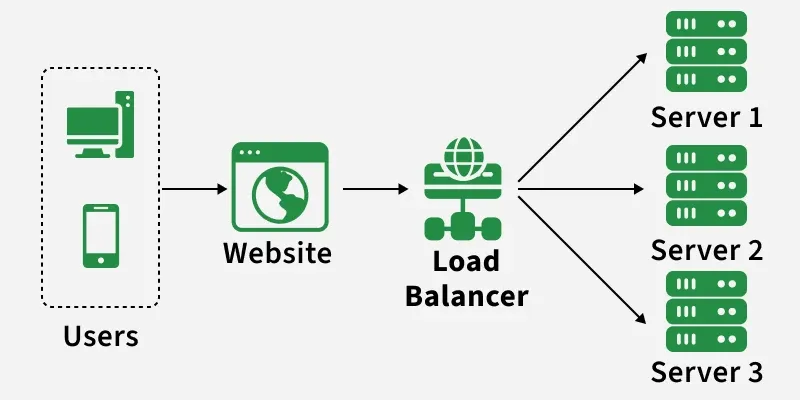
Advantages
Load balancing improves system performance, reliability, and scalability by efficiently distributing traffic.
- Distributes load evenly across servers to reduce stress and improve response times while handling increasing traffic efficiently.
- Automatically redirects traffic from failing servers to healthy ones, reducing downtime and ensuring high availability.
- Supports easy scalability by adding more servers and improves security by blocking malicious traffic before it reaches servers.
Disadvantages
Load balancing introduces additional complexity, cost, and dependency in the system.
- Requires careful setup and continuous monitoring to ensure proper functioning and quick issue resolution.
- If the load balancer fails, it can block access to all servers unless backup systems are in place.
- Can be costly due to additional tools, infrastructure, and maintenance requirements.
Failover
Failover is a mechanism that automatically switches traffic or operations to a backup system when the primary system fails, ensuring continuous service availability.
- It provides high availability by quickly activating standby resources.
- It minimizes downtime during system failures.
**Example: In an online banking system, if the main server goes down, the failover system automatically switches users to a backup server so transactions can continue without interruption.
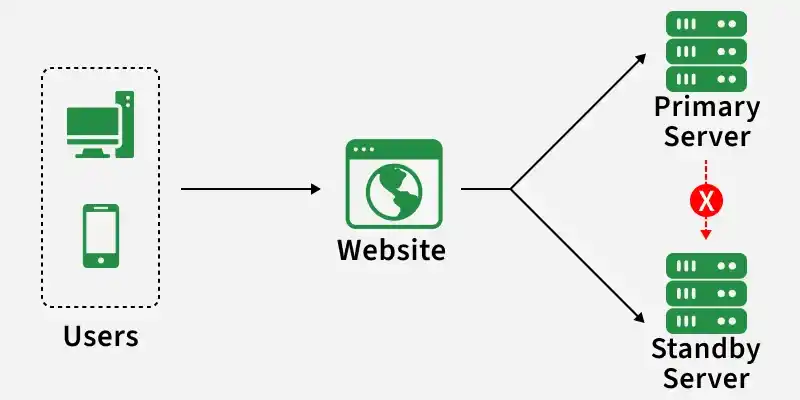
Failover
In the Diagram
- Users send requests to the website, which first goes to the primary server under normal conditions.
- If the primary server fails (shown with cross), the system detects it and automatically switches to the standby server.
- The standby server then takes over and continues handling requests, ensuring no interruption in service.
Advantages
Failover improves system availability by ensuring backup resources take over during failures.
- It keeps services running smoothly by switching to a backup system if the main one fails.
- It reduces downtime by smoothly switching to backup resources, so services stay available.
- Usually easy to set up than load balancing systems, especially for ensuring backup.
Disadvantages
Failover focuses on availability but does not improve performance or traffic distribution.
- Failover switches to a backup server if needed but doesn’t handle or distribute traffic, so it doesn't improve performance
- When switching to a backup server, there might be a short delay that could cause small disruptions.
- Keeping backup systems can be expensive and might waste resources that aren’t used much.
Differences between Load Balancing and Failover
Below are the differences between Load Balancing and Failover:
| Load Balancing | Failover |
|---|---|
| Distributes incoming traffic across multiple servers | Switches to a backup server or system when the primary fails |
| It's aims to optimize performance and resource utilization | It's focuses on maintaining service availability during failures |
| It Improves scalability by adding more servers as needed | It provides redundancy by having backup systems ready |
| It is easily can lead to complex configuration and management | Generally simpler to implement but less about load distribution |
| Can create a single point of failure if the load balancer fails | Reduces downtime by switching to backup but can have some delay |
| Needs regular checking and updating. | Involves maintaining backup systems, which can be costly |
| Helps balance load and avoid server overload | Ensures continuity but doesn't manage load across systems |
| Typically involves higher infrastructure costs | May cost extra to keep unused backup systems running |