Monotonic Reads Consistency (original) (raw)
Last Updated : 23 Jul, 2025
Accessing and managing data efficiently is crucial. Monotonic Reads Consistency offers a streamlined approach to data access, ensuring simplicity and improved performance. By prioritizing monotonic reads, where data retrieval never regresses in time, users experience a consistent view of the database. This method eliminates the complexities of dealing with inconsistent data versions, enhancing reliability and ease of use. With monotonic reads, accessing data becomes smoother, leading to better user experiences and optimized system performance. This article explores the significance of monotonic reads consistency in simplifying data access and improving overall efficiency.
Important Topics to Understand Monotonic Reads Consistency
- What is Monotonic Reads Consistency?
- Importance of Monotonic Reads Consistency in System Design
- How do Monotonic Reads Consistency Works?
- Implementation Strategies of Monotonic Reads Consistency
- Challenges of Monotonic Reads Consistency
- Real-World Examples of Monotonic Reads Consistency
- Design Principles for Ensuring Monotonic Reads Consistency
What is Monotonic Reads Consistency?
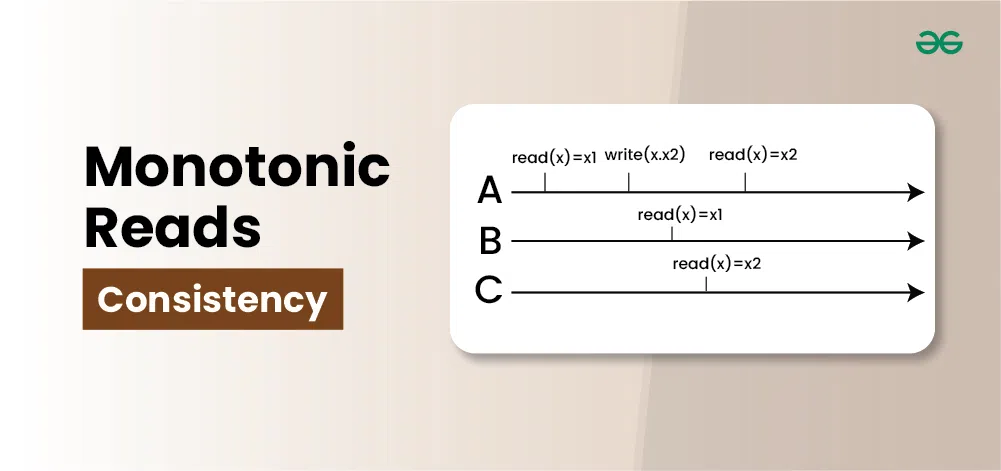
In system design, Monotonic Reads Consistency is a principle that ensures data consistency by guaranteeing that once a client observes a particular state of data, it will never see an older state in subsequent reads. This means that data accessed by a client will always appear to be moving forward in time, never regressing to an earlier state.
- This consistency model simplifies data access and improves predictability by eliminating the possibility of observing outdated or inconsistent data.
- It's particularly valuable in distributed systems where multiple clients might be accessing and updating the same data concurrently.
- By enforcing monotonic reads, system designers can enhance reliability and streamline data access, leading to improved performance and user experiences.
Importance of Monotonic Reads Consistency in System Design
Monotonic Reads Consistency holds significant importance in system design for several reasons:
- **Predictable Behavior: By guaranteeing that once a client reads a particular state of data, it will never see an older state in subsequent reads, monotonic reads consistency ensures predictable behavior in the system. This predictability simplifies the design process and reduces the likelihood of unexpected outcomes or errors.
- **Simplified Data Access: Monotonic reads eliminate the need for complex mechanisms to handle inconsistencies in data versions. Clients can rely on the assurance that the data they access is always moving forward in time, simplifying data access and reducing the complexity of client-side code.
- **Improved Reliability: In distributed systems where multiple clients may be accessing and updating data concurrently, ensuring consistency is paramount for reliability. Monotonic reads consistency helps maintain the integrity of the data by preventing clients from observing outdated or inconsistent states, thus enhancing overall system reliability.
- **Optimized Performance: By providing a consistent view of the database without the overhead of handling inconsistent data versions, monotonic reads consistency can contribute to optimized system performance. Reduced complexity in data access mechanisms and fewer opportunities for conflicts can lead to faster response times and improved throughput.
- **Enhanced User Experience: Consistent and reliable data access translates to a better user experience. Users can trust that the information they retrieve from the system is accurate and up-to-date, leading to increased satisfaction and confidence in the system's functionality.
How do Monotonic Reads Consistency Works?
Monotonic read consistency works by guaranteeing that once a client observes a particular state of data, it will never see an older state in subsequent reads. Here's how it typically operates:
- **Initial Read: When a client first accesses a piece of data, it observes a specific version or state of that data.
- **Subsequent Reads: Any subsequent reads by the same client will always return data that is as recent as or newer than the previously observed state. In other words, the client's view of the data never regresses to an earlier state.
- **Data Updates: If updates occur to the data between the client's reads, those updates will be reflected in subsequent reads. However, the client will never see a version of the data that predates its initial observation.
- **Consistency Guarantee: This consistency model provides a guarantee of monotonicity, ensuring that clients always perceive the data as progressing forward in time. Even in distributed systems with multiple clients accessing and updating the data concurrently, monotonic reads consistency ensures a consistent and predictable view of the database.
- **Implementation: Achieving monotonic reads consistency often involves mechanisms such as versioning, timestamps, or transactional boundaries to track and enforce the order of data updates and reads.
Implementation Strategies of Monotonic Reads Consistency
- **Versioning: Assign version numbers to data updates. Each read operation checks and records the version number.
- **Timestamps: Attach timestamps to data updates. Each read operation considers the timestamp of the last read and ensures future reads have equal or newer timestamps.
- **Logical Clocks: Use logical clocks (e.g., Lamport clocks) to order events in a distributed system. Clients track the highest logical clock value seen.
- **Session Guarantees: Maintain session consistency by tying client interactions to a session context that tracks data versions or timestamps.
Challenges of Monotonic Reads Consistency
- **Distributed Systems Complexity: Ensuring monotonic reads in distributed systems requires synchronization across multiple nodes, which can be complex and resource-intensive.
- **Performance Overhead: Tracking versions or timestamps and ensuring they are up-to-date can introduce additional latency and computational overhead.
- **Network Partitions: During network partitions, ensuring consistent views of data can be challenging as nodes might not be able to communicate updates effectively.
- **Concurrency Control: Managing concurrent updates and ensuring that clients do not see stale data requires sophisticated concurrency control mechanisms.
- **State Management: Maintaining the state of the last read version or timestamp for each client session can be resource-intensive, especially in systems with many clients.
Real-World Examples of Monotonic Reads Consistency
- **Cassandra: Implementation: Cassandra, a distributed NoSQL database, offers tunable consistency levels, including options that can ensure monotonic reads through mechanisms like read repair and lightweight transactions. Social media platforms where user activity feeds need to reflect the latest interactions without showing older states.
- **Amazon DynamoDB: DynamoDB provides eventual consistency by default but can be configured for stronger consistency models, including monotonic reads using conditional writes and consistent reads. E-commerce platforms where inventory data must consistently reflect the latest stock levels to avoid overselling.
- **Google Cloud Spanner: Cloud Spanner offers strong consistency guarantees, including monotonic reads, by using synchronized clocks (TrueTime) to order transactions. Financial applications where transaction histories must reflect a consistent and non-decreasing order of operations.
- **Apache HBase: HBase, a distributed database that runs on top of the Hadoop ecosystem, uses timestamps to ensure that clients always read the most recent data available. Real-time analytics systems where time-series data must reflect a consistent progression of events.
Design Principles for Ensuring Monotonic Reads Consistency
Designing systems to ensure monotonic reads consistency involves adhering to several key principles. These principles guide the development and maintenance of distributed systems to guarantee that once a client observes a particular state of data, they will not see an older state in subsequent reads. Here are the main design principles:
- **Data Versioning and Timestamps
- **Versioning: Assign unique, incrementing version numbers to data updates. Each read operation should return the latest version number it has seen.
- **Timestamps: Use timestamps to mark data updates. Ensure clients track the latest timestamp they have read, and only return data with timestamps equal to or newer than this value.
- **Session Guarantees
- **Session Tracking: Maintain session state that tracks the highest version or timestamp observed by the client within a session.
- **Sticky Sessions: Use sticky sessions where a client consistently interacts with the same server or node, which simplifies tracking the latest read state.
- **Quorum Reads and Writes
- **Quorum-Based Consistency: Use quorum reads and writes to ensure that a majority of nodes agree on the data state, reducing the likelihood of stale reads.
- **Conflict Resolution and Merging
- **Conflict-Free Replicated Data Types (CRDTs): Use CRDTs that inherently resolve conflicts in distributed systems, ensuring that all nodes eventually converge on the same state.
- **Consistent Hashing and **Data Partitioning
- **Consistent Hashing: Distribute data across nodes in a manner that minimizes the movement of data and ensures consistent access patterns.
- **Data Partitioning: Partition data logically and ensure that partitions are consistently managed to maintain monotonic reads.
- **Replication and Synchronization
- **Synchronous Replication: Ensure data is synchronously replicated across nodes so that updates are immediately visible to all clients.
- **Leader-Follower Model: Use a leader-follower replication model where the leader handles writes and propagates updates to followers, ensuring consistency.
- **Client-Side Mechanisms
- **Read Tracking: Implement client-side mechanisms to track the versions or timestamps of data they have read, ensuring future reads respect these values.
- **Monitoring and Auditing
- **Consistency Checks: Regularly monitor and audit the system to detect and correct any inconsistencies that might violate monotonic reads.
Conclusion
Monotonic reads consistency is essential for reliable and predictable data access, especially in distributed systems. By guaranteeing that once data is read, subsequent reads won't show older versions, it simplifies data handling and enhances system performance. Implementing strategies like versioning, timestamps, session tracking, and quorum-based reads ensures this consistency. While challenges exist, such as managing complexity and performance overhead, the benefits in terms of reliability and user experience are significant. Ensuring monotonic reads consistency is a crucial aspect of effective system design, leading to smoother and more dependable data interactions.