Primary Scalability Bottlenecks in System Design (original) (raw)
Last Updated : 17 Apr, 2026
A bottleneck in a system is a point where data flow or processing gets restricted, reducing overall performance. It occurs when one component becomes slower than others and cannot efficiently handle incoming requests. This leads to reduced throughput, scalability issues, and delays under increased workload.
- Bottlenecks limit system performance and prevent efficient handling of high traffic, often becoming visible during peak load conditions.
- They can occur in databases, networks, servers, or code, and resolving one bottleneck may sometimes expose another in the system.
**Example: If a web application has a fast server but a slow database, the database becomes the bottleneck because it cannot process queries quickly when many users access the system.
Types of Bottlenecks
Types of bottlenecks are different points in a system-such as database, network, server, code, storage, authentication, or third-party services—where limited capacity restricts performance and scalability.
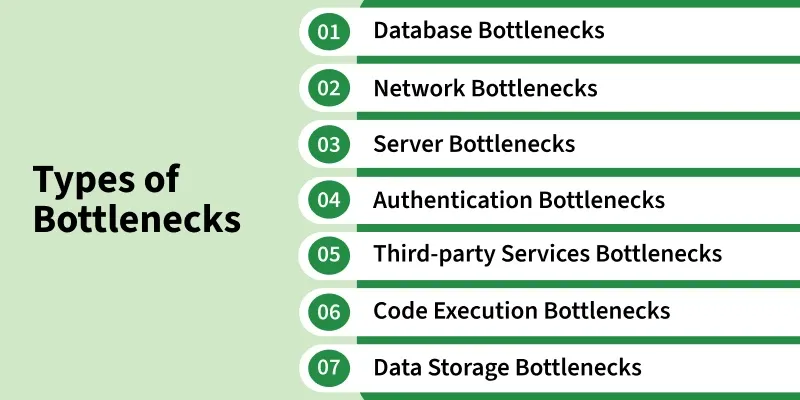
**1. Database Bottlenecks
Many programs rely heavily on databases, which are also frequently the main cause of scalability issues. Performance restrictions in a database system that can limit its capacity to process requests and transactions effectively are known as database bottlenecks.
- An application's or system's overall performance, scalability, and responsiveness can all be seriously affected by these obstacles.
- Database bottlenecks happen when problems like slow queries, insufficient hardware resources, or inadequate indexing cause the database to become a performance bottleneck.
**Example: If an e-commerce website experiences a surge in traffic during a holiday sale, slow database queries can lead to delayed order processing, frustrating users, and potentially resulting in abandoned carts.
**2. Network Bottlenecks
Network bottlenecks can significantly hinder scalability in a distributed system. It happen when a certain resource or component restricts a computer network's capacity or performance, which slows down or degrades the system's overall performance.
- They can occur at various points in a network topology and can severely impact the efficiency and responsiveness of an application or system.
- These bottlenecks occur due to bandwidth limitations, high latency, packet loss, congestion, or inefficient network topology.
**Example: A video streaming service may encounter network bottlenecks if it doesn't have adequate content delivery infrastructure. Users may experience buffering or low-quality video streams when too many requests strain the network.
**3. Server Bottlenecks
When the application server is unable to manage more requests or concurrent connections, a server bottleneck occurs. Limitations in server resources, including CPU, RAM, or disk I/O, may be the cause of this.
- Consider a social media site where an unexpectedly popular post causes a huge surge in users attempting to access it at once.
- If the server lacks the necessary resources to handle this surge, it may become unresponsive, degrading the user experience.
**Example: You have a web application that allows users to upload and process images. As the user base grows, the server begins to experience performance issues. The server's CPU becomes a bottleneck because the image processing algorithm used by the application is computationally intensive, causing delays in image processing and overall sluggishness of the application.
**4. Authentication Bottlenecks
Authentication is essential for securely verifying user identities and controlling access to system resources. An authentication bottleneck occurs when this process becomes slow or overloaded, affecting overall system performance and user experience.
- Caused by high volumes of login requests or inefficient authentication mechanisms.
- Can result from limited infrastructure or poorly optimized authentication workflows.
**Example: An e-banking application may experience authentication bottlenecks during peak usage times, causing login delays if the authentication system cannot keep up with the volume of incoming requests.
**5. Third-party Services Bottlenecks
For many features, such as cloud storage, geolocation, and payment processing, modern apps frequently rely on third-party services, which limits a system's overall performance, dependability, and scalability.
- A number of things, such as the third-party service's availability, response latency, rate limitations, or API modifications, might cause these bottlenecks.
- Identifying and addressing third-party services bottlenecks is crucial for designing systems that can provide consistent and responsive user experiences.
**Example: If a ride-sharing app depends on an external mapping service and that service experiences downtime or slow response times, it can affect the app's performance and scalability.
**6. Code Execution Bottlenecks
In system design, code execution bottlenecks are circumstances in which the design, writing, or execution of software code affects a computer system's performance and efficiency. These bottlenecks can be caused by a variety of factors, including poor use of system resources, high CPU utilization, and slow reaction times.
**Example: Inefficient algorithms for rendering complex data in a web application's front-end code can lead to slow page loads and lower user satisfaction. Detecting and optimizing these code bottlenecks is crucial for achieving scalability.
**7. Data Storage Bottlenecks
When a system's storage mechanisms and infrastructure start to limit its performance, capacity, or dependability, it is said to have a data storage bottleneck. These bottlenecks can impact the overall functionality and efficiency of the system.
- This might include slow access to file storage systems or inefficient utilization of disk space, leading to issues such as slow data access, data loss, or scalability problems.
- Identifying and addressing data storage bottlenecks is critical for designing systems that can handle data effectively.
**Example: Consider a cloud-based file-sharing platform; if the underlying file storage system struggles to handle an increasing number of files or doesn't provide efficient data retrieval, it can impede the platform's ability to scale gracefully.