Stateless and Stateful Systems in System Design (original) (raw)
Last Updated : 30 Apr, 2026
In system design, stateless systems handle each request independently, making them highly scalable but without memory of past interactions. Stateful systems retain client state, providing continuity and data integrity but adding complexity to scalability.
Stateless Systems
In stateless systems, the server does not store client state between requests. Each request is processed independently, and any required data must be included in the request or retrieved from external storage (such as databases or caches).
**Example: A REST API for a mobile app where each request includes an authentication token (JWT). The server verifies the token and processes the request without storing session information.
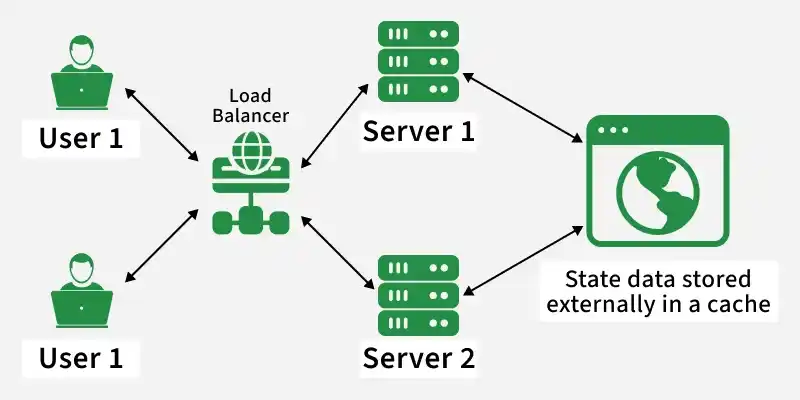
stateless
Characteristics
Statelessness in system design is characterized by several key features:
- **Independence: Each request is self-contained and processed without relying on past interactions, simplifying system design.
- **Scalability: Easy to scale horizontally since no shared state needs to be managed across servers.
- **Fault Tolerance: Requests can be routed to other servers, but reliability depends on retries and consistent backend state.
- **State Transfer: Clients send required state (e.g., tokens) with each request, adding slight overhead.
- **Protocols: Commonly use HTTP, where each request carries all necessary information.
Stateless Architecture Patterns
Design methods that highlight the statelessness of system components are known as stateless architecture patterns. Systems that are scalable, robust, and simple to manage can be created due to these patterns.
- **Layered Architecture: Divides the system into independent layers, promoting modularity, separation of concerns, and reusability.
- **Microservices: Splits an application into stateless services, each handling a specific business function, enabling scalability and easy deployment.
- **Serverless Computing: Uses stateless, event-driven functions that scale automatically, letting developers focus on code rather than infrastructure.
- **Event-Driven Architecture: Components communicate asynchronously via events without shared state, supporting loose coupling and responsiveness.
- **Immutable Infrastructure: Deploys fresh, unchangeable instances each time, removing state management and ensuring resilience and consistency.
Use Cases
Stateless systems are widely used in scenarios where scalability, simplicity, and independent request processing are important.
- **Web APIs: Stateless systems are commonly used for building RESTful APIs. Each HTTP request contains all the information needed for the server to process it.
- **Content Delivery Networks (CDNs): CDNs often use stateless caching servers to serve static content to users. Since each request is independent, caching servers can quickly retrieve and deliver cached content without the need for maintaining state.
- **Serverless Computing: Serverless architectures rely on stateless functions that execute in response to events or triggers.
- **Authentication and Authorization: Stateless authentication mechanisms, such as JSON Web Tokens (JWT), are commonly used to authenticate and authorize users in web applications.
- **Load Balancers: Often designed to be stateless for scalability, but may maintain state (e.g., sticky sessions or connection tracking) depending on configuration.
Challenges
Stateless systems simplify scaling but introduce challenges in managing continuity, security, and complex workflows.
- **Maintaining Context: Since the server does not retain client data, managing multi-step workflows requires passing context in each request or relying on external storage.
- **Handling State Transfer: All required data must be sent with every request, increasing payload size and adding network overhead.
- **Security Concerns: Tokens or sensitive data must be carefully secured (e.g., encryption, HTTPS) to prevent misuse or leakage.
- **Limited Support for Transactions: Handling complex, multi-step operations across requests is difficult and often requires additional coordination mechanisms.
Stateful Systems
Stateful systems keep track of client information between requests. The server remembers session data, preferences, and other details to provide a continuous and personalized experience.
**Example: An online shopping website where the server stores a user’s login session and shopping cart. If the user adds items to the cart, the server remembers those items during the session.
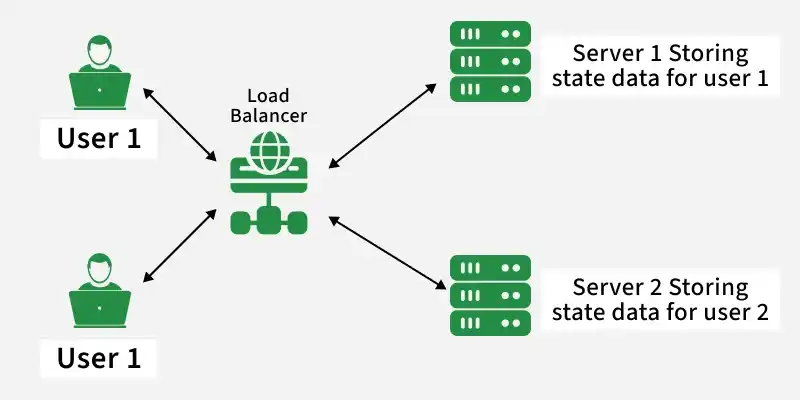
Stateful
Characteristics
The characteristics of statefulness in system design encompass several key aspects:
- **Persistence of State: Retain user sessions, application context, or ongoing process data across interactions.
- **Complex Workflows: Ideal for multi-step operations that rely on past interactions.
- **Data Consistency: Maintain a single source of truth to prevent inconsistencies in shared data.
- **Scalability Challenges: Scaling requires careful state management, partitioning, and synchronization.
- **Failure Recovery: Use checkpointing, replication, and failover to restore state after crashes.
Stateful Architecture Patterns
Stateful architecture patterns are design approaches that focus on keeping track of information (state) within a system. These patterns are useful when you need to remember data across different interactions or transactions.
- **Session State Management: Stores user sessions (login, preferences, cart) on the server using memory, databases, or distributed caches.
- **Database-Centric Architecture: Keeps all state in the database; apps read/write to track state, common in monolithic or client-server apps.
- **Stateful Replication: Copies state across servers for high availability and fault tolerance using methods like primary-backup or quorum replication.
- **Stateful Microservices: Some microservices maintain state for sessions, caching, or workflows that require memory across interactions.**Saga Pattern: Manages long-running distributed transactions with compensating actions to ensure consistency across multiple services.
Use Cases
Stateful systems are used in scenarios where maintaining context, continuity, and consistent data across interactions is essential.
- **User Sessions: Store login details, preferences, and shopping carts on the server to provide a continuous and personalized user experience across multiple requests.
- **Databases: Maintain persistent data to ensure consistency, durability, and reliable data retrieval for applications over time.
- **Distributed Systems Coordination: Use stateful components like Raft or Paxos to manage coordination, leader election, and consistency across distributed nodes.
- **Real-time Collaboration: Keep shared state updated to synchronize changes instantly in applications like collaborative editors, chat systems, or live dashboards.
Challenges
Stateful systems provide continuity and consistency but introduce complexity in scaling, management, and reliability.
- **Scalability Complexity: Scaling is harder because state must be shared or synchronized across servers, requiring techniques like replication or partitioning.
- **Resource Management: Maintaining sessions and connections consumes more memory and system resources, increasing operational overhead.
- **Consistency Challenges: Keeping data consistent across distributed systems is difficult and often requires coordination mechanisms or consensus algorithms.
- **Security Risks: Storing sensitive session data requires strong security measures like encryption, authentication, and access control.
Combining Stateless and Stateful Components
Combining stateless and stateful components within a system is a common architectural practice that leverages the strengths of each approach to achieve a balance of scalability, resilience, and functionality.
1. Stateless Frontend, Stateful Backend
- The frontend components, such as web servers or client applications, can be designed as stateless to maximize scalability and simplify deployment.
- Backend services, responsible for handling business logic and data management, can be stateful.
2. Stateless Microservices with Stateful Data Stores
- Microservices can be designed as stateless, allowing them to scale independently and handle requests in a distributed environment.
- Stateful data stores, such as databases or caching layers, can be used to manage and maintain persistent state.
- APIs can be designed as stateless to facilitate horizontal scaling and simplify communication between clients and servers.
- Stateful components, such as authentication and authorization services, manage user sessions and access tokens to maintain security and enforce access control policies.
4. Event-Driven Architecture with Stateful Processors
- Event-driven architectures leverage stateless event producers and consumers to decouple components and facilitate asynchronous communication.
- Stateful event processors or workflow engines can be used to manage long-running processes, maintain state, and coordinate interactions between components.
5. Combining Stateless and Stateful Components in Workflows
- Complex workflows or transactions may involve a combination of stateless and stateful components.
- For example, a user registration process might begin with stateless API calls to validate input and initiate registration, followed by interactions with stateful components to store user data and manage session state.