System Design of Airline Management System (original) (raw)
Last Updated : 31 Mar, 2026
Booking a flight online (airline websites) is quick and seamless process, just a few clicks and you’re done. But is it equally simple to build the massive systems that power these bookings, manage thousands of flights daily, and ensure smooth operations across the globe?
- Behind the scenes, the system must handle millions of concurrent users, real-time seat availability, and dynamic pricing.
- It also needs to ensure high reliability, prevent overbooking, and coordinate across multiple airlines, airports, and payment systems
1. Designing Scalable and Reliable Airline Systems
Airline Management System is a puzzle of interconnected modules. These systems handle millions of transactions per second, integrate third-party services and fault-tolerant even during peak travel seasons. Here we will demonstrate to you how to create an architecture for an airline management system on a big scale.
System Stakeholders and Their Roles
This section identifies the key users of the system and their responsibilities in airline operations.
- **Passengers (for booking and managing travel)
- **Airline staff (for operations like check-in and crew scheduling)
- **Administration (for operations related to admin)
Objectives of the System
This section outlines the primary goals the system must achieve to ensure efficiency, security, and a smooth user experience.
- **Seamless Flight Searching - Allow passengers to easily search for the flights based to their origin, destination, date, and whether they are domestic or international.
- **Efficient Booking Services - This service needs to be enabled so that travelers can easily book, cancel, and alter their tickets online.
- ****Booking and payment security -**The system should be totally safe, including data security and secured payment mechanisms.
- **Enhanced User Experience - The system should have a user interface that is responsive and simple to understand so that everyone can use it.
- **Real time notification - To ensure that passengers are informed, the system must provide real-time flight status updates, such as delays, cancellations, or gate changes. These alerts should be sent by SMS, email, or the app to guarantee prompt access.
2. System Requirements
Designing a robust airline management system requires careful planning and well-defined specifications. By understanding both functional and non-functional requirements, we can ensure seamless operations, security and scalability while balancing constraints for an efficient system.
Functional Requirements
This section describes the core features that the airline system must support.
- Seamless search
- Booking and Cancellation
- Real-time notification updates
- Secure payment
- Admin Panel
Non-Functional Requirements
This section defines the system qualities like performance, scalability, and reliability.
- Not country specific
- Consistent and Partition (CAP theorem)
- Scalable
- Low latency
- Security
Constraints
This section highlights the limitations and conditions under which the system must operate.
- Use limited resources
- OS/Browser friendly
- Fast booking
- Proper authorization
- 24/7 Customer support
3. System Capacity Estimation
Estimating system capacity is crucial for maintaining efficiency and performance. By analyzing cache memory needs and long-term storage requirements, we can ensure smooth operations, scalability, and optimal resource utilization. A well-planned capacity model prevents bottlenecks and keeps the system responsive under heavy usage****.**
Cache Memory Estimation for Daily Operations
In order to ensure good speed and enhance system efficiency, data that is accessed frequently should be kept in cache memory. Thus, it is important to pre-calculate the cache memory which is required for storing flight meta data and user session data.
**Flight information storage
Let's assume there are total 50 flights arrived or depart from the airline. And let's assume the flight record size is 1KB.
1 KB (Flight info size) * 50 flights/day = 50 KB
**User Session data cache
Assuming the total daily active users are 1,00,000 and to store single user session data into cache memory we need 1 KB of storage. We only want to cache the 10% of the active daily visiting users.
1,00,000 searches/day * 0.1 * 1KB/ session = 10,000 KB
**Total cache memory
Flight + User session = 50KB + 10,000KB = 10,050KB = 9.8 MB
Storage Estimation of the System
To monitor the historical data of flights, passengers, and bookings, we must determine how much memory is required. The following calculation provides an overall estimate for the upcoming three years.
**Flight Information Storage
Let's assume there are total 50,000 flights arrived or depart from the airline in the 3 years. And let's assume the flight record size is 1KB.
1 KB (Flight info size) * 50,000 flights in 3 years = 50,000 KB
**User Session Data Cache
Assuming the total users are 10,00,00,000 who visits on the platform and to store single user session data into main memory we need 1 KB of storage.
10,00,00,000 searches * 0.1 * 1KB/ session = 10,00,00,00KB
**Total Main Memory
Flight + User session = 50,000 KB + 1,00,00,000 KB = 1,00,50,000KB ~ 9814 MB
4. High Level Design
The high-level design (HLD) of an airline management system is like a rough sketch of how the whole thing works—showing the main parts and how they connect to handle stuff like searching for flights, booking tickets, and real-time updates. It’s a big-picture guide, not diving into the messy details of code or tech specifics.
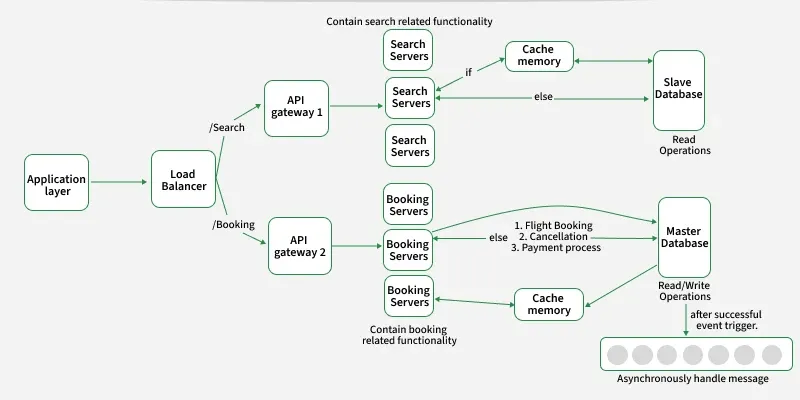
HLD of Airline Management System
System Components
This section describes the key infrastructure components used in the system.
- **CDN: A geographically distributed network of servers that improves reliability and speed of data transfer.
- **Load Balancer: Distributes incoming traffic across multiple servers to handle load efficiently.
- **API Gateway: Acts as an entry point for all client requests and routes them to appropriate microservices.
- **Rate Limiter: Limits request frequency to prevent DDoS attacks and system overload.
- **Microservices: Independent, loosely coupled services handling specific functionalities.
- **Message Queues: Enable asynchronous communication between services and trigger notifications/events.
Working
This section explains how different components interact to process user requests.
- Presentation Layer (User Interfaces) will initially be accessed by the user or administrator via web/mobile interfaces. Where the user is able to access the searching and booking services.
- The user's request will go to the nearest CDN. It sends the response if it has cache information on the request; if not, it sends the request to the load balancer.
- The traffic will be properly managed by the load balancer, which will distribute it equally among each of the horizontally scaled servers.
- The request will first be sent to the API gateway, which determines the incoming request and authenticates the user. Only after that will it be sent directly to the servers.
- The rate limiter controls the number of requests to avoid overwhelming the servers with excessive incoming traffic.
- Now that all the processes have been completed, the API can access the microservices, which currently include the searching, booking services and remainder services.
- When the query pertains to flight searches, it initially retrieves data from the database (We are currently utilizing a Master-slave architecture). At present, for the search service, we utilize the slave database as our sole aim is to carry out read operations.
- If the query pertains to flight bookings, it first retrieves data from the database, sends a notification via a message queue, and provides the user with a confirmation response.
- The metadata linked to searching and booking will now be stored in the cache memory to guarantee low latency.
- Our entire system is now prepared; it is highly scalable, consistent, secure, and has low latency.
5. Low-Level Design
Low-level design (LLD) is a key step in software development, focusing on the core details—how each piece, like classes and functions, gets built to make the system work. It’s like a detailed plan for how every component operates. LLD uses the high-level design (HLD) as a starting point, breaking it down into smaller, specific details.
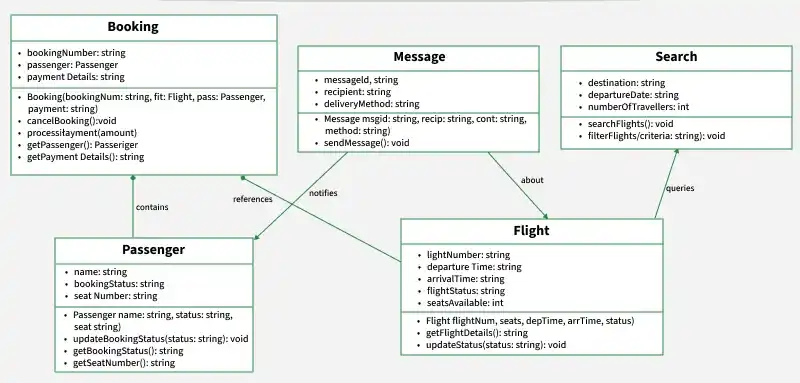
UML - Class Diagram
System Architecture Overview
The class diagram includes five main classes:
- **Flight: Represents a flight with details like flight number, departure time, seat availability, flight status and many more .
- **Passenger: Stores information about the traveler, such as their name and seat number.
- **Booking: It manages the booking process of the system and also linking passengers to flights.
- **Search: Handles flight searches based on user inputs like origin and destination.
- **Remainder: Send the real time notifications and updates to the clients.
Low-Level Working of System Architecture
**Flight Class: This class is all about managing airline flights—it holds key details like the flight number, departure and arrival cities, times, available seats, gate info, and flight status. You can use it to check flight details or update the status, making it super handy for keeping track of flights in an airline system.
Python `
class Flight: def init(self, flightNum, depCity, arrCity, depTime, arrTime, seats, gate): self.flightNumber = flightNum self.departureCity = depCity self.arrivalCity = arrCity self.departureTime = depTime self.arrivalTime = arrTime self.seatsAvailable = seats self.gate = gate self.flightStatus = "Scheduled" # Default status
def getFlightDetails(self):
    return (f"Flight {self.flightNumber}: {self.departureCity} to {self.arrivalCity}, "
            f"Departs: {self.departureTime}, Arrives: {self.arrivalTime}, "
            f"Seats: {self.seatsAvailable}, Gate: {self.gate}, Status: {self.flightStatus}")

def updateStatus(self, status):
    self.flightStatus = status
`
**Passenger Class: This class helps manage passenger details like name, booking status, and seat number. It lets you update booking status, assign a seat, and fetch passenger details whenever needed. A simple way to keep things organized for flight management.
Python `
class Passenger: def init(self, name, booking, seat): self.name = name self.booking = booking self.seatNumber = seat
def updateBookingStatus(self, status):
    self.booking = status

def assignSeat(self, seat):
    self.seatNumber = seat

def getName(self):
    return self.name

def getBookingStatus(self):
    return self.booking

def getSeatNumber(self):
    return self.seatNumber
`
**Booking Class Structure: This class helps manage flight bookings by keeping track of the booking number, passenger, flight details, and payment status. It lets you create, cancel, and update bookings while handling payments easily.
Python `
class Booking: def init(self, bookingNum, flt, passenger, payment): self.bookingNumber = bookingNum self.flight = flt self.passenger = passenger self.paymentDetails = payment
def createBooking(self, flt, passenger, payment):
    self.flight = flt
    self.passenger = passenger
    self.paymentDetails = payment

def cancelBooking(self):
    self.flight = None
    self.passenger = None
    self.paymentDetails = "Cancelled"

def processPayment(self, amount):
    self.paymentDetails = f"Paid: {amount}"

def getBookingNumber(self):
    return self.bookingNumber

def getPassenger(self):
    return self.passenger

def getFlight(self):
    return self.flight

def getPaymentDetails(self):
    return self.paymentDetails
`
**Search Class Structure: This class allows users to search for flights by specifying the origin, destination, departure date, and number of travelers. It enables users to filter results and find the most suitable flight options.
Python `
class Search: def init(self, orig, dest, depDate, travellers): self.origin = orig self.destination = dest self.departureDate = depDate self.numberOfTravellers = travellers
def searchFlights(self, orig, dest, depDate, travellers):
    self.origin = orig
    self.destination = dest
    self.departureDate = depDate
    self.numberOfTravellers = travellers
    return f"Searching flights from {orig} to {dest} on {depDate} for {travellers} travellers"

def filterFlights(self, criteria):
    return f"Filtering flights by {criteria}"
`
**Message Class Structure: This class handles messaging by storing details like message ID, recipient, content, and the delivery method. It lets you send messages and update their content when needed.
Python `
class Message: def init(self, msgId, recip, cont, method): self.messageId = msgId self.recipient = recip self.content = cont self.deliveryMethod = method
def sendMessage(self):
    # Placeholder for sending logic
    return f"Sending message to {self.recipient} via {self.deliveryMethod}: {self.content}"

def updateContent(self, newContent):
    self.content = newContent
`
6. API Routes
APIs are like the traffic controllers of an airline system—they make sure requests flow smoothly between users and the database. From searching flights to managing bookings, each route plays a key role in keeping everything connected and efficient. Let’s break down the required endpoints .
- **GET - /search (Retrieve all available flights)
- **GET /flights/{flightNumber} (Fetch details of a specific flight)
- **POST /admin_flights (Admin Only - Add a new Flight)
- **POST /bookings (Create a new booking)
- **GET /bookings/{bookingNumber} (To retrieve booking details)
- **DELETE /bookings/{bookingNumber} (Cancel a booking)
- **GET - /user/{userId} (Fetch passenger details)
7. Database Design
When dealing with airline systems, keeping track of all the essential data—like passengers, flights, bookings, and payments—is super important. Imagine a system where everything is neatly stored so that users can search for flights, book tickets, manage passenger info, and process payments smoothly.
If airlines and travel agencies build a well-structured database, they can streamline operations and offer a hassle-free booking experience to customers. Consider it the framework that keeps a travel system functioning smoothly in the background!
If you are interested in knowing more about the database design architecture, read this article.
Concurrency Handling
- **Lock Seats During Booking: When a user begins the booking process, the system locks the seat to prevent others from reserving it until the process is finished, thus avoiding overbooking.
- **Check Version Before Confirming: Every flight record contains a version number, which the system verifies prior to booking confirmation to make sure that the seat has not been booked by another user already.
- **Use Safe Transactions: All steps involved in booking (checking seats, reserving, updating) are consolidated into one transaction. This prevents errors by ensuring that they either all succeed or fail together.
- **Reserve Seats Temporarily: When a booking is made, a seat is reserved for 5 minutes. During this time, other users cannot book it, which decreases the likelihood of conflicts.
- **Process Payments Separately: Payments are processed through a queue after seat reservation, which prevents the seat from being locked for an extended period during payment processing and maintains system efficiency.
8. Scalability and Security
In building a robust system that handles both growth in user traffic and sensitive data protection, it's crucial to focus on both scalability and security. Below are five key points that highlight how our system is designed to scale efficiently while ensuring that security remains top-notch.
- **Vertical and Horizontal Scaling
Vertical scaling involves improving the current infrastructure, like upgrading CPUs or adding main memory. However, for optimal scalability, our system uses horizontal scaling by adding more servers to distribute the workload efficiently across the system, ensuring that traffic spikes don't disrupt performance. - **Managing Peak Loads with Load Balancing
To manage high traffic during peak seasons, we’ve implemented load balancing to equally distribute the incoming traffic across horizontal scaled servers which ensures that when lots of users are submitting requests at once, no single server is overloaded and prevents the delays or failures. - **Latency Reduction through Database Design
Our system reduces latency by leveraging a Master-Slave database structure, which ensures fast data retrieval even during network partitions. For non-critical tasks, we utilize an AP(Availability and partition) database like Cassandra, which prioritizes availability and can handle high traffic loads without delays. - **Comprehensive Authentication and Multi-Factor Authentication
Security starts with strong authentication. We use multi-factor authentication (MFA) for all user logins, ensuring that access is tightly controlled. Additionally, all login attempts are logged for auditing, which helps quickly detect and respond to potential security threats. - **Data Encryption and DDoS Protection
For the data encryption AES-256 encryption is used to protect all sensitive data while it is in transit and at rest. Furthermore, to prevent Distributed Denial of Service (DDoS) attacks, we employ a multi-layered defense strategy, including Web Application Firewalls (WAF), rate limiting, and traffic monitoring to keep our system available and secure under pressure.
9. Future Enhancements
The airline management system is built with complete flexibility which allows for future improvements to enhance functionality and user experience. Here are a few planned enhancements we can make in our system so that it become more advance:
- **AI-Powered Recommendations: For future planning, we might look into integrating AI to suggest flights that align with user preferences, such as preferred airlines or travel times. For example, the system could propose a flight on a user’s preferred airline by analyzing past bookings in the Booking table.
- **Advanced Analytics for Admins: We can improve the admin panel by adding analytics dashboards that pull data from the Flight, Booking, and Payment tables to display trends such as popular routes or peak booking times, aiding admins in making more informed decisions.
- **Multi-Language Support: To enhance global accessibility of the system, we plan to include multi-language support in the user interface, enabling users from different regions to interact with it in their native language.