Types of OLAP Systems in DBMS (original) (raw)
Last Updated : 12 Jan, 2026
OLAP is considered (Online Analytical Processing), which is a type of software that helps in analyzing information from multiple databases at a particular time. OLAP is simply a multidimensional data model, and also applies querying to it.
Types of OLAP Servers
- Relational OLAP
- Multi-Dimensional OLAP
- Hybrid OLAP
- Transparent OLAP
Relational OLAP (ROLAP) - Star Schema Based
ROLAP (Relational OLAP) operates on the principle that data can be viewed multidimensionally without being stored in a multidimensional format. It stores data in relational databases and uses SQL queries to perform operations like slicing and dicing by adding "WHERE" clauses.
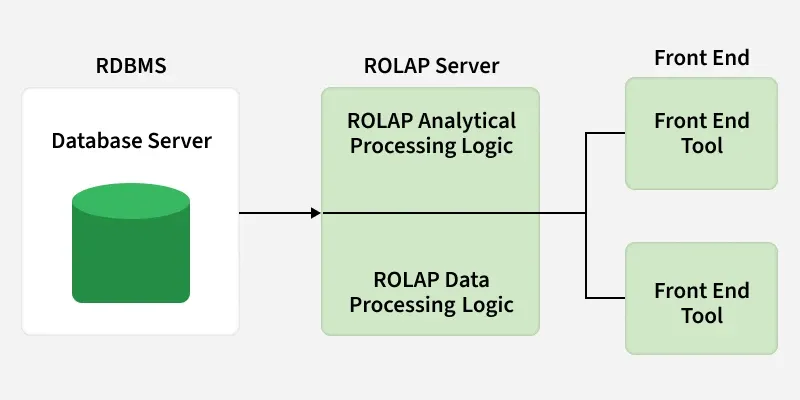
ROLAP
**Note: ROLAP is well-suited for handling large volumes of data and leverages the capabilities of relational database systems.
Multidimensional OLAP (MOLAP) - Cube-Based
MOLAP (Multidimensional OLAP) stores data in a specialized multidimensional array format on disk. Each cell in the array represents a combination of dimension values and holds the corresponding measure (fact) data.
- OLAP operations are performed using the fast random access capabilities of arrays.
- The data is stored in a linear order based on a fixed sequence of dimension traversal, enabling quick retrieval and analysis.
- Unlike ROLAP, which stores only records with non-zero facts, MOLAP defines all possible combinations of dimension values, making its arrays sparse-most cells are empty.
- To manage this and ensure efficient performance, MOLAP uses techniques like advanced indexing and hashing for fast data access.
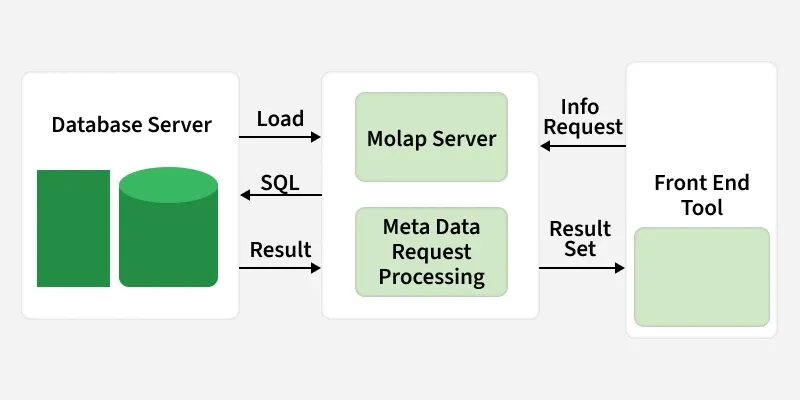
MOLAP
**Note: MOLAP cubes offer quick data retrieval, are ideal for slicing and dicing, and support complex calculations, which are precomputed during cube creation.
Hybrid OLAP (HOLAP)
- HOLAP is a combination of ROLAP and MOLAP. HOLAP servers allow for storing large data volumes of detailed data.
- On the one hand, HOLAP leverages the greater scalability of ROLAP.
- On the other hand, HOLAP leverages cube technology for faster performance and summary-type information.
- Cubes are smaller than MOLAP since detailed data is kept in the relational database.
Transparent OLAP (TOLAP)
- TOLAP systems are designed to work transparently with existing RDBMS systems.
- This allows users to access OLAP features without needing to transfer data to a separate OLAP system.
- This allows for more seamless integration between OLAP and traditional RDBMS systems.
Other Types of OLAP
There are some other types of OLAP Systems that are used in analyzing databases. Some of them are mentioned below.
- **Web OLAP(WOLAP):WOLAP is a web browser-based OLAP solution that operates on a three-tier architecture: client, middleware, and database server. Unlike traditional client/server OLAP, no software installation is needed only a browser and internet/intranet access.
- **Desktop OLAP (DOLAP): DOLAP stands for desktop analytical processing. Users can download the data from the source and work with the dataset, or on their desktop. Functionality is limited compared to other OLAP applications. It has a cheaper cost.
- **Mobile OLAP (MOLAP): MOLAP is wireless functionality for mobile devices. User work and access the data through mobile devices.
- **Spatial OLAP (SOLAP): SOLAP integrates Geographic Information Systems (GIS) with OLAP, allowing users to explore spatial data (alphanumeric, image, vector) in a single interface. It supports quick, map-based analysis of spatial databases.
- **Real-time OLAP (ROLAP): RTOLAP combines OLTP and OLAP, enabling real-time data analysis as updates occur. It provides a unified view of data from multiple sources and supports advanced analytics like predictive modeling.
- ****Cloud OLAP (COLAP):**COLAP is a cloud-based OLAP system that allows data access from anywhere. It eliminates the need for on-premise infrastructure, offering scalability, cost-efficiency, high availability, and disaster recovery.
- **Big Data OLAP (BOLAP): BOLAP handles large-scale data from platforms like Hadoop. It supports high-performance, real-time analytics and complex queries that traditional OLAP tools cannot manage.
- ****In-memory OLAP (IOLAP):**IOLAP stores data in memory, enabling rapid processing and real-time analysis. It supports large datasets, complex queries, and advanced analytics such as data mining and predictive modeling.
| Advantages | Disadvantages |
|---|---|
| Fast Query Response | Complex Implementation |
| Handles large, complex queries quickly | Requires specialized skills to set up and maintain. |
| Multidimensional Analysis | High Storage Needs |
| Analyzes data across multiple dimensions (e.g., time, region). | Needs significant storage for multidimensional data. |
| Customizable and Flexible | Not Ideal for Transactions |
| Users can define dimensions, hierarchies, and calculations. | Poor performance for transactional processing |
| Enables deeper insights and informed decisions. | Performance may decline with very large datasets. |
To learn in detail, refer to the Difference Between OLAP and OLTP.