Sympathetic Vibratory Physics | pendulograph (original) (raw)
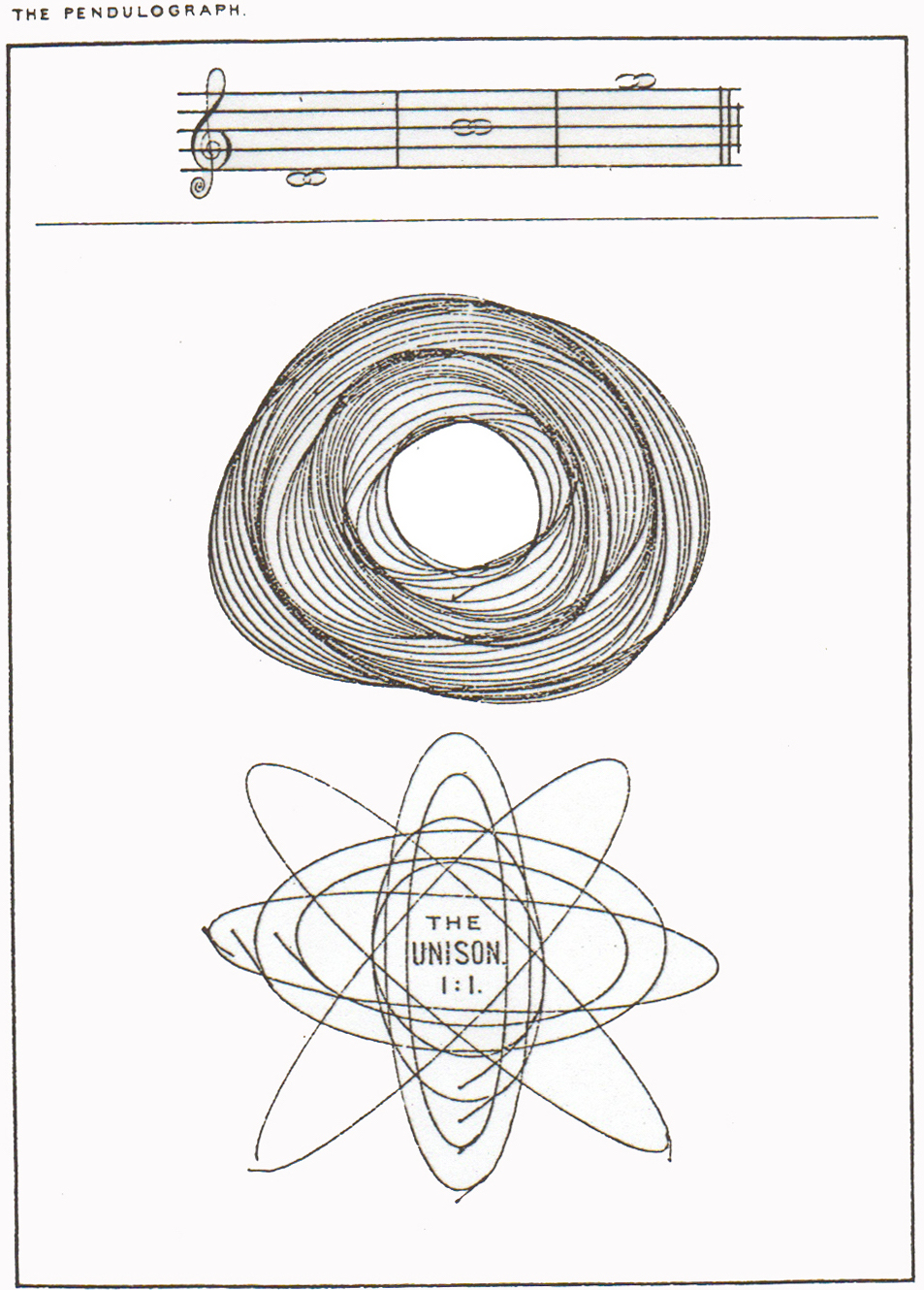
Excellent work describing the construction and function of an articulated pendulum and how it creates uniform complex motions when drawing magnificently beautiful wave forms. The basis of which are music ratios - fully explained and graphically demonstrated. A chord of music notes can and does form mathematically correct wave forms. This device was very "in" during the 1880s and 1890s. Explains very well the numerical relations of vibrations.
See Pendulograph
The twelve keys, their trinities, scales, and chords, rising times through seven octaves, each thirteenth note octave of the previous and first of the rising
—, reversed
—Keys mingled
—The Pendulograph alluded to, . . . 28 [Harmonies of Tones and Colours, Table of Contents2 - Harmonies]
IF we strike the twelve keys of in trinities, scales, and chords, as written in musical , beginning with the lowest C in the bass clef, this first development is linked into the lower of seven octaves by the four lower tones sounded by C. If we follow with the twelve keys six times, at the seventh time they will gradually rise into the higher . We obtain a glimpse of the arising from musical notes in the Pendulograph. How exquisite would they be if they could be represented in their natural coloured tones! — as, for instance, the chord of the scale of C in red, yellow, and blue, with the six coloured tones rising from each, and harmoniously blended into each other. [Harmonies of Tones and Colours, The Twelve Keys Rising Seven Times, page 28a]
THE above quotation from that beautiful work, The Pendulograph, shows how firmly its author believes that the Almighty Himself will be proved to be the key to His works; a frequently expressed also in a striking work, Nature and the Supernatural, by the Rev. J. W. Reynolds, M.A. For many years I have been endeavouring to resolve some of the intricacies of natural harmony with the same views. In the pursuit of knowledge it is eminently important to "avoid profane and vain babblings, and oppositions of science falsely so called" (I Tim. vi. 20), and to remember that facts gained from the study of 's marvellous works, that "ought to be had in remembrance" (Psa. cxi. 4, Prayer Book Version), and the truths of Holy Scripture, can never really oppose each other. Research shows us countless varieties developed by trinities springing from unities, and we find true scientific depth in the Scriptural phrases, where the whole earth is continually mentioned as worshipping the Almighty. This truth is beautifully expressed in the Te Deum Laudamus—"Holy, holy, holy, Lord God Almighty; and are full of Thy ." [Harmonies of Tones and Colours, Reflections on the Scheme1, page 43]
See Also