Sympathetic Vibratory Physics | Key (original) (raw)
A series of notes forming a or scale; tonality; also, the levers on a keyboard instrument.
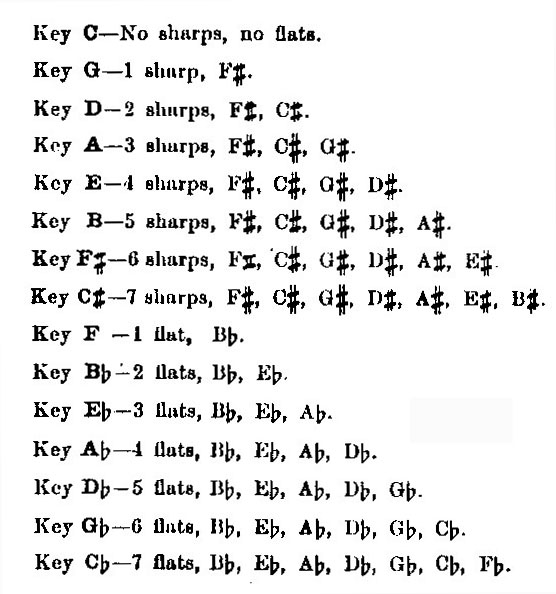
Key Signature - Sharps and Flats
(1) A mechanical contrivance for closing or opening ventages, as in flutes, clarinets, ophicleides, etc. By means of keys on such instruments, apertures too remote to be reached by the outstretched fingers are brought under control of the player.
(2) A lever which brings the pallets of an organ under the control of the hand or foot of an organist.
(3) A lever which controls the striking apparatus of a key-stringed instrument. In the harpsichord it acted on the jack, in the pianoforte it acts on the hammer.
(4) The wrest or key used for tuning instruments having metal pegs. Its end is hollowed out, so as to fit over the four-sided end of the peg, and the crossbar with which it is surmounted gives leverage to the hand of the tuner, so that he is enabled to tighten or loosen a string, or (in the case of a drum) slacken or strain a parchment.
(5) The sign placed at the commencement of the musical which shows the pitch of the notes, was originally called a clavis or key. This sign is called in modern music a .
(6) Key, in its modern sense, is the starting point of the definite series of sounds which form the recognised scale. Different starting points require the relative proportion of the steps of the scale to be maintained by means of sharps or flats in the signature. The key of C requires no flats or sharps for this purpose, hence it is called normal (diatonic) key. [Stainer, John; Barrett, W.A.; A Dictionary of Musical Terms; Novello, Ewer and Co., London, pre-1900]
Ramsay
"Of these three chords, which constitute a scale or key, next proceeds to generate, in a similar way, a family of scales or keys, and these in two lines, the Major and the Minor. The twice twelve-fold family of keys is brought forth in much the same way as were the chords which constitute them, and as were the notes which constitute the chords. There is a beautiful growth-like continuity in the production of all." [Scientific Basis and Build of Music, page 20]
"The third note of the octave scale, E, the center of the tonic chord in the key of C, is the center of the system. It is the note which has the least tendency either upward or downward, and it has immediately above it in the octave scale the note which has the greatest amount of specific gravity, F, the root of the major subdominant; and immediately beneath it the note which has the greatest amount of specific levity, D, the top of the major dominant. Thus the root of the subdominant chord and the top of the dominant are placed right above and below the center of the system, and the gravity of the one above, and the of the one below, causes each of them to move in the direction of the center. These tendencies are seen in the scale at whatever key it may be pitched, and by whatever names the notes may be called. And it is on account of this permanency of of the notes that the third note of the scale, E, in the key of C, has a lower effect1 than the second, D; and that the fourth note, F, has a lower effect than either the first, second, or third; the fifth note, G, has a higher effect than the fourth, F; but the sixth, A, has a.." [Scientific Basis and Build of Music, page 28]
of twelve mathematical scales is that F# and G?, which in the tempered system are one, being counted the same, are made two scales in the mathematical; but it is a needless nicety. Twelve is the natural and period for both mathematical and tempered scales. And as the system of twelve Fifths contains the key system of music four times, only three of these twelve Fifths being required for any one key, it follows that the tempered key is affected by only one-fourth part of the small amount to be tempered into the whole twelve. [scientific Basis and Build of Music, page 30]
In order to find the notes for the next major key above C, we have to multiply the of D, which is the top of the dominant C, by 3 and 5. It is out of the key of C at this point that the new key sprouts and grows, and by the primes and method which produce the key of C itself. So if we would find the relative minor of C, let us take the note which is a minor third below D - that is, B - to produce the . The sprouts and grows from this point of the key of C; for the relative minor grows out of the , as out of the man at first the woman is taken. Moreover, B is the last-born of the notes for the major scale; for the middles, that is, the thirds of chords, are always produced by the prime 5; and the tops, that is, the fifths of chords, are produced by the prime 3, and are born before the , though placed after them in the chords. Well, because B is the last-born note of the , as well as a minor third below the top of the highest chord of the , it seems that the should have this for its point of departure. Again, we have seen that the and the are found in their strings and their vibrations by an inverse process, that one going back upon the other; and, there taking Nature's clue, let us proceed by an inverse process of generating the . Making B45 our , as F1 was our for the , let us divide by 3 and 5 for a and to B, as we multiplied by 3 and 5 for a top and to F. B45 divided by 3 is 15; here then is our E, the root of the chord, just where we had found it coming upward; for, remember, we found E15 by multiplying C3 by 5. This E, then, is the same in and . Now B45 divided by 5 is 9; [Scientific Basis and Build of Music, page 31]
The major scale is composed of three fifths with their middle notes, that is to say, their . And as three such fifths are two octaves, less the small minor third D to F, taking the scale of C for example, so these three fifths are not joined in a circle, but the top of the dominant and the of the subdominant are standing apart this much, that is, this minor third, D, e, F. Had they been joined, the key would have been a motionless system, with no compound chords, and no opening for modulation into other keys. [Scientific Basis and Build of Music, page 38]
GRAVITY - The downward effect, to the , of a sound in a key. [Scientific Basis and Build of Music, page 40]
LEVITY - The upward effect, to the , of a sound in a key. [Scientific Basis and Build of Music, page 40]
It is according to the Law of Duality that the keys on the piano have the same order above and below D, and above and below G# and A?, which is one note. In these two places the dual notes are given by the same key; but in every other case in which the notes are dual, the order above the one and below the other is the same. The black keys conform to the scale, and the fingering conforms to the black keys. On that account in the major scale with flats, for the right hand the thumb is always on F and C; and as the duals of F and C are B and E in the minor scale with sharps, for the left hand thumb is always on B and E. [Scientific Basis and Build of Music, page 44]
that has done so.1 And in every new key into which we modulate Nature performs the same operation, till in the course of the twelve scales she has cut every greater note into two, and made the notes of the scale into instead of . These we, as a matter of convenience, call semitones; though they are really as much tones as are the small intervals which Nature gave us in the of the first scale between B-C and E-F. She only repeats the operation for every new key which she had performed at the very first. It is a new key, indeed, but exactly like the first. The 5 and 9 commas interval between E and G becomes a 9 and 5 comma interval; and this Nature does by the rule which rests in the , and is uttered in the obedient , and not by any mathematical authority from without. She cuts the 9-comma F to G into two, and leaving 5 commas as the last interval of the new key of G, precisely as she had made 5 commas between B and C as the last interval of the key of C, she adds the other 4 commas to the 5-comma step E to F, which makes this second-last step a 9-comma step, precisely as she had made it in the key of C.2 [Scientific Basis and Build of Music, page 48]
But, as the subdominant sixth and dominant seventh suggest that the chromatic chord should be a 4-note chord, we must find out how completes this diatonic chromatic triad and makes it a 4-note chord, and that according to its own intrinsic as of minor thirds. has always a rationale in her operations which it is ever delightful to discover. Wedged in between the minor dominant and the major subdominant, this triad, B D F, has already B, the top of the dominant minor, for its ; and F, the root of the subdominant major, for its top; and its middle is the mysterious D which, in its two positions as root of the minor subdominant and top of the major dominant, stands at the two extremes of the whole twofold diatonic key, bounding and embracing all; and which in its two degrees as D26 2/3 and D27 claims kindred with both minor and major modes of the twofold key system. Surely this Janus-faced D, looking this way toward the and that way to the , seems to say, "the complement of this chord, of which I am the , is not far to seek nor hard to find on either side." It has already B in common with the minor dominant; the very next step is to the middle of this chord, G. Roots and tops of chords may not be altered, but middles may with impunity be flattened or sharpened as occasion may require. No two of them in succession in the have the same structure; the chromatic triad, in claiming this middle, claims it sharpened, for it must have [Scientific Basis and Build of Music, page 54]

In the above line it will be readily observed that these three chromatic chords, having each of their intervals a minor third, involve, as necessary elements of their build, every one of the semitones at one point or another of the line. This is a second witness to the legitimacy of the chromatic scale of semitones. We have our first witness to the same in the of the semitones progressively in the course of the modulations by which, in growth-like continuity, links the successive keys; whether developed upward, as is the natural way of the majors; or downward, as in the natural way of the minors; or half upward and half downward, which is an expedient in order to simplify the signatures. In whichever direction the modulation is effected, one note is always divided, and must, true to , be signified by placing a sharp or a ?, as the case may be, to the 4-comma altered interval, and this always leaves a 5-comma interval to occupy the place to which has assigned such interval in the original scale. When this operation has been twelve times performed, we have the chromatic scale of semitones. Thus by two witnesses the thing is established. By further examination of these chromatic chords we find other interesting features beside their witness to the semitones of the octave. [Scientific Basis and Build of Music, page 56]
By taking four minor thirds upward from G# or downward from A?, we have the first chromatic chord in its twofold form. Its central note is D, the top of the dominant major, and the root of the subdominant minor, being its own dual, that is to say, its being dual to its .1 On the keyboard it has the same order of keys above it and below it; this dual D [Scientific Basis and Build of Music, page 56]
being also the center of the diatonic triplet, B, D, F, which is the diatonic germ of the chromatic system. Four minor thirds upward or downward from C# we have a second chromatic chord, its central note being G. The dual1 of C# is E?; and there is the same order of keys on the 2 below C# as there is above E?. Four minor thirds from E? upward or downward forms a third chromatic chord, the central note of which is A. The dual A, the center of the third chromatic, is G, the center of the second; and these two notes, by their duality, and by the duality of the two chords throughout, balance each other exactly on the on either side of the first chromatic chord, which contains all its own duals, and by this self-duality sits in the center, like the tonic chord among the diatonic three. [Scientific Basis and Build of Music, page 57]
The various raisings and lowerings of notes in advancing keys, major and minor. - In each of the majors ascending the top of the dominant is raised a comma. A40 in the key of C becomes A40 1/2 in the key of G; E60 in the scale of G is E60 3/4 in the scale of D; B90 in the scale of D is B91 1/8 in the scale of A. This alteration of the top of the dominant major goes on through all the twelve scales. Similarly, by the Law of Duality, each in the minors descending has the root of the subdominant lowered a comma. D54 in the key of E minor is D53 1/2 in the key of A; G72 in the scale of A is G71 1/9 in the scale of D; C48 in the scale of D is C47 11/27 in the scale of G. This alteration of the root of the subdominant goes on through all the twelve minor scales. [Scientific Basis and Build of Music, page 62]
The service of altered notes in advancing keys. - It is to be noted that F# generated by the power of 5 serves in three keys - G, D, and A. When next altered it is by the power of 3, and is F#; it in this form serves in four keys - E, B, F#, and C#. It is then altered again and becomes, by the power of 5, F#,#, and serves in three keys as before - G#, D#, and A#; and [Scientific Basis and Build of Music, page 62]
lastly it is altered again and becomes, by the power of 3 once more, F#,#, and serves in four keys. But this carries us beyond the horizon of our musical world of twelve keys; for in B#, the top of the tonic E, we have reached our twelfth fifth, and it here coalesces with C of the seventh octave, and closes the circle. This is the way that all notes become alternately altered, either by commas and sharps in the upward genesis of scales, or by commas and flats in the downward , by the alternate powers of 3 and 5. In the upward in this illustration, notes by the power of 5 serve in three keys, and those by the power of 3 serve in four keys. In the minors it is just the inverse on this by the Law of Duality. But no note serves for more than either three or four keys, as the case may be. [Scientific Basis and Build of Music, page 63]
- The below the in a key. [Scientific Basis and Build of Music, page 63]
Tonic - The middle in a key. [Scientific Basis and Build of Music, page 63]
- The above the in a key. [Scientific Basis and Build of Music, page 63]
Position - The relative place of chords in a key. [Scientific Basis and Build of Music, page 63]
- Change of key. [Scientific Basis and Build of Music, page 63]
where there stands an open door between the and the seventh, these two having no note in common, it is easy and natural to slip out of the key into another, either in ascending the major or descending the minor octave; and in order to keep in the key, the two chords of these notes have to reach out to each other a helping hand, and compound in order to affiliate. This, however, by the law of sympathy and assimilation, which reigns in this happy, realm, they are always ready to do.1 [Scientific Basis and Build of Music, page 66]
The Chromatic Scale is naturally the last to come into view, for it is not generated by a mathematical process at all. Chromatic intervals are indeed found in the scale as mathematically generated. The semitones between B-C and E-F are two chromatic intervals, and the chord which occurs between the and the in the when it begins with the minor mode is a chromatic chord, though in an uncompleted condition. But the making of the octave into a chromatic scale of twelve small or semi-tones, is the work of modulation from one key to another through the whole twelve keys in either the major or minor sphere; and this process is fully set forth in the pre-note to the chromatic treatise. [Scientific Basis and Build of Music, page 69]
At the first, in the laws of quantities and motions adjusting musical vibrations, there is one chord of the three notes, F, A, C, the , , and of the five notes which compose the true natural scale; this one chord can be reproduced a higher, C, E, G, in the same mathematical form, taking the of the first for the of the second chord. In like manner this second can be reproduced another higher, G, B, D, still in the same mathematical form, and so fit to be a member of the of a key. But the law does not admit of another reproduction without interfering with the first chord, so that a fourth fifth produces no new effect; but the whole key is simply a higher, i.e., if the fourth fifth has been properly produced by multiplying the of the third by 3 and by 5, the generating primes in music. That this carries us into a new scale is seen in that the F is no longer the F? but F#, and the A is no longer A? but A,. But if we suppose the fourth fifth to be simply the old notes with their own vibration numbers, then D, F, A would not be a belonging either to the major or the minor mode, but a a comma less. The letters of it would read like the minor subdominant, D, F, A; but the intervals, as found in the upward development of the major genesis, instead of being, when expressed in commas, 9, 5, 8, 9, which is the minor subdominant, would be 8, 5, 9, 8, which is not a of the musical system; these having always, whether or , two 9's, one [Scientific Basis and Build of Music, page 77]
G# as it occurs in the scales of A, E, and B major, and A? as it occurs in the scales of F and B? minor, are only distant the apotome minor, and are well represented by one key of the piano. It is only G# as it occurs in the scale of F six sharps , and A? as it occurs in the scale of E six flats , that is not represented on the piano. These two extreme notes F# and E? minor are at the distance of fifteenth fifths and a minor third from each other. This supplies notes for 13 major and 13 minor mathematical scales; but as this is not required for our musical world of twelve scales, so these far-distant G# and A? are not required. The piano is only responsible for the amount of which twelve fifths require, and that is never more than one comma and the apotome minor. [Scientific Basis and Build of Music, page 80]
A LESSON ON THE DEVELOPMENT OF KEYS FOR THE BEGINNER.
To develop the two new notes for a new key a higher, you multiply the of the top of the dominant of the key you have by 3 and by 5, thus-
MAJOR.
C 9 D 8 E 5 F 9 G 8 A 9 B 5 C
24 27 30 32 36 40 45 48
48 54 60 64 72 80 90 96 [Scientific Basis and Build of Music, page 82]
In a musical air or harmony, i.e., when once a key has been instituted in the , all the various notes and chords seem animated and imbued with and ; and the center of attraction and repose is the , i.e., the key-note or . The moving notes have certain leanings or attractions to other notes. These leanings are from two causes, local proximity and native affinity. The attraction of native affinity arises from the and of the notes as seen in the six-octave genesis, and pertains to their harmonic combinations. The attraction of local proximity arises from the way the notes are marshalled compactly in the octave scale which appears at the head of the , and pertains to their melodic succession. In this last scale the proximites are diverse; the 53 commas of the octave being so divided as to give larger and lesser distances between the notes; and of course the attraction of proximity is strongest between the nearest; a note will prefer to move 5 commas rather than 8 or 9 commas to find . Thus far . [Scientific Basis and Build of Music, page 91]
In passing from one key to another in the fellowship of keys in a , the new key grows out of the top of the dominant and converts the old dominant into a . The dominant and subdominant being at the opposite extremes of the key, with the between them, are not related by affinity. This want of affinity makes an opening in the system for the new chord to come in by, and it, being related by affinity to the chord of the old dominant, which is now the new Tonic, comes in and establishes itself and the new key for the time. It is this gap between subdominant and dominant, along with the affinity existing between the new key and the old dominant, which makes this musical event to be so gracefully accomplished. This is what is called natural modulation, the passing for a time into another key in the course of a ; and its abundant and habitual use in music, even in the simplest chorales, shows how natural and acceptable it is. The young student will find illustrations in the second lines of the tunes - , Sicily, Tranquility, Eaton, Birmingham, Jackson, Bethel, Bedford, and Sheffield. Take , for example, and let the young student follow carefully, noting each chord of the little passage, which we shall analyse for his help. It is by such practice that he will become by-and-by familiar with the kinship of keys and the legitimate resources of harmony. [Scientific Basis and Build of Music, page 93]
This is in the key of E? Major, and the key into which it moves for a passage is the next above it, B? Major. The first chord, E? G B?, is the ; the second and third are the and dominant; the fourth, C E? G, whose full form would be C E? G B?, is the compound subdominant of the new key, which suggests the approaching modulation. The next two chords, in which the measure closes, may either be viewed as the and dominant of the key, or the subdominant and of the new key. The second measure opens with the same chord which closes the first measure, and is best defined as the of the new key; the second chord is clearly the dominant of the new key, and the whole of the second measure is in the new key, and reads, T. D. S. T. compound D. T. Some of these chords might be read as chords of the old key, so near to each other and so are the contiguous keys. All contiguous keys to a certain extent overlap each other, so that some of the chords may be variously read as belonging to the one or to the other. [Scientific Basis and Build of Music, page 94]
In the opening of the third measure the returns to its own key by striking the . This case is a very simple illustration of how a will move with perfect naturalness in more keys than one, the keys so grow out of each other, and may either merely snatch a passing chord from a new key, or pass quite into it for a or two, or for a whole measure, then return as naturally, either by a smooth and quiet or by a strongly contrasted turn, according to the chords between which the turn takes place. In such modulation there may or there may not be marked a #, ?, or ?, in the air itself; the note which raises in the new key may occur in one of the other parts of the harmony. In it is A, the fourth, which is altered; from being ? it is made ?. The change which takes place in the of the scale, which is C in , is only one comma, the ratio of 80 to 81, and it slips into the new key as if nothing had happened. No mark is placed to it, as the comma difference is never taken notice of, although it is really and regularly taking place, with all the precision of , in every new key. It is, however, only the note which is altered four commas, which is marked by a #, ?, or ?, as the case may be. [Scientific Basis and Build of Music, page 94]
"There are three chromatic chords, and each of these three is related to eight particular tonic chords. When one the these chromatic chords goes to any one of its eight tonic chords, three of its notes move in semitonic progression, and the other note moves by the small tone, the ratio of 9:10. There is exception to this rule, whether the key be or . But when the chromatic chord which should resolve to the of C is followed by the subdominant, or the of F (the example in Mr. Green's book), only two of its notes move in semitonic progress. Your friend describes the chord as if it had gone to the of B; and what he said about it, and about D going to C, is what is supposed to be [Scientific Basis and Build of Music, page 94]
VIOLIN-FINGERING - Whenever the third finger is normally fourth for its own open , then the passage from the third finger to the next higher open is always in the ratio of 8:9; and if the key requires that such passage should be a 9:10 interval, it requires to be done by the little finger on the same , because the next higher open is a comma too high, as would be the case with the E string in the key of G. In the key of C on the you cannot play on the open A and E strings; you must pitch all the notes in the scale higher if you want to get [Scientific Basis and Build of Music, page 99]
Whenever a comes in in making a new key - that is, the last necessary to make the new key - the middle of the chord in major keys with sharps is raised by the , and the of the same chord by a comma. Thus when pausing from the key of C to the key of G, when F is made A is raised a comma. When C is made in the key of D, then E is raised a comma, and you can use the first open . When G is made for the key of A, then B is raised a comma. When D is made for the key of E, then F# is raised a comma; so that in the key of G you can use all the open strings except the first - that is, E. In the key of D you can use all the open strings. In the key of A you can use the first, second, and third strings open, but not the fourth, as G is . In the key of E you can use the first and second open. [Scientific Basis and Build of Music, page 100]
Fig. 1 - The pendulums in this illustration are suspended from points determined by the division of the into Commas; the comma-measured chords of the Major key being S, 9, 8, 9, 5; T, 9, 8, 5, 9; D, 8, 9, 5, 9. The pendulums suspended from these points are tuned, as to , to swing the mathematical ratios of the Diatonic scale. The longest is F, the chords being properly arranged with the subdominant, , and dominant, the lowest, center, and upper chords respectively. Although in "Nature's Grand Fugue" there are 25 pendulums engaged, as will be seen by reference to it, yet for the area of a single key 13 pendulums, as here set forth, are all that are required. It will not fail to be observed that thus arranged, according to the law of the genesis of the scale, they form a beautiful curve, probably the curve of a falling . It is an exceedingly interesting sight to watch the unfailing coincidences of the pendulums perfectly tuned, when started in pairs such as F4, A5, and C6; or started all together and seen in their manifold manner of working. The is then treated to a sight, in this solemn silent , of the order in which the vibrations of sounding instruments play their sweet coincidences on the of the delighted ; and these two "art senses," the and the , keep good company. Fig. 2 is an illustration of the correct of a Pendulum Oscillation, as defined in this work. In watching the swinging pendulums, it will be observed that the coincidences [Scientific Basis and Build of Music, page 104]
The Plate shows the Twelve Major and Minor Scales, with the three chords of their harmony - subdominant, , and dominant; the tonic chord being always the center one. The straight lines of the three squares inside the embrace the chords of the major scales, which are read toward the right; e.g., F, C, G - these are the roots of the three chords F A C, C E G, G B D. The tonic chord of the scale of C becomes the subdominant chord of the scale of G, etc., all round. The curved lines of the embrace the three chords of the successive scales; e.g., D, A, E - these are the roots of the three chords D F A, A C E, E G B. The tonic chord of the scale of A becomes the subdominant of the scale of E, etc., all round. The sixth scale of the Majors may be written B with 5 sharps, and then is followed by F with 6 sharps, and this by C with 7 sharps, and so on all in sharps; and in this case the twelfth key would be E with 11 sharps; but, to simplify the signature, at B we can change the writing into C, this would be followed by G with 6 flats, and then the signature dropping one at every new key becomes a simpler expression; and at the twelfth key, instead of E with 11 sharps we have F with only one . Similarly, the Minors make a change from sharps to flats; and at the twelfth key, instead of C with 11 sharps we have D with one . The young student, for whose help these pictorial illustrations are chiefly prepared, must observe, however, that this is only a matter of musical orthography, and does not practically affect the music itself. When he comes to the study of the mathematical scales, he will be brought in sight of the exact very small difference between this B and C?, or this F# and G?; but meanwhile there is no for him. [Scientific Basis and Build of Music, page 108]
In the center column are the notes, named; with the lesser and larger steps of their mathematical evolution marked with commas, sharps, and flats; the comma and of the descending placed to the left; the comma and of the ascending to the right; and in both cases as they arise. If a note is first altered by a comma, this mark is placed next to the letter; if first altered by a or , these marks are placed next the letter. It will be observed that the sharpened note is always higher a little than the note above it when flattened; A# is higher than ?B; and B is higher than ?C, etc.; thus it is all through the scales; and probably it is also so with a fine guided by a true ; for the natural of sharpened notes is upward, and that of flattened notes downward; the of such is so small, however, that there has been of opinion as to whether the # and ? have a space between them, or whether they overlap, as we have shown they do. In tempered instruments with fixed keys the small disparity is ignored, and one key serves for both. In the double columns right and left of the notes are their mathematical numbers as they arise in the Genesis of the scales. In the seven columns right of the one number-column, and in the six on the left of the other, are the 12 major and their 12 relative minor scales, so arranged that the mathematical number of their notes is always standing in file with their notes. D in A minor is seen as 53 1/3, while the D of C major is 54; this is the comma of in the primitive , and establishes the sexual distinction of and all through. The fourth of the is always a comma lower than the of the , though having the same name; this note in the development of the scales by flats drops in the a comma below the , and in the development of the scales by sharps ascends in the a comma above the . In the head of the plate the key-notes of the 12 majors, and under them those of their relative minors, are placed over the respective scales extended below. This plate will afford a good deal of teaching to a careful student; and none will readily fail to see beautiful indications of the deep-seated of Major and Minor. [Scientific Basis and Build of Music, page 109]
Under the of a music plant this plate gives us to realize the growth-like continuity of chords and scales. The roots of the three chords of a key are represented in F, C, and G of the key of C. The plant might be represented as a creeping stem, like the creepers of the , with its progressive roots struck into the ; but it is better to show an upward stem with aerial roots, for such are the roots of the musical plant. The main stem of the plant has the three chords, F a C e G b D; that is, F a c, C e g, G b d, the subdominant, , and dominant. The terminal chord, D f# a, is to show that the keys as well as the chords out of each other. Include the side branches which terminate with the octave notes of the chords, read thus - F a c f, G e g e, G b d g, because a chord is felt to be most complete in its when thus shut in by the octave note of its . This is the reason why the great three-times-three chord does not stop at D, the top of the dominant chord, but goes on to the sixth octave of the fundamental root, shutting all in by the great , F, in order to preserve the of the effect which this chord of chords produces. Before D. C. Ramsay showed that the scale of Harmonics extended to six octaves, it was by teachers of the science of music only extended to four. [Scientific Basis and Build of Music, page 110]
With perfect duality of response does resolution of chords go on in the minors. When the tonic chord follows the subdominant one, they have for their note in common A, i.e., in the key of A; and the middle of the subdominant moves by semitonic progression to the top of the tonic. When the tonic chord follows the dominant one, the top of the tonic and the root of dominant E is a note in common, and the top of the dominant goes by semitonic progression to the middle of the tonic. These simple chords are thus linked together exactly with the same degree of continuity as the simple chords of the . When the tonic chord follows the compound subdominant, this compound chord, like the compound dominant in the , has two semitonic progressions - one to the top and one to the middle of the tonic - and they have one note in common. When the compound dominant follows the subdominant, the root of the subdominant is lent to the top of the dominant, and thus a note in common is created, and the middle of the subdominant moves by semitonic progression to the root of the dominant. When the compound subdominant follows the dominant, the is lent to the root of the subdominant, creating a note in common between them, and the root of the dominant goes to the middle of the subdominant in semitonic progression. This is the way of . The unbroken continuity of her ways is perfectly illustrated in the linked and kinship of chords in a key; or when one key passes by modulation to another key; and that through all the chords and all the keys. We shall see wondrously more of this when we come to the study and contemplation of the Chromatic System of Chords. [Scientific Basis and Build of Music, page 112]
When the major and minor scales are generated to be shown the one half in #s and the other half in ?s, it is not necessary to carry the mathematical process through the whole 24, as when the majors are all in #s and the minors all in ?s; because when six majors have been generated in #s, they furnish the new notes needed by the six relative minors; and when six minors have been generated in ?s, they furnish the new notes for the six relative majors. This plate begins with the in C and the in A. The notes of these two are all identical except the D, which is the sexual note, in which each is not the other, the D of the being a comma lower than the D of the . Going round by the keys in #s, we come first to E minor and G major. G major has been mathematically generated, and the relative minor E gets its F# from it; but the D of C major must also be [Scientific Basis and Build of Music, page 112]
Starting again at C major and A minor and going round by the keys in ?s, we come first to D minor and F major. The gets its ? fourth from the ? sixth of the relative minor; and as the interval between D-E, the major sixth and seventh, must be a <9-comma> interval, and its own D-E is only an <8-comma> one, it must take the D of A minor, which is a comma lower, and this will correctly show the <9-comma> interval between D and E. This is the way of their mutual providing in the region of ?s; the ? sixth of the is given to be the ? fourth of the relative major; and the comma-lower fourth of the sub-relative minor becomes the correct of the . The arrows indicate the source from which, and the place to which; the new notes come and go. [Scientific Basis and Build of Music, page 113]
The signature of and relative minor is always the same whether in #s or ?s; but in the keys with #s in the plate the signature is only given on the major stave, to indicate that generating upwards is its natural way; and in the keys with ?s the signature is only placed in the minor stave, to indicate that generating downward is the natural way for the minor mode. [Scientific Basis and Build of Music, page 113]
When Plate XIII. is divided up the middle of the column, as in Plate XIV., so as that one side may be slipped up a , representing a new key one-fifth higher, its subdominant made to face the old , the two new notes are then pictorially shown, the second being altered one comma and the seventh four commas. The key at this new and higher pitch is by 's unfailing care kept precisely in the same form as the first; and wherever the major scale is pitched, higher or lower, the form remains unaltered, all the intervals arranging themselves in the same . The , and the obedient to it, carry 's in them, and the writing must use such marks as may truly represent this; hence the use of sharps, flats, and naturals; these, however, be it observed, are only marks in the writing; all is at any pitch in the scale itself. All this is equally true of the minor mode at various pitches. These two plates are only another and more pictorial way of showing what the and the signature are usually made to express. [Scientific Basis and Build of Music, page 114]
One purpose of this plate is to show that times the interval of a divides the octave into semitones; and each of these notes is the first note of a major and a minor scale. When the same note has two names, the one has sharps and the other has flats. The of sharps and flats taken together is always . In this plate will also be observed an exhibition of the omnipresence of the chromatic chords among the twice twelve scales. The in the center of the plate is also used as to show the whole 24 scales. Going from the end, the winding line, advancing by fifths, goes through all the keys notes; but in order to keep all within the , a double expedient is resorted to. Instead of starting from C0, the line starts from the subdominant F0, that is, one key lower, and then following the line we have C1, G2, etc., B6 proceeds to G? instead of F#, but the continues still to indicate as if the keys went on in sharps up to F12, where the winding line ends. Going from the end, the line starts from E0 instead of A0 - that is, it starts from the dominant of A0, or one key in advance. Then following the line we have B1, F#2, etc. When we come to D#5, we proceed to B? instead of A#6, but the continues as if still in sharps up [Scientific Basis and Build of Music, page 114]
In the festoons of ellipses the signatures are given in the usual conventional way, the major F having one and minor E having one . The major and minor keys start from these respective points, and each successive is made a new keynote of a and a respectively; and each in the festoons having the key shown in its two forms; for example, in the major F, one , or E#, eleven sharps; in the minor E, one , or F?, eleven flats. Thus is seen all the various ways that notes may be named. The four minor thirds which divide the octave may be followed from an by the curved lines on which the ellipses are hung; and these four always constitute a chromatic chord. [Scientific Basis and Build of Music, page 115]
These two plates show the chromatic chord resolving into the major and minor tonic chords of the twenty-four scales. There seems to be twenty-five, but that arises from making G? and F# in the major two scales, whereas they are really only one; and the same in the series, E? and D# are really one scale. C in the and A in the , which occur in the of the series, when both sharps and flats are employed in the signatures, are placed below and outside of the circular to give them prominence as the types of the scale; and the first chromatic chord is seen with them in its and form, and its typical manner of resolving - the form rising to the , and falling to the and ; the form falling to the , and rising to the and . The signatures of the keys are given under the . [Scientific Basis and Build of Music, page 116]
advance by semitones, the keys with ?s and #s alternate in both modes. The between G# and A? in the , and between D# and E? in the , is in each mode, and the scale made one. The dotted lines across the plate lead from to relative minor; and the solid spiral line starting from C, and winding left and right, touches the consecutive keys as they advance normally, because genetically, by fifths. The relative major and are in one at C and A; and in the right opposite this the relative to F# is D#, and that of G? and E?, all in the same , and by one set of notes, but read, of course, both ways. [Scientific Basis and Build of Music, page 117]
with her irrevocable proportions to measure his scales for him. The stars at the C of the first scale and at the B# of the last show the of 12 fifths and 7 octaves. The of B# is 3113 467/512; C24 multiplied 7 times by 2 brings us to the 3072; these two notes in the tempered system are made one, and the unbroken horizon of the musical world of twofold keys is created. The very small between these two pitches is so distributed in the 12 tempered scales that no single key of the 12 has much to bear in the loss of perfect intonation. [Scientific Basis and Build of Music, page 118]
Key Chord
The common chord of the , e.g., C, E, G is the key-chord of C.
Key Note
"The note which, according to the signature, forms the starting point of the scale. The . The do." [Stainer, John; Barrett, W.A.; A Dictionary of Musical Terms; Novello, Ewer and Co., London, pre-1900]
The twelve major scales
—The term key-note employed in the ordinary sense of the musician
—The twelve key-notes, with the six notes of each as they veer round in trinities, are written in musical , and the scales added
—The of the four and three of the key-note and its trinities in the of its scale
—The twelve keys follow each other times through seven octaves linked into the lower and higher
—Keys mingled
—The modulating of scales, the eleventh notes rising to higher keys, . . . . . . 26 [Harmonies of Tones and Colours, Table of Contents2 - Harmonies]
The chords
—The fourteen roots of the chords of the twelve major keys
—A threefold major chord examined, fourfold with its octave
—The of each key seen to have two chords and its scale one chord, thirty-six in all, forty-eight with octaves
—The chords of the twelve keys as they follow in order are written in musical
—Colours seen to agree, . . . 27 [Harmonies of Tones and Colours, Table of Contents2 - Harmonies]
The twelve keys, their trinities, scales, and chords, rising times through seven octaves, each thirteenth note octave of the previous and first of the rising
—, reversed
—Keys mingled
—The Pendulograph alluded to, . . . 28 [Harmonies of Tones and Colours, Table of Contents2 - Harmonies]
The modulating gamut
—One of the twelve keys meeting by fifths through seven octaves
—Keys not mingled
—A table of the key-notes and their trinities thus meeting
—The fourths not isolated
—The table of the twelve scales meeting by fifths
—The twelve keys, trinities, scales, and chords thus meeting are written in musical
—The meeting through seven circles, each circle representing the eighteen tones
—The keys of C and G meeting, coloured
— of the various major developments, . . . . 29 [Harmonies of Tones and Colours, Table of Contents3 - Harmonies]
The same laws, developing the minor scales, show that the and descending scales vary from the harmony of the key-note and its trinities
—Each key developing three harmonies
—The tenth note of a minor scale modulates into a higher key, . . . . 36 [Harmonies of Tones and Colours, Table of Contents3 - Harmonies]
The twelve keys meeting by fifths, one modulating through seven octaves, keys not mingled
—The twelve veering round, the intermediate notes not coloured
—The keys of A and E meeting the intermediate notes coloured in musical , . . . . . 39 [Harmonies of Tones and Colours, Table of Contents3 - Harmonies]
The twelve major and the twelve minor keys written in musical
—First, the twelve major keys rising mingled as they develope times through seven octaves
—Second, one of the twelve meeting by fifths, keys not mingled
—Third, the twelve minor keys mingled
—Fourth, the twelve minor key-notes and their trinities, the keys meeting by fifths in the line above the keys of the ascending scales, and in the line below the keys of the descending scales, 42 [Harmonies of Tones and Colours, Table of Contents3 - Harmonies]
", pure, natural, and harmonical, in the true and evident sense of the term, is the division of any keynote, or starting-point, into it's integral and ultimate parts, and the descending divisions will always answer to the ascending, having reference to the general whole. The and mystery in the development of harmonies consists in the fact that every keynote, or unit, is a including the past, the present, and the future, having in itself an inherent power, with a tendency to expand and contract. In the natural system, as each series rises, its contents expand and fall back to the original limit from any point ascending or descending; we cannot perceive finality in any ultimate; every tone is related to higher and lower tones; and must be part of an organized whole." - F. J. , Harmonies of Tones and Colours - Developed by Evolution, page 16
I had for a long time studied the development of the of colour, and believed that I had gained them correctly; but I saw no way of proving this. The thought occurred—Why not test the laws in musical harmonies? I wrote down the development of the seven major keys of the white notes in keyed instruments. I was perplexed by the as of "to and fro," but the development of numbers explained this point, and I found that the method of development in colours, tones, and numbers agreed. I remembered the keys with sharps, but had forgotten that B? belonged to the key of F, and here I thought that the laws failed. But I found by reference that all were correct, the eighth being the first of a higher , the laws having enabled me to distinguish between flats and sharps, [Harmonies of Tones and Colours, General Remarks on Harmonies of Tones and Colours, page 12]
THIS scheme is grounded upon the that a key has been gained which unites with simplicity, the laws of which are wonderfully simple, although most complex in their working, explaining all the intricacies which arise in the developments of . [Harmonies of Tones and Colours, The Method of Development or Creation of Harmonies1, page 15]
THE term "key" will now be employed in the ordinary sense of the musician, as a note which keeps all those other notes under which do not belong to its harmony. A good requires that the first note struck should govern and regulate the rest, carrying on the intricacies of the key through the seven octaves and descending. [Harmonies of Tones and Colours, Diagram IV - The Development of the Twelve Major Scales, page 26a]
The twelve key-notes, with the six notes of each as they veer round in trinities, are again written in musical , and the scales added. The key-note leads the scale, and, after striking the two next highest notes of the of the harmony, goes forward, with its four lowest, an octave higher. The of each harmony have been traced as the three lowest, thus meeting the three highest in three pairs, the fourth note being isolated. Notwithstanding the curious of the three and four of the scale, the three lowest pair with the three highest, and the fourth with its octave. The four pairs are written at the end of each line, and it will be seen how exactly they all agree in their mode of development. Keys with sharps and keys with flats are all mingled in twelve successive notes. If we strike the twelve scales as they follow each other, each thirteenth note being octave of the first note of the that have developed, and first of the rising , the seventh time the scales gradually rise into the higher of seven octaves beyond the power of the instrument. is reversed. After the and octave of a scale have been sounded , the seems to lead to the descending; but ten notes of any scale may be struck without the necessity of modulation; at the seventh note we find that the eleventh note in the progression of harmonics rises to meet the seventh. For instance, B, the seventh note in the scale of C, must have F#. This point will be fully entered into when examining the meeting of fifths. To trace the scale of C veering round as an example for all, we may begin with C in Diagram II., and go forward with F, G, A, and B an octave higher. If the twelve scales were traced veering round, they would be found to correspond with the as written in musical . [Harmonies of Tones and Colours, Diagram IV - The Development of the Twelve Major Scales, page 26a]
ON a keyed instrument only are major key-notes, but as the double tones C#-D? and F#-G? are roots, there are fourteen different chords. The that are roots are written in musical . As an example of the major chords in the different keys, we may examine those in the key of C. A major fifth includes five out of the of its key; with the or central note it is the threefold chord, or when the octave note is added. Including the silent key-notes, a threefold chord embraces eight, or, counting the double tones, not including E#, . The first and second chords of the seven of the harmony are perfect major chords in the key of C; the central note of the third chord, being #C-?D, is a . The first pair of fifths in the scale, with its central note, is a chord of the key; if we include the octave, the last pair of fifths, with its central note, is the same chord an octave higher than the lowest chord of the . Of the chords written in musical of the twelve keys, the octave chord is only written to C, the of each having two chords and the scale one, in all, or if the octave chords are added. Notice how the chords of each and the chord of its scale are altered. [Harmonies of Tones and Colours, Diagram V - The Chords of the Twelve Major Keys, page 27a]
THE twelve keys have been traced following each other times through seven octaves, the keys mingled, the thirteenth note being the octave, and becoming first of each rising . Thus developing, the seven notes of each eighth key were complementary pairs, with the seven notes of each eighth key below, and one of the twelve keys may be traced, all meeting in , not mingled. When the notes not required for each of the thus meeting are kept under, the eighths of the twelve all meet by fifths, and as before, in , each key increases by one , the keys with flats following, each decreasing by one ; after this, the octave of the first C would follow and begin a higher . It is most interesting to trace the , no longer isolated, but meeting each other, having risen through the progression of the keys to higher . In the of C, B is the isolated fourth, meeting F#, the isolated fourth in the key of G, and so on. Each key-note becomes the root of the fifth key-note higher; thus C becomes the root of G, &c. [Harmonies of Tones and Colours, Diagram VII - The Modulating Gamut of the Twelve Keys1, page 29]
The following table shows the regularity of each of the twelve key-notes by fifths, and the use of the two poles is again seen. The key-notes and their trinities are closely linked into each other, the three highest notes of the lower fifth key becoming the three lowest of the higher fifth key, and the four lowest becoming the four highest in an octave higher. The twelve keys, rising in each note a tone higher and descending a tone lower, cause the meetings by fifths. Having examined the table, we may strike the keys by fifths as written in the musical , beginning with the lowest C in [Harmonies of Tones and Colours, Diagram VII - The Modulating Gamut of the Twelve Keys1, page 29]
In the development of the key-notes, the or is written to each note, but not to the keys. The reversal of the three and four notes of each of the twelve key-notes and their trinities meeting by fifths having been traced, we will now examine the twelve scales meeting by fifths, and the results arising from the of the three and four notes of each lower scale in the higher. Take as an example the scale of C: C D E F G A B, and that of G: G A B C D E F#. The four lowest notes of the of C are the four highest, an octave higher, in G; F, the central and isolated note of the of C, having risen a tone higher than the octave in the scale of G. The twelve scales thus modulate into each other by fifths, which sound the same as the key-notes and their trinities. Refer to the twelve scales written in musical by fifths, and strike them, beginning at the lowest C in the bass clef; this scale sounds no intermediate tones, but these must be struck as required for all the scales to run on in fifths. After striking the seven notes of C, if we fall back three, and repeat them with the next four notes of the ; or strike the and octave of C, and fall back four, repeating them and striking the next four, the four last notes of each scale will be found to be always in the harmony of the four first of the higher scale. When the twelve scales have been thus gained, as we trace them also on the table, they may be struck descending by following them as written in musical upwards, and [Harmonies of Tones and Colours, Diagram VII - The Modulating Gamut of the Twelve Keys2, page 30]
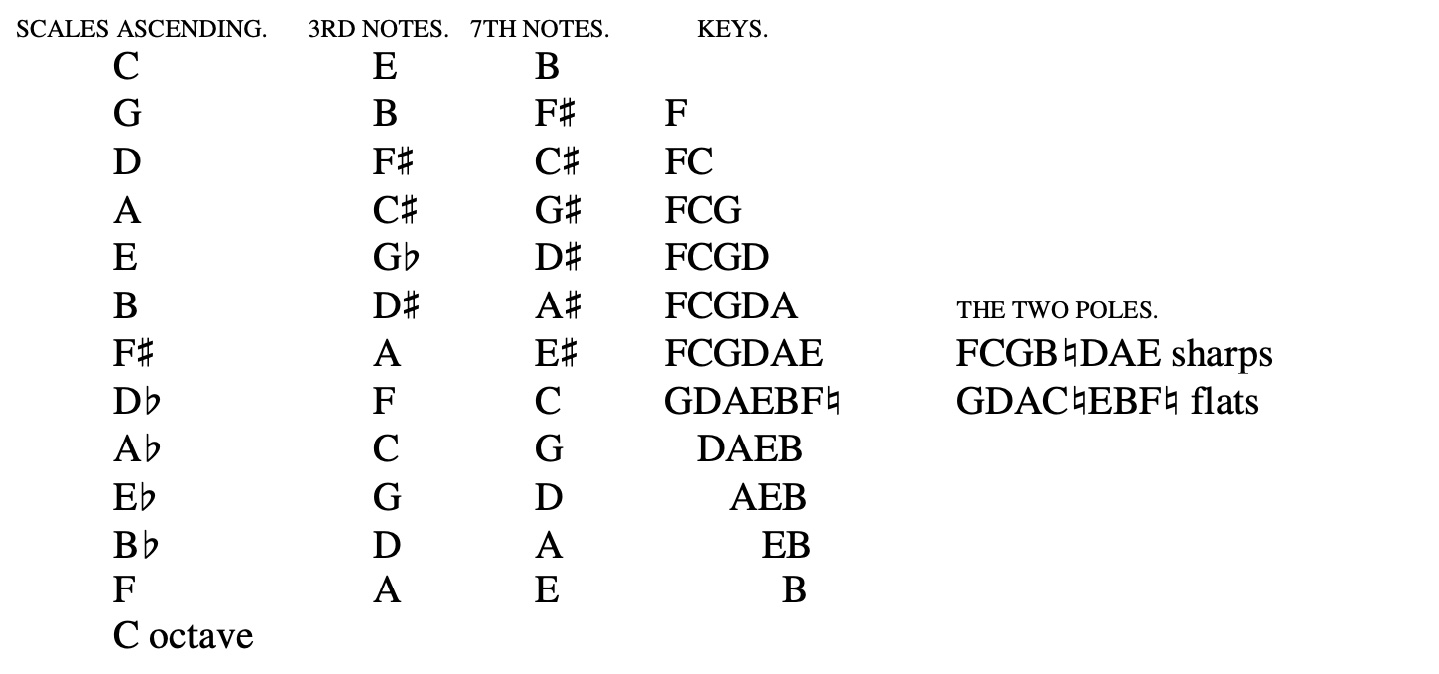
[Harmonies of Tones and Colours, The Twelve Scales Meeting by Fifths, page 31a]
Finally, trace the twelve keys by fifths as they veer round through the seven circles, each circle representing the eighteen tones. Beginning with C in the innermost circle , C becomes the root of G, G of D, and so on. In descending, begin with C in the outermost circle (though really the first of a higher which we have not the power of striking on instruments); F, its , becomes the key-note, B? the and then the key-note, and so on. The keys thus gained are written in musical below. [Harmonies of Tones and Colours, The Twelve Scales Meeting by Fifths, page 31a]
The keys of C and G meeting are coloured, and show the beautiful results of colours arising from gradual when meeting by fifths. Each key-note and its trinities have been traced as complete in itself, and all knit into each other, the of each rising a tone and developing seven times through seven octaves, the keys mingled. The twelve scales have been traced, developing seven times through seven octaves, all knit into each other and into the key-notes and their trinities. The chords have also been traced, each complete in itself, and all knit into each other and into the key-notes, trinities, and scales. And lastly, one of the twelve keys, no longer mingled, but modulating into each other, have been traced, closely linked into each other by fifths through seven octaves, three keys always meeting. Mark the of notes thus linked together, and endeavour to imagine this of tones meeting from the various notes. [Harmonies of Tones and Colours, The Twelve Scales Meeting by Fifths, page 31a]
THE term "key" in the minor developments must be taken in the sense in which it is understood by musicians, although it will be seen that it is only the seven of the harmony that are the relative minor keys of the majors, the scales with their chords sounding other keys. The grandeur, combined with simplicity, of the laws which develope musical are strikingly exhibited in the minor keys. Although at first they appear most paradoxical, and, comparing them with the majors, we may almost say contradictory in their laws of development, when they are in some understood, the intricacies disappear, and the twelve keys follow each other (with the thirteenth octave), all exactly agreeing in their mode of development. I shall endeavour to trace them as much as possible in the same manner as the majors, the lowest developments of the minor keys being notes with scales and chords, the notes always sounding their major harmonies in tones. Here an apparently paradoxical question arises. If the major keys are gained by the notes sounding the tones, how are the minor keys obtained? Strictly speaking, there are no minor key-notes: the development of a harmony is but a mode of succession within the octave, caused by each minor key-note employing the sharps or flats of the fourth major key-note higher; and with this essential difference, it will be seen in how many points the developments of major and minor harmonics agree. I have carefully followed the same laws, and if any capable mind examines the results, I am prepared for severe criticism. I can only express that it was impossible to gain any other results than the seven of the harmony, the and the descending scale and the chords combining three different keys. [Harmonies of Tones and Colours, Diagram VIII - On the Development of the Twelve Minor Harmonies, page 32]
ALTHOUGH only twelve notes of a keyed instrument develope perfect minor harmonics, there are fifteen different chords, the double tones D#-E?, E#-F?, A#-B? all sounding as roots. The fifteen roots are written in musical . A major and a minor fifth embrace the same number of key-notes, but the division into threefold chords is different. In counting the , a major fifth has four below the third note of its harmony, and three above it; a minor fifth has three below the third note of its harmony, and four above it. A major seventh includes twelve key-notes, a minor seventh only eleven. As an example of the minor chords in the different keys, we may first examine those in the key of A, written in musical . The seven of its harmony have two threefold chords, and two of its ascending scale. If we include the octave note, the highest chord of the descending scale is a repetition (sounding an octave higher) of the lowest chord of the seven in its harmony, and the second chord of the descending scale is a repetition of the first chord of its ascending scale. These two repetition chords are only written to the key of A: the chords of the other eleven keys will all be found exactly to agree with those of A in their mode of development. We may again remark on the beautiful effect which would result if the colours of the minor chords could be seen, with the tones, as they develope. [Harmonies of Tones and Colours, Diagram XII - The Chords of the Twelve Minor Keys, page 37a]
IF we strike the as written in musical , beginning with the lowest A in the bass clef, each key-note, with its trinities, scale, and chords, sounds three harmonics. We may follow with the twelve keys as they rise, and descend by following the keys upwards as written in musical , each key falling lower. [Harmonies of Tones and Colours, Diagram XIII - The Twelve Keynotes with Their Trinities, page 38a]
CHAPTER XVII.
"There's not the smallest orb which thou behold'st,
[Harmonies of Tones and Colours, Diagram XIV - The Modulating Gamut of the Twelve Minor Keys by Fifths1, page 39]
Let us first examine the meeting of the key-notes and their trinities in musical ; the isolated fourths rising through the of the now meet, and seven pairing. We must notice how closely they are linked into each other, the three highest notes of the lower being the three lowest of the higher an octave higher, and the four lowest becoming the four highest an octave higher; we descend by following the keys as written in musical upwards. [Harmonies of Tones and Colours, Diagram XIV - The Modulating Gamut of the Twelve Minor Keys by Fifths1, page 39]
If we strike the ascending scales as written in musical again, beginning with the lowest A in the bass clef, we see that the second and sixth notes of each scale meet in higher harmony; the or of the scale which varies from the seven notes of its harmony is written to each note. We descend as written in musical upwards; each third and seventh note meet in lower harmony, and thus all exactly agree in their mode of development. Having examined the scales as written in the table below, where the or as before is marked to each note, but not to the keys, let us strike the key-notes, trinities, scales, and chords. The three harmonies of each key are written at the end of each line of musical . To descend, we follow the musical upwards, as before. [Harmonies of Tones and Colours, Diagram XIV - The Modulating Gamut of the Twelve Minor Keys by Fifths2, page 40]
Secondly, we have the one of the twelve keys as they meet by fifths through the seven octaves. The keys are no longer mingled; the scales meet by fifths in the same keys and their trinities. [Harmonies of Tones and Colours, Diagram XV - The Twelve Major and the Twelve Minor Keys, page 42a]
The Key of each 7 meeting by fifths, unmingled. [Harmonies of Tones and Colours, The 12 Major Keys as They Rise, page 42c]
The Key of the ascending scale written above, and of the descending scale
below. [Harmonies of Tones and Colours, The 12 Major Keys as They Rise, page 42c]
sixth note, which would be perfected, without entering upon the higher key; and it cannot sound the seventh falling into the octave without . Therefore the eighth note is not the octave of the first, as it is the fourth note of the higher key. [Harmonies of Tones and Colours, Supplementary Remarks, page 54]
If, as I believe, the Natural Sciences throughout develope by Trinities, how silently, yet how strikingly, may we trace the wonders of Redeeming . " hath builded her house; she hath hewn out her seven pillars."— Prov. ix. I. We strikingly see in the development of the type of 2 Cor. iii. 18, as each key rises from to light, or, descending, falls from light to .
F. J. Hughes
BEDWYN LODGE,
SANDOWN, ISLE OF WIGHT,
February, 1885 [Harmonies of Tones and Colours, Supplementary Remarks, page 54]
In the Minor Scale, the Trinities and develope five pairs; the last become the higher key-note and its , consequently the would develope the higher key.[Harmonies of Tones and Colours, The Seven of each Harmony with its Scale, page 59]
Key Scales
| C Major | C | D | E | F | G | A | B | C |
|---|---|---|---|---|---|---|---|---|
| Dorian Mode | D | E | F | G | A | B | C | D |
| A Minor | A | B | C | D | E | F | G | A |
| A Harmonic Minor | A | B | C | D | E | F | G# | A |
| A? Major | A? | B? | C | D? | E? | F | G | A? |
| A Major | A | B | C# | D | E | F# | G# | A |
| B Major | B | C# | D# | E | F# | G# | A# | B |
| B? | B? | C | D | E? | F | G | A | B? |
| D | D | E | F# | G | A | B | C# | D |
| D? Major | D? | E? | F | G? | A? | B? | C | D? |
| E? | E? | F | G | A? | B? | C | D | E? |
| E Major | E | F# | G# | A | B | C# | D# | E |
| F Major | F | G | A | B? | C | D | E | F |
| F# Major | F# | G# | A# | B | C# | D# | E# | F |
| G Major | G | A | B | C | D | E | F# | G |
| G? Major | G? | A? | B? | C? | D? | E? | F | G? |
Progression of Keys
Key
Sharps or flats placed at the beginning of a composition to indicate its key.
See Also
eleven keys
kinship of keys
Overtone series
progression of keys
Seed
Neutral Center
Law of Assimilation
twelfth key
twelve keys