Sympathetic Vibratory Physics | Scale (original) (raw)
noun: a piece of equipment used for weighing people or things
noun: a series of musical notes in a fixed order from the lowest to the highest or the highest to the lowest
A scale is a arithmetically related set or series of musical tones, frequencies, elements and power scales. There are countless types or forms of scales.
chromatic scale
diatonic scale
genetic scale
masculine scale
melodic scale
natural scale
primitive scale
scale of A
scale of B sharp
scale of D
scale of G
Scale of Locked Potentials
scale of mathematical intonation
scale of ninths
Scale of the Forces in Octaves
Scale of vitalized focalized intensity
semitonic scale
Table 11.01 - Scale of Infinite Ninths its Structure and Base
twelve major scales
twelve minor scales
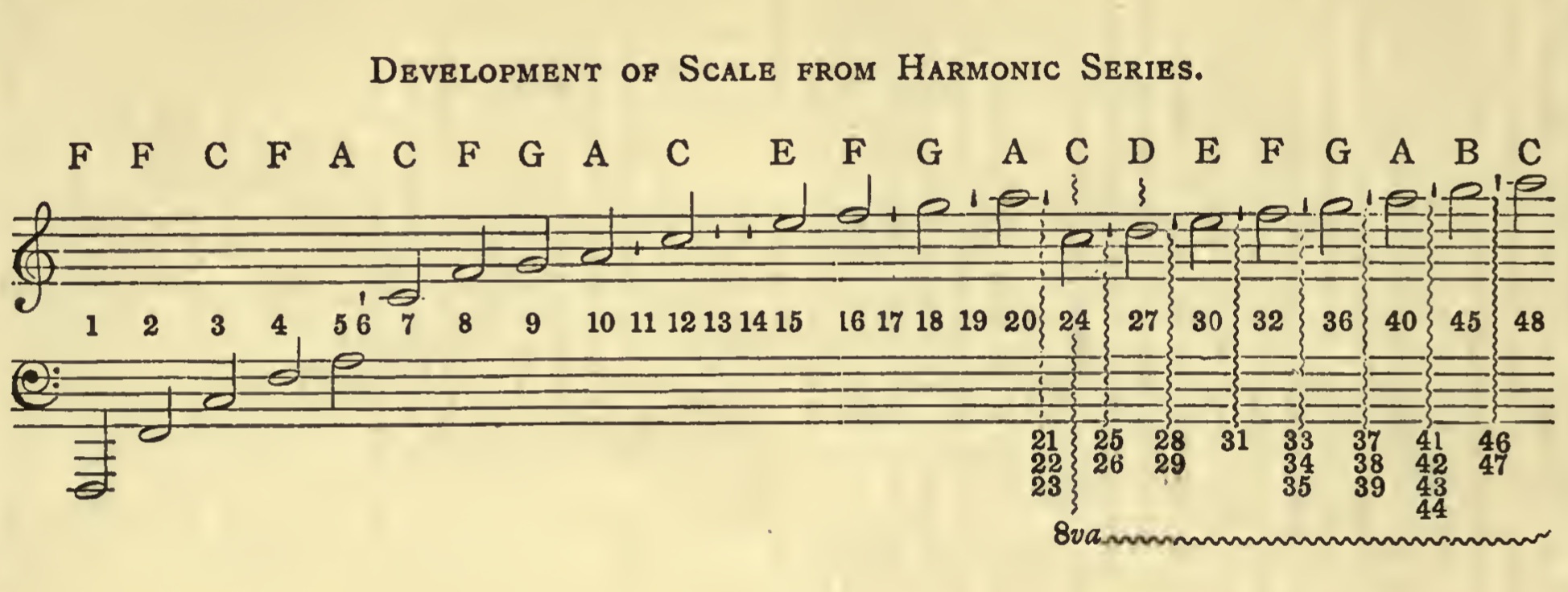
(from Stone's Scientific Basis of Music)
This dynaspheric force, which is also called etheric, is conditioned as to its nature on the of the atoms which form its transmitting ; and which are both in variety and in their combinations. They may, however, be broadly divided into two categories; viz., the and the non-sentient atoms. Dynaspheric force, composed of non-sentient atoms, is the force that has been already mechanically applied by Mr. to his motor; and which will probably, ere long, supersede the agencies now used for locomotive, projectile, and other purposes. When the laws which govern it come to be understood it will produce materially a great commercial and industrial . There is no hard-and-fast line between the and the non-sentient atoms; just as zoophytes are a connecting link between the animal and vegetable creation, so there is a graduated scale of atoms, between atoms [See ] which although animated by the divine life are not , and those which are as highly developed, relatively to them, as man is to a cabbage. [Dynaspheric Force]
, which, upwards, are able to surmount freely overfalling waterfalls several metres high, if particularly hollowed out flow-guiding stones cause the to flow in 'cycloid-spiral-space-curves', the form of that arises and can be observed above every through which is able to . This how the water-inwinding suctional forces and the reactive forces acting in the come into being in the of the . It is the latter forces that are at issue here. Today's , which measures and weighs everything exactly, overlooked them, because the ' of measure and ' can neither be measured with a , nor weighed with decimal scales. [The Energy Evolution - Harnessing Free Energy from Nature, The Life-Current in Air and Water]
In a word, after decades-long observations, trials and series of experiments, I succeeded in getting to the bottom of this mysterious of 's and in becoming aware of the unspeakable and purest that are united behind her two eternally concealed faces. I came to recognise the scales of fate of all life upon which every is scrupulously weighed after death and that whatever is no longer fit for the next higher evolutive progression is once more ruthlessly eliminated, it being of too a for its metaphysical transformation into exalted entities in the form of the above and levitative current. It has to return to greater or lesser depths within the Earth to with those vibratory influences in such a way that out of these basic substances new and levitative energies for a renewed attempt to . It is these revitalised substances, whose higher forms of essences possess and upwardly impelling functions, which make this resurrection possible. Falling and light- and heat-forms then subsequently ensure the of 'what is destined to ', namely the actual physical form of in which the counter-energies also reside, which initiate the further interactions that enable this of raw materials to grow, to and further itself. [The Energy Evolution - Harnessing Free Energy from Nature, The Life-Current in Air and Water]
When the fruit juices that have flourished in the begin to , it is a sign that differences have triggered the fermenting , which in the initial stages has to the from the . The former will be separated and centrifugated out through . The latter interconnects with itself, as it were, and the of this remarkable marriage is that something, which also brings us out of the delicately balanced that the Earth ceaselessly enjoys. Not being in a of stable equilibrium, she has constantly to about her own in a form of that declinates and oscillates in two directions. This is how she generates the inversely symmetrically- and inversely proportionally-acting force, which enables everything that crawls and flies on this Earth to move 'originally' (autonomously) in order to seek out its , which also contains allotropic energy-producing substances. These are then broken down through the vibration of the organs, leading to the familiar of strength and vigour, whose ur-causes have not been perceived by scientists, who with common calories and measure them with scales and rulers. Moreover, they also believe they have captured everything with their tweezers that is proper to . Unfortunately, however, this cannot be accomplished with such an , because the of 'measure' and '' is an imperceptible extraordinary , which as the '' is the 'reactivated' itself, which actively moves the . [The Energy Evolution - Harnessing Free Energy from Nature, New Forms of Motion and Energy]
already very shaky scientific edifice would come tumbling down, if the full scope of the reactive energy should become known too quickly. An of such a kind would then arise, which could not be endured in these days of shortages, and the baby would be thrown out with the bath-water by those, who have only one idea left: somehow to struggle through life and to be of all problems. Were this implemented, however, then the most marvellous things would come to life again, which compared to the present situation would be a . The trick therefore is - how do I tell the innocent children that the end has come for all manner of lusts for power, because a power is now appearing, before which everything else must unconditionally capitulate. Today this new power rejoices over the victory, which was brought about by the fact that the Germans - and this can be examined from any desired viewpoint - were unfortunately the best exponents of a founded on faecal matter. Unhappily they exploited precisely those expulsive energies that enable us, for example, to rid ourselves of those substances so vital to the Earth for maintaining the eternal of her motive forces. With the aid of these earthly and other waste materials she recreates everything anew, which our evolutionally older descendants absolutely require for their various necessities of life. For this reason wise will not hesitate much longer before she clears everything off the green with a single sweep of the hand, as it were, upon which, using scales and an , attempts were made to discover the '', namely, that which provides for the and measure of all things. And thus, instead of specific elements they found absolutely remnants, which they then declared to be 'atoms'. That these remnants of a former , which have been artificially rendered (stripped of life-force, so to speak), interact in a lively fashion, is quite obvious. Under no circumstances, however, do the products of that produce higher products come into being in this way, but only forms of heat and cold. These promote the of decay through further interactions, which in turn give rise to the and factors that promote an accelerated as well as the annihilating energies that by the square. That these energy-forms, which foster and are possessed of a force of resistance that increases by the square, contradict the irrational assumption that they actually further the of culture, is perhaps only incomprehensible to those who know nothing of the specific counter-elements and who, because of a tragic , established the crowning law of contemporary technology, such that under all circumstances the resistance must by the square of the velocity. The specific , the falling as it were, comes into being when etherialised substances are transferred to the 4th dimension. This happens, due to the fact that negatively potentiated constituents of carbonic [The Energy Evolution - Harnessing Free Energy from Nature, The Economy Founded on Reactively Produced Energy]
Ramsay
SCALE - "groups of notes or chords in succession, which are bound and unified in some clear and definite way." [Scientific Basis and Build of Music, page 64.]
"Of these three chords, which constitute a scale or key, next proceeds to generate, in a similar way, a family of scales or keys, and these in two lines, the Major and the Minor. The twice twelve-fold family of keys is brought forth in much the same way as were the chords which constitute them, and as were the notes which constitute the chords. There is a beautiful growth-like continuity in the production of all." [Scientific Basis and Build of Music, page 20]
"The system of musical sounds is derived from the laws of motion and a particular election of numbers which give the greatest variety of simple ratios.
There are three primary and pregnant ratios which produce the chords and scales. The first is the ratio of 1:2, producing Octaves, and nothing else; the second is the ratio of 2:3, producing Fifths; the third is the ratio of 4:5, producing Thirds." [Scientific Basis and Build of Music, page 26]
" and , and centrifugal force; these musical forces do not here refer to the center of the , but the center of the musical system, e.g., E in the scale of C." [Scientific Basis and Build of Music, page 27]
"The third note of the octave scale, E, the center of the tonic chord in the key of C, is the center of the system. It is the note which has the least tendency either upward or downward, and it has immediately above it in the octave scale the note which has the greatest amount of specific gravity, F, the root of the major subdominant; and immediately beneath it the note which has the greatest amount of specific levity, D, the top of the major dominant. Thus the root of the subdominant chord and the top of the dominant are placed right above and below the center of the system, and the gravity of the one above, and the of the one below, causes each of them to move in the direction of the center. These tendencies are seen in the scale at whatever key it may be pitched, and by whatever names the notes may be called. And it is on account of this permanency of of the notes that the third note of the scale, E, in the key of C, has a lower effect1 than the second, D; and that the fourth note, F, has a lower effect than either the first, second, or third; the fifth note, G, has a higher effect than the fourth, F; but the sixth, A, has a.." [Scientific Basis and Build of Music, page 28]
The extremes of the levities and gravities of a are always at the extent of three fifths; and whatever notes are adopted for these three fifths, the center is the . As there never can be more than three fifths above each other on the same terms, so there can never be more than one such scale at the same time. A fourth fifth is a comma less than the harmonic fifth1; and this is Nature's danger-signal, to show that it is not admissible here. Nature does not sew with a knotless thread in music. The elements are so place that nothing can be added nor anything taken away without producing confusion or defect. What has been created is thus at the same time protected by Nature. [Scientific Basis and Build of Music, page 38]
The mathematical scales, if followed out regardless of other laws which rule in music, would read like a chapter in Astronomy. They would lead us on like the cycles of the , for example. In 19 years we have 235 moons; but the moon by that time is an hour and a-half fast. In 16 such cycles, or about 300 years, the moon is about a day fast; this, of course, is speaking roughly. This is the way seemingly through all the astronomical realm of creation. And had we only the mathematical ratios used in generating the notes of the scale as the sole law of music, we should be led off in the same way. And were we to follow up into the inaudible region of vibrations, we should possibly find ourselves where light, and heat, and chemical elective motions and electric currents are playing their unheard harmonies; or into the seemingly still region of solid substances, where an almost infinite tremor of vibrations is balancing the ultimate elements of the world. in this case would seem like some passing meteor coming in from among the silent oscillations of the planetary bodies of the solar system, and flashing past with its charming sound effects, and leaving us again to pass into the higher silence of those subtle vibrations to which we have referred, having no infolding upon itself, no systematic limit, no horizon. But music is not such a passing thing. Between the high silence of these intense vibrations, and the low silence of oscillating pendulums and revolving planets, has constituted an audible of vibrations, in which is placed a definite limit of systematic sounds; seven octaves are carried like a measuring line round twelve fifths; and and unite in placing a horizon for the musical world, and music comes [Scientific Basis and Build of Music, page 39]
of the being upward, and the of the being downward. The ascending , beginning with the of the subdominant major F, produces in the ascent a scale of notes at varying distances, and of increasing levities; the middle note, D27, being carried a little above the center of the system. The descending , beginning with the top of the dominant minor B, produces in the descent a scale of notes with identical variety of distances, but with increasing gravities; the middle note, D26 2/3, being pressed a little below the center of the system, thus giving rise to these two D's - one whose genetic number is 27, the major D, and one whose genetic number is 27 2/3, the minor D - the duality of D is thus residing in itself.1 [Scientific Basis and Build of Music, page 43]
It is according to the Law of Duality that the keys on the piano have the same order above and below D, and above and below G# and A?, which is one note. In these two places the dual notes are given by the same key; but in every other case in which the notes are dual, the order above the one and below the other is the same. The black keys conform to the scale, and the fingering conforms to the black keys. On that account in the major scale with flats, for the right hand the thumb is always on F and C; and as the duals of F and C are B and E in the minor scale with sharps, for the left hand thumb is always on B and E. [Scientific Basis and Build of Music, page 44]
Here, then, we have an order of modes entirely symmetical in pairs placed thus; the only mode that can stand alone being the Dorian, built on D, whose duality has been discovered to reside in itself. All this build of , which was the watchword of Greek art, as it is also one of the watchwords of , presupposes that the tones of the scale, with lesser and larger intervals lying between them, were resting in their ears exactly as they are in ours,1 and as they are in all humanity, save where it has sunk down into the savage condition, benighted in the that is in the world. It is not to be concluded that the Dorian mode is Nature's primitive scale, although it might have a certain pre-eminence [Scientific Basis and Build of Music, page 45]
It should not be supposed that this division of the notes into semitones, as we call them, is something invented by man; it is only something observed by him. The cutting of the notes into twelve semitones is 's own doing. She guides us to it in passing from one scale to another as she builds them up. When we pass, for example, from the key of C to the key of G, Nature divides one of the intervals into two nearly equal parts. This operation we mark by putting a # to F. We do not put the # to F to make it , but to show [Scientific Basis and Build of Music, page 47]
that has done so.1 And in every new key into which we modulate Nature performs the same operation, till in the course of the twelve scales she has cut every greater note into two, and made the notes of the scale into instead of . These we, as a matter of convenience, call semitones; though they are really as much tones as are the small intervals which Nature gave us in the of the first scale between B-C and E-F. She only repeats the operation for every new key which she had performed at the very first. It is a new key, indeed, but exactly like the first. The 5 and 9 commas interval between E and G becomes a 9 and 5 comma interval; and this Nature does by the rule which rests in the , and is uttered in the obedient , and not by any mathematical authority from without. She cuts the 9-comma F to G into two, and leaving 5 commas as the last interval of the new key of G, precisely as she had made 5 commas between B and C as the last interval of the key of C, she adds the other 4 commas to the 5-comma step E to F, which makes this second-last step a 9-comma step, precisely as she had made it in the key of C.2 [Scientific Basis and Build of Music, page 48]
In the - that is, the going on from one to another - of these triplets in harmonizing the octave scale ascending, goes on normally till we come to the passage from the to the seventh note of the scale, whose two chords have no note in common, and a new has to be taken to link them together. And here the true way is to follow the method of in the of chords.1 The root of the subdominant chord, to which the of the octave scale belongs, which then becomes a 4-note chord, and is called the dominant seventh; F, the root of the subdominant F, A, C, is added to G, B, D, the notes of the dominant, which then becomes G, B, D, F; the two chords have now a note in common, and can pass on to the end of the octave scale normally. In going down the octave scale with harmony, the passage from the seventh to the , where this break exists, meets us at the very second ; but following 's method again, the top of the dominant goes over to the root of the subdominant, and F, A, C, which has no note in common with G, B, D, becomes D, F, A, C, and is called the subdominant sixth; and continuity being thus established, the harmony then passes on normally to the bottom of the scale, every successive chord being linked to the preceding note by a note in common. [Scientific Basis and Build of Music, page 49]
We have gone from vibrations to musical notes; from notes to chords; and now we proceed to scales - that is, groups of notes or chords in succession, which are bound and unified in some clear and definite way. [Scientific Basis and Build of Music, page 64]
The Chromatic Scale is naturally the last to come into view, for it is not generated by a mathematical process at all. Chromatic intervals are indeed found in the scale as mathematically generated. The semitones between B-C and E-F are two chromatic intervals, and the chord which occurs between the and the in the when it begins with the minor mode is a chromatic chord, though in an uncompleted condition. But the making of the octave into a chromatic scale of twelve small or semi-tones, is the work of modulation from one key to another through the whole twelve keys in either the major or minor sphere; and this process is fully set forth in the pre-note to the chromatic treatise. [Scientific Basis and Build of Music, page 69]
In getting the of a , in inches or otherwise, to produce the scale of music, any number may be fixed on for the ; or for the vibrations of the note any number may be fixed on for the ; but in the fractions which show the proportions of the notes of the scale, there is no coming and going here; this belongs to the invariables; there is just one way of it. Whatever is not here is . It is here we are to look for the . The numbers which express the and the numbers which express the motions are always related as being of the same kind. The fractions bring their characters with them, and we know by this where they come from. 1/4 of a gives a note 2 octaves above the whole , no matter what may be its ; 2 has exactly the same as 1; 2/4 gives the note which is 1 octave above the whole ; but in the case of 3/4 here is a new ingredient, 3; 3/4 of a gives a note which is a below the [Scientific Basis and Build of Music, page 75]
There is nothing extraordinary in this. It is another fact which gives this one its importance, and that is that the musical system is composed of three fifths rising one out of another; so this note by 3/4 becomes the not only of a chord, but the of all the three chords, of which the one is the ; the chord of the balance of the system, the chord of the key; the one out of which it grows, and the one which grows out of it, being like the scales which sway on this central balance-beam. Thus F takes its place, C in the center, and G above. These are the 3 fifths of the system on its or major side. The fractions for A, E, and B, the notes of the three chords, are 4/5, 3/5, and 8/15; this too tells a tale; 5 is a new ingredient; and as 3 gives fifths, 5 gives . From these two primes, 3 and 5, along with the or , all the notes of the system are evolved, the octaves of all being always found by 2. When the whole system has been evolved, the numbers which are the lengths of the strings in the or major mode are the numbers of the vibrations of the notes of the or minor mode; and the of the or are the vibration-numbers of the notes of the or masculine mode. These two numbers, the one for lengths and one for vibrations, when multiplied into each other, make in every case 720; the octave of 360, the number of the degrees of the circle. [Scientific Basis and Build of Music, page 76]
At the first, in the laws of quantities and motions adjusting musical vibrations, there is one chord of the three notes, F, A, C, the , , and of the five notes which compose the true natural scale; this one chord can be reproduced a higher, C, E, G, in the same mathematical form, taking the of the first for the of the second chord. In like manner this second can be reproduced another higher, G, B, D, still in the same mathematical form, and so fit to be a member of the of a key. But the law does not admit of another reproduction without interfering with the first chord, so that a fourth produces no new effect; but the whole key is simply a higher, i.e., if the has been properly produced by multiplying the of the third by 3 and by 5, the generating primes in music. That this carries us into a new scale is seen in that the F is no longer the F? but F#, and the A is no longer A? but A,. But if we suppose the fourth to be simply the old notes with their own vibration numbers, then D, F, A would not be a belonging either to the major or the minor mode, but a a comma less. The letters of it would read like the minor subdominant, D, F, A; but the intervals, as found in the upward development of the major genesis, instead of being, when expressed in commas, 9, 5, 8, 9, which is the minor subdominant, would be 8, 5, 9, 8, which is not a of the musical system; these having always, whether or , two 9's, one [Scientific Basis and Build of Music, page 77]
Helmholtz falls into a mistake when he says- "The system of scales and modes, and all the network of harmony founded on them, do not seem to rest on any immutable laws of Nature, but are due to the aesthetical principle which is constantly subject to change, according to the development of ." It is true, indeed, that the is the last judge; but the is to judge something which it does not create, but simply judges. is the maker of music in its scales and modes. The styles of may vary with successive generations, and in the different nations of men; but the scientific basis of music is another thing. It is a thing, belonging to the aesthetic element of our being and our environment; it is under the of the beautiful, rather than the of the useful or the just; but all these various aspects of our relation to creation have their laws which underlie whatever changes may be fashionable at any period in our practice. If the of a musical tone, that is, its quality or , depends on the number and comparative strength of the partial tones or of which it is composed, and this is considered to be the great discovery of Helmholtz, it cannot be that the scales and modes are at the caprice of the fickle and varied of times and individuals, for these partials are under 's mathematical usages, and quite beyond any for man's to change. It is these very partials or brought fully into view as a system, and they lead us back and back till they have brought us to the great all-prevading law of gravitation; it is these very partials, which clothe as an audible every musical sound, which constitute the musical system of sounds. [Scientific Basis and Build of Music, page 78]
Mr. Pole, in his Philosophy of Music, begins his remarks about the scale by a reference to the savage condition of men, and their few and uncouth musical sounds. This is the fashionable way at present of viewing mankind's early days. It is not necessary, however, to conceive the first state of mankind [Scientific Basis and Build of Music, page 78]
as the savage state. The savage is the sunken state of man, consequent on falling away from by distrust and disobedience, and the loss of paradisial converse with Him. We may presume that music in the beginning, when the first human pair sang out with unbroken voices the of their hearts, was in the scale to which mankind, risen and restored by 's , have returned. Our last days are thus become like the first again; and the lost dominion of has returned, in the Incarnate One, into the hands of mankind. [Scientific Basis and Build of Music, page 79]
Having found the framework of the major scale by multiplying F1 three times by 3, find the framework of the by dividing three times by 3. But what shall we divide? Well, F1 is the of the 25 notes of the great genetic scale; B45 is the last-born of the same scale. We multiply upward from F1 for the ; divide downward from B45 for the . Again, B45 is the of the chord of the major system, a minor third below D, the of that chord, and the of the whole , so B is the relative minor to it. Now since the is to be seen as the INVERSE of the , the whole process must be . instead of ! from the chord instead of from the chord. from the top of the minor dominant instead of from the root of the major subdominant. This will give the framework of the minor system, B45/3 = E15/3 = A5/3 = D1 2/3. But as 1 2/3 is not easily compared with D27 of the , take a higher octave of B and divide from it. Two times B45 is B90, and two times B90 is B180, and two times B180 is B360, the number of the degrees of a circle, and two times B360 is B720; all these are simply octaves of B, and do not in the least alter the of that note; now B720/3 is = E240/3 = A80/3 = D26 2/3. And now comparing D27 found from F1, and D26 2/3 found from B720, we see that while E240 is the same both ways, and also A80, yet D26 2/3 is a comma lower than D27. This is the note which is the center of the dual system, and it is itself a dual note befittingly. [Scientific Basis and Build of Music, page 81]
There are two octaves in the key of C, as it is called. Now for the scale of a higher than C, that is G, multiply the top of the dominant, that is the highest note of the , by 3 and by 5, and the two new notes for the scale of G will be found; the rest of the notes are the same mathematically as those of C. [Scientific Basis and Build of Music, page 82]
The chords of the scale are S F A C, T C E G, D G B D. Now D is the top of the dominant. Well, take it as D27 or D54 it is all the same, higher or lower octave.
D27 D27
3 5
2) 81 A, 2)185 F#
2) 40 1/2 A, 2) 67 1/2 F#
20 1/4 A, 33 3/4 F# [Scientific Basis and Build of Music, page 82]
third; and in order to do so, A has been mathematically raised a comma, which makes G A B now a 9-8 comma . E F G, which in the scale of C was a 5-9 comma , must now take the place of A B C in the scale of C, which was a 9-5 comma ; and in order to do so, F is mathematically raised 4 commas, and must be marked F#; and now the interval is right for the scale of G. E F# G is a 9-5 comma interval. This mathematical process, in the majors, puts every scale in its original form as to vibration-numbers; but since the same letters are kept for the naming of the notes, they must be marked with commas or sharps, as the case may be. In the Sol Fa notation such marks would not be necessary, as Do is always the key-note, Ray always the , and Te always the seventh. [Scientific Basis and Build of Music, page 83]
When higher or lower octaves of any note or scale are wanted for convenience of comparison, or divide by two, the octave-producer. [Scientific Basis and Build of Music, page 83]
The interval F G A, which in the scale of A was a 9-8-comma interval, must take the place of C D E of the scale of A, which is an 8-9-comma interval; and in order to do this, G has been mathematically lowered a comma. As the middle of the dominant in the is raised a comma, so the root of the subdominant is lowered a comma. The interval A B C, which in the scale of A was a 9-5-comma interval, is here to take the place of E F G in the scale of A, which is a 5-9-comma interval; and in order to do so, B is lowered 4 commas, and so becomes ?B; and this mathematical process makes the new scale exactly like the old one. This is the way of the minors when calculated as a descending series of scales, which is their natural way. [Scientific Basis and Build of Music, page 84]
In respect of harmony, the natural scale of five notes is like the scale of man's five senses; as the other notes can be compounded so as to form the octave of harmony, so is joined by , and new elements of knowledge come into existence in the process of . But the knowledge we have in our logical deductions is knowledge on different terms from , which is ; though if the logical process be rightly done, it is knowledge as certainly as the compound chords of the octave scale are harmony, quite as much, and a little more, perhaps, though on more complex terms, as that of the five notes of the natural scale. [Scientific Basis and Build of Music, page 86]
The six successive major scales with sharps require 2 new notes each, and the six successive minor scales with sharps require also 2 new notes each; but one of these new notes for each minor scale is supplied from the scale of the relative major, and the other from the sub-relative major, i.e., the scale one-fifth lower than the relative. So when the major scales with sharps have been developed they furnish all the new notes needed for the minors. The six successive minor scales with flats require 2 new notes each, and the six successive major scales with flats require each 2 new notes; but one of these is supplied from the scale of the relative minor, and the other from the scale of the , i.e., the scale one fifth higher than the relative. So when the minor scales with flats are developed they furnish all the new notes require by these majors. [Scientific Basis and Build of Music, page 89]
The reason why there are 13 mathematical scales is that G? and F# are written separately as two scales, although the one is only a comma and the apotome minor higher than the other, while in the regular succession of scales the one is always 5 notes higher than the other; so this G? is an anomaly among scales, unless viewed as the first of a second cycle of keys, which it really is; and all the notes of all the scales of this second cycle are equally a comma and the higher than the notes of the first cycle; and when followed out we find that a third cycle is raised just as much higher than the second as the second is higher than the first; and what is true of these majors may be simply repeated as to the D# and E? of the minors, and the new so begun, and all successive cycles. Twelve and not is the natural number for the mathematical scales, which go on in a spiral line, as truly as for the tempered scales, which close as a circle at this point. [Scientific Basis and Build of Music, page 89]
The two notes required for the scale of
E minor are the F# of G, and the D of C major;
for B minor, the C# of D, and the A of G major;
for F# minor, the G# of A, and the E of D major;
for C# minor, the D# of E, and the B of A major;
for G# minor, the A# of B, and the F# of E major;
for D# minor, the E# of F#, and the C# of B major. [Scientific Basis and Build of Music, page 90]
In a similar and responsive way provides for the six major scales with flats.
The two new notes required for the scale of
F major are the B? of D, and the D of A minor;
for B? major, the E? of G, and the G of D minor;
for E? major, the A? of C, and the C of G minor;
for A? major, the D? of F, and the F of C minor;
for D? major, the G? of B?, and the B? of F minor;
for G? major, the C? of E?, and the E? of B? minor.1 [Scientific Basis and Build of Music, page 90]
The scales march on following each other methodically, whether they be written with sharps or flats, and
"Not a is out of , as the tides obey the ."
The most natural, because the genetic, way to write the scales is to make the major scales all in sharps, after C, because the major genesis is upward in ratios ascending; and to make the minor scales all in flats, after A, because the minor genesis is downward in ratios descending. Let the young student, however, always keep in mind that the sharps and flats are simply marks to show how , at whatever pitch we are taking the scales, is securely keeping them in the same form as when they are first generated; and in their no sharps or flats are needed. [Scientific Basis and Build of Music, page 90]
It must be noted that the two new notes needed for each new scale are quite a different affair from the sexual note, that is the note which is different in and , e.g., the two D's in major C and minor A. The [Scientific Basis and Build of Music, page 90]
sexual note in the scales of G major and E minor are the two A's; in D major and B minor, the two E's; in A major and F# minor, the two B's; in E major and C# minor, the two F's; in B major and G# minor, the two C's; and in F# major and D# minor, the two G's. These two last scales being the beginning of a second cycle of twelve scales when the scales are written half in flats and half in sharps, as we have done them in this case. Turning to the other half of our circle, those which we have, and which usually in music books are, written in flats, in F major and D minor the sexual notes are the two G's; in B? and G, the two C's, in E? and C, the two F's; in A? and F, the two B's; in D? and B?, the two E's; and in G? and E?, the two A's. [Scientific Basis and Build of Music, page 91]
In a musical air or harmony, i.e., when once a key has been instituted in the , all the various notes and chords seem animated and imbued with and ; and the center of attraction and repose is the , i.e., the key-note or . The moving notes have certain leanings or attractions to other notes. These leanings are from two causes, local proximity and native affinity. The attraction of native affinity arises from the and of the notes as seen in the six-octave genesis, and pertains to their harmonic combinations. The attraction of local proximity arises from the way the notes are marshalled compactly in the octave scale which appears at the head of the , and pertains to their melodic succession. In this last scale the proximities are diverse; the 53 commas of the octave being so divided as to give larger and lesser distances between the notes; and of course the attraction of proximity is strongest between the nearest; a note will prefer to move 5 commas rather than 8 or 9 commas to find . Thus far . [Scientific Basis and Build of Music, page 91]
The one of these three chords is called the ; the chord above is called the dominant; and the chord below is called the subdominant. The in which these three chords contribute to form the octave scale is as follows:- The first note of the scale is the root of the tonic; the second is the [Scientific Basis and Build of Music, page 96]
In the first six chords of the scale the is the first of each two. The tonic chord alternating with the other two produces an order of twos, as - tonic dominant, tonic subdominant, tonic subdominant. The first three notes of the octave scale are derived from the , the , and the middle of the tonic dominant and ; the second three are derived from the , , and middle of the subdominant, , and subdominant. The roots, tops, and middles of the chords occurring as they do produce an order of threes, as - , , ; , , . The first, third, fifth, and eighth of the scale are from the tonic chord; the second and seventh from the dominant; and the fourth and sixth from the subdominant. In the first two chords of the scale the precedes the dominant; in the second two, the subdominant; and in the third two the again precedes the subdominant; and as the top of the subdominant chord is the root of the tonic, and the top of the tonic the root of the dominant, this links these chords together by their roots and tops. The second chord has the top of the first, the third has the root of the second, the fourth has the root of the third, the fifth has the top of the fourth, and the sixth has the root of the fifth; and in this way these successive chords are woven together. The only place of the octave scale where there are two middles of chords beside each other is at the sixth and seventh. The seventh note of the octave scale is the middle of the dominant, and the sixth is the middle of the subdominant. These two chords, though both united to the , which stands between them, are not united to each other by having a note in common, inasmuch as they stand at the extremities of the ; and since they must be enabled to succeed each other in musical progression, has a beautiful way of giving them a note in common by which to do so - adding the root of the subdominant to the top of the dominant, or the top of the dominant to the root of the subdominant, and this gives natural origin to compound chords. The tonic chord, being the center one of the three chords, is connected with the other two, and may follow the dominant and sub- [Scientific Basis and Build of Music, page 97]
"Each note in the scale is attracted to the note above it or the one below it. B is attracted to C. If F and G were attracted to each other by proximity, then A would be left alone without a note to attract or by which to be attracted by proximity. All the [Scientific Basis and Build of Music, page 98]
"What we have thus said about the resolving notes to the major tonic has been allowed in the case of the . No one ever said that the of the minor scale resolved to the root of the tonic. Notwithstanding the importance of the notes, the semitonic interval above the of the scale decided the matter for the Law of Proximity; and no one ever said that D, the root of the subdominant minor, did not to C, the center of the tonic minor, on the same terms that two notes are brought to the center of the tonic major; with this difference, that the semitonic interval is above the center in the and below it in the . The other two notes which into the tonic minor are on the same terms as the ; with this difference, that the semitonic interval is below the root of the tonic major and above the top of the tonic minor. And the small tone ratio 9:10 is above the top of the tonic major and below the root of the tonic minor. If it has been the case that D resolved to the root of the tonic major, then, according to the Law of Duality, there would have been another place where everything would have been the same, only in the inverse ; but, fortunately for itself, the has no other to keep it in . This has not been fallen into by from analogy. [Scientific Basis and Build of Music, page 99]
VIOLIN-FINGERING - Whenever the third finger is normally fourth for its own open , then the passage from the third finger to the next higher open is always in the ratio of 8:9; and if the key requires that such passage should be a 9:10 interval, it requires to be done by the little finger on the same , because the next higher open is a comma too high, as would be the case with the E string in the key of G. In the key of C on the you cannot play on the open A and E strings; you must pitch all the notes in the scale higher if you want to get [Scientific Basis and Build of Music, page 99]
the use of these two open strings in the key of C, on account of the intervals from G to A and from D to E being the ratio of 9:10, the medium in the scale. G, the third finger on the third , to A, the open second , and D, the third finger on the second , to E, the open first , being in ratio of 8:9, the large , you must either use the fourth finger for A and E, or use all the other notes a comma higher. But if thus you use all the notes a little higher, so as to get the use of the A and E strings open, then you cannot get the use of the G and D strings open. On the other hand, in this key of C, if you use the G and D strings open, you cannot use the A and E strings open. One might think the cases parallel, but they are not; because you have a remedy for the first and second open strings, but no remedy for the other two. The remedy for the first and second open strings is to put the fourth finger on the second and third strings for the E and A; but it would be inconvenient, if not impossible, to use the other two strings, G and A, by putting the first finger a comma higher than the open . [Scientific Basis and Build of Music, page 100]
EXPLANATION OF PLATES.
[BY THE EDITOR.]
THIS plate is a Pendulum illustration of the System of musical vibrations. The circular lines represent Octaves in music. The thick are the octave lines of the fundamental note; and the thin lines between them are lines of the other six notes of the octave. The notes are all on lines only, not lines and spaces. The black dots arranged in these lines are not notes, but pendulum oscillations, which have the same ratios in their slow way as the vibrations of sounding instruments in the much quicker region where they exist. The center circle is the Root of the System; it represents F1, the root of the subdominant chord; the second thick line is F2, its octave; and all the thick lines are the rising octaves of F, namely 4, 8, 16, 32, and 64. In the second octave on the fifth line are dots for the three oscillations which represent the note C3, the Fifth to F2, standing in the ratio of 3 to 2; and the corresponding lines in the four succeeding Octaves are the Octaves of C3, namely 6, 12, 24, and 48. On the third line in the third Octave are 5 dots, which are the 5 oscillations of a tuned to swing 5 to 4 of the F close below; and it represents A5, which is the Third of F4 among musical vibrations. On the first line in the fourth Octave are 9 dots. These again represent G9, which stands related to C3 as C3 stands to F1. On the seventh line of the same octave are 15 dots; these represent the vibrations of E15, which stands related to C3 as A5 stands to F1. On the sixth line of the fifth Octave are 27 dots, representing D27, which stands related to G9 as G9 stands to C3, and C3 also to F1; it is the Fifth to G. And last of all, on the fourth line of the sixth Octave are 45 dots, representing B45, which, lastly, stands related to G9 as E15 stands to C3, and A5 to F1; it is the Third to this third chord - G, B, D. The notes which arise in each octave coming outward from the center are repeated in a double of dots in the following Octaves; A5 appears as 10, 20, and 40; G9 appears as 18 and 36; E15 appears as 30 and 60; D27 appears as 54; and last of all B45 only appears this once. This we have represented by oscillations, which we can follow with the , the three chords of the musical system, F, A, C; C, E, G; and G, B, D. C3 is from F1 multiplied by 3; G9 is from C3 multiplied by 3; these are the three Roots of the three Chords. Their Middles, that is their Thirds, are similarly developed; A is from F1 multiplied by 5; E15 is from C3 multiplied by 5; B45 is from G9 multiplied by 5. The primes 3 and 5 beget all the new notes, the Fifths and the Thirds; and the prime 2 repeats them all in Octaves to any extent. [Scientific Basis and Build of Music, page 102]
In Fig. 1, the mathematical framework of the scales and , is shown the genesis of the scale. F1, in the top figure, is multiplied by 3, and that by 3, and that by 3, which brings us to D27, top of the major dominant. F1 is the of the whole system. C3 is the of the first chord, and from that grows the next, and from that the next; and so we have F, C, G, and D, the tops and roots of the major system of chords. When these 3 roots are each multiplied once by 5, the middles of the chords are found, as shown - A, E, and B; so B is the last-born of the family. When B is taken 4 octaves higher at the number 720 and divided by 3, and that by 3, and that by 3, we get the notes E, A, and D, which are the roots and tops of the minor system of chords. Dividing B, E, and A each by 5 once, we get the middles of the 3 minor chords, as shown. [Scientific Basis and Build of Music, page 103]
This plate is a representation of the area of a scale; the major scale, when viewed with the large , lowest; the when viewed the reverse way. It is here pictorially shown that and does not mean larger and smaller, for both modes occupy the same , and have in their structure the same intervals, though standing in a different . It is this in structural arrangement of the intervals which characterizes the one as and the other as , which are much preferable to the and as distinctive names for the two modes. Each scale, in both its modes, has three Fifths - subdominant, , and dominant. The middle fifth is the , and its lowest note the key-note of the scale, or of any written in this scale. The 53 commas of the are variously allotted in its notes - 3 of them have 9 commas, 2 have 8, and 2 have 5. The area of the scale, however, has much more than the octave; it is two octaves, all save the minor third D-F, and has 93 commas. This is the alike of masculine and feminine modes. The two modes are here shown as directly related, as we might figuratively say, in their marriage relation. The law of Duality, which always emerges when the two modes are seen in their , is here illustrated, and the dual notes are indicated by oblique lines across the pairs. [Scientific Basis and Build of Music, page 106]
When Leonhard Euler, the distinguished mathematician of the eighteenth century, wrote his essay on a New Theory of Music, Fuss remarks - "It has no great success, as it contained too much geometry for musicians, and too much music for geometers." There was a reason which Fuss was not seemingly able to observe, namely, that while it had hold of some very precious musical it also put forth some , and is always a hindrance to true progress. Euler did good service, however. In his letters to a German Princess on his theory of music he showed the true use of the mathematical primes 2, 3, and 5, but debarred the use of 7, saying, "Were we to introduce the 7, the tones of an octave would be increased." It was wise in the great mathematician to hold his hand from adding other notes. It is always dangerous to offer strange fire on the . He very clearly set forth that while 2 has an unlimited use in producing Octaves, 3 must be limited to its use 3 times in producing . This was right, for in producing a fourth Fifth it is not a Fifth for the scale. But Euler erred in attempting to generate the semitonic scale of 12 notes by the use of the power of 5 a second time on the original materials. It produces F# right enough; for D27 by 5 gives 135, which is the for F#. D27 is the note by which F# is produced, because D is right for this process in its unaltered condition. But when Euler proceeds further to use the prime 5 on the middles, A, E, and B, and F#, in their original and unaltered state, he quite errs, and produces all the sharpened notes too low. C# for the key of D is not got by applying 5 to A40, as it is in its ; A40 has already been altered for the key of G by a comma, and is A40 1/2 before it is used for producing its ; it is A40 1/2 that, multiplied by 5, gives C#202 1/2, not C200, as Euler makes C#. Things are in the same condition with E before G# is wanted for the key of A. G# is found by 5 applied to E; not E in its original and unaltered state, E30; but as already raised a comma for the key of D, E30 3/8; so G# is not 300, as Euler has it, but 303 3/4. Euler next, by the same erroneous methods, proceeds to generate D# from B45, its ; but before D# is wanted for the key of E, B has been raised a comma, and is no longer B45, but B45 9/16, and this multiplied by 5 gives D#227 13/16, not D225, as Euler gives it. The last which he generates to complete his 12 semitones is B?; that is A#, properly speaking, for this series, and he generates it from F#135; but this already altered note, before A# is wanted for the key of B, has been again raised a comma [Scientific Basis and Build of Music, page 107]
The Plate shows the Twelve Major and Minor Scales, with the three chords of their harmony - subdominant, , and dominant; the tonic chord being always the center one. The straight lines of the three squares inside the embrace the chords of the major scales, which are read toward the right; e.g., F, C, G - these are the roots of the three chords F A C, C E G, G B D. The tonic chord of the scale of C becomes the subdominant chord of the scale of G, etc., all round. The curved lines of the embrace the three chords of the successive scales; e.g., D, A, E - these are the roots of the three chords D F A, A C E, E G B. The tonic chord of the scale of A becomes the subdominant of the scale of E, etc., all round. The sixth scale of the Majors may be written B with 5 sharps, and then is followed by F with 6 sharps, and this by C with 7 sharps, and so on all in sharps; and in this case the twelfth key would be E with 11 sharps; but, to simplify the signature, at B we can change the writing into C, this would be followed by G with 6 flats, and then the signature dropping one at every new key becomes a simpler expression; and at the twelfth key, instead of E with 11 sharps we have F with only one . Similarly, the Minors make a change from sharps to flats; and at the twelfth key, instead of C with 11 sharps we have D with one . The young student, for whose help these pictorial illustrations are chiefly prepared, must observe, however, that this is only a matter of musical orthography, and does not practically affect the music itself. When he comes to the study of the mathematical scales, he will be brought in sight of the exact very small difference between this B and C?, or this F# and G?; but meanwhile there is no for him. [Scientific Basis and Build of Music, page 108]
In the center column are the notes, named; with the lesser and larger steps of their mathematical evolution marked with commas, sharps, and flats; the comma and of the descending placed to the left; the comma and of the ascending to the right; and in both cases as they arise. If a note is first altered by a comma, this mark is placed next to the letter; if first altered by a or , these marks are placed next the letter. It will be observed that the sharpened note is always higher a little than the note above it when flattened; A# is higher than ?B; and B is higher than ?C, etc.; thus it is all through the scales; and probably it is also so with a fine guided by a true ; for the natural of sharpened notes is upward, and that of flattened notes downward; the of such is so small, however, that there has been of opinion as to whether the sharp and ? have a space between them, or whether they overlap, as we have shown they do. In tempered instruments with fixed keys the small disparity is ignored, and one key serves for both. In the double columns right and left of the notes are their mathematical numbers as they arise in the Genesis of the scales. In the seven columns right of the one number-column, and in the six on the left of the other, are the 12 major and their 12 relative minor scales, so arranged that the mathematical number of their notes is always standing in file with their notes. D in A minor is seen as 53 1/3, while the D of C major is 54; this is the comma of in the primitive , and establishes the sexual distinction of and all through. The fourth of the is always a comma lower than the of the , though having the same name; this note in the development of the scales by flats drops in the a comma below the , and in the development of the scales by sharps ascends in the a comma above the . In the head of the plate the key-notes of the 12 majors, and under them those of their relative minors, are placed over the respective scales extended below. This plate will afford a good deal of teaching to a careful student; and none will readily fail to see beautiful indications of the deep-seated of Major and Minor. [Scientific Basis and Build of Music, page 109]
Under the of a music plant this plate gives us to realize the growth-like continuity of chords and scales. The roots of the three chords of a key are represented in F, C, and G of the key of C. The plant might be represented as a creeping stem, like the creepers of the , with its progressive roots struck into the ; but it is better to show an upward stem with aerial roots, for such are the roots of the musical plant. The main stem of the plant has the three chords, F a C e G b D; that is, F a c, C e g, G b d, the subdominant, , and dominant. The terminal chord, D f# a, is to show that the keys as well as the chords out of each other. Include the side branches which terminate with the octave notes of the chords, read thus - F a c f, G e g e, G b d g, because a chord is felt to be most complete in its when thus shut in by the octave note of its . This is the reason why the great three-times-three chord does not stop at D, the top of the dominant chord, but goes on to the sixth octave of the fundamental root, shutting all in by the great , F, in order to preserve the of the effect which this chord of chords produces. Before D. C. Ramsay showed that the scale of Harmonics extended to six octaves, it was by teachers of the science of music only extended to four. [Scientific Basis and Build of Music, page 110]
given to this scale, as the D of A minor would be a comma too low; it would make a <9-comma> interval between D and E, the seventh and eighth, where the minor mode has an <8-comma> one. So its two new notes are thus found in the relative and sub-relative majors. This is the way of their mutual providing in the region of the #s; the # seventh of the is given to be the # second of the , and the comma-higher second of the sub-relative becomes the seventh of the ; and then we have a true written representation of what has done. [Scientific Basis and Build of Music, page 113]
The being divided into 53 commas, the intervals are measured, as usual, by these, the large second having 9-commas, the medium second having 8, and the small second 5. These measures are then made each the by which to draw hemispheres showing the various and comparative areas of the seconds. The comparative areas of the are shown by the hemispheres of the seconds which them facing each other in pairs. The comma-measures of the various thus determined are then made the radii by which to draw the two hemispheres of the fifths. The areas of the three fifths are identical, as also the attitudes of their unequal hemispheres. The of the six , on the other hand, in their two kinds, being reversed in the upper and under halves of the scale, their gives them the appearance of being attracted towards the center of the ; while the of the three fifths is all upward in the , and all downward in the ; their attraction being towards the common center of the twelve scales which has placed between the of the and the fourth of the , as seen in the two D's of the dual genetic scale, - the two modes being thus seen, as it were, revolving [Scientific Basis and Build of Music, page 113]
When Plate XIII. is divided up the middle of the column, as in Plate XIV., so as that one side may be slipped up a , representing a new key one-fifth higher, its subdominant made to face the old , the two new notes are then pictorially shown, the second being altered one comma and the seventh four commas. The key at this new and higher pitch is by 's unfailing care kept precisely in the same form as the first; and wherever the major scale is pitched, higher or lower, the form remains unaltered, all the intervals arranging themselves in the same . The , and the obedient to it, carry 's in them, and the writing must use such marks as may truly represent this; hence the use of sharps, flats, and naturals; these, however, be it observed, are only marks in the writing; all is at any pitch in the scale itself. All this is equally true of the minor mode at various pitches. These two plates are only another and more pictorial way of showing what the and the signature are usually made to express. [Scientific Basis and Build of Music, page 114]
The middle portion with the and lines are the chromatic chords, as it were 'd. They are shown 5-fold, and have their form from the right side, and their form from the left. In the column on the right they are seen in resolution, in their primary and fullest manner, with the 12 minors. The reason why there are 13 scales, though called the 12, is that F# is one scale and G? another on the side; and D# and E? separated the same way on the side. Twelve, however, is the natural for the mathematical scales as well as the tempered ones. But as the mathematical scales roll on in cycles, F# is mathematically the first of a new , and all the notes of the scale of F# are a comma and the apotome minor higher than G?. And so also it is on the side, D# is a comma and the higher than E?. These two thirteenth keys are therefore simply a repetition of the two first; a fourteenth would be a repetition of the second; and so on all through till a second of would be completed; and the to it would be just the first of a third a comma and the apotome minor higher than the second, and so on ad infinitum. In the tempered scales F# and G? on the side are made one; and D# and E? on the side the same; and the circle of the twelve is closed. This is the explanation of the in any of the plates being called . The lines join identical notes with diverse names. The lines thread the rising which constitute the chromatic chords under diverse names, and these chords are then seen in , or the and sides opposites. The system of the Secondary and Tertiary manner of resolution might be shown in the same way, thus exhibiting 72 resolutions into Tonic chords. But the Chromatic chord can also be used to to the Subdominant and Dominant chords of each of these 24 keys, which will exhibit 48 more chromatic resolutions; and resolving into the 48 chords in the primary, secondary, and tertiary manners, will make 144 resolutions, which with 72 above make 216 resolutions. These have been worked out by our author in the Common Notation, in a variety of positions and inversions, and may be published, perhaps, in a second edition of this work, or in a practical work by themselves. [Scientific Basis and Build of Music, page 115]
These two plates show the chromatic chord resolving into the major and minor tonic chords of the twenty-four scales. There seems to be twenty-five, but that arises from making G? and F# in the major two scales, whereas they are really only one; and the same in the series, E? and D# are really one scale. C in the and A in the , which occur in the of the series, when both sharps and flats are employed in the signatures, are placed below and outside of the circular to give them prominence as the types of the scale; and the first chromatic chord is seen with them in its and form, and its typical manner of resolving - the form rising to the , and falling to the and ; the form falling to the , and rising to the and . The signatures of the keys are given under the . [Scientific Basis and Build of Music, page 116]
The scales in this plate advance by semitones, not in their normal way by fifths; but their normal progress by fifths is shown by the line winding round under the and touching the ellipses containing the scales by semitonic advance; the scales being read to the right for the majors inside, and to the right for the minors outside. In each of the modes the scales are written in ?s and #s, as is usual in signatures; and since the scales [Scientific Basis and Build of Music, page 116]
advance by semitones, the keys with ?s and #s alternate in both modes. The between G# and A? in the , and between D# and E? in the , is in each mode, and the scale made one. The dotted lines across the plate lead from to relative minor; and the solid spiral line starting from C, and winding left and right, touches the consecutive keys as they advance normally, because genetically, by fifths. The relative major and are in one at C and A; and in the right opposite this the relative to F# is D#, and that of G? and E?, all in the same , and by one set of notes, but read, of course, both ways. [Scientific Basis and Build of Music, page 117]
with her irrevocable proportions to measure his scales for him. The stars at the C of the first scale and at the B# of the last show the of 12 fifths and 7 octaves. The of B# is 3113 467/512; C24 multiplied 7 times by 2 brings us to the 3072; these two notes in the tempered system are made one, and the unbroken horizon of the musical world of twofold keys is created. The very small between these two pitches is so distributed in the 12 tempered scales that no single key of the 12 has much to bear in the loss of perfect intonation. [Scientific Basis and Build of Music, page 118]
This diagram shows pictorially the open in the spiral of the mathematical scales, in which, if written in sharps only, B# is seen a little, that is, a comma and the apotome minor, in advance of C, and as the first scale of the new ; for it is a of 's beautiful steps to call it a thirteenth scale of this , since every scale in the is 31 commas in advance of the preceding, whereas B# is only one comma and a small in advance of C. If the scales be written in ?s and #s for convenience of signature, then G# is seen a comma and in advance of A?; while the whole circle of keys advancing by fifths are each 31 commas in advance of the preceding. We may therefore cast utterly from us the of there being more than twelve mathematical scales, and view the so-called as simply the first of a new round of the endless spiral of scales. There is, however, in this note a with the strange device, "," for it leads us onward into ever-advancing regions of vibrations, and would at last bring us to the ultimate and dynamic structure of the world. The tempered system of 12 keys, as in Fig. 1, is by causing the G# and A? to and be one, as the two D's are already literally one by 's own doing. [Scientific Basis and Build of Music, page 118]
In Fig. 1 is shown the way in which duality arranges the new in the majors to the middle of the dominant, and the new to the middle of the subdominant in the minors, all through the six scales done in flats and sharps. The goes to the root of the subdominant and the to the top of the dominant in the other six, as in Fig. 2. This is the invariable way that the new sharps and flats are responsively added all through the system. [Scientific Basis and Build of Music, page 120]
The curved lines enclose the three chords of the major mode of the scale, with the ratio-numbers for the vibration in their simplest expression, counted, in the usual way in this work, from F1, the root of the major subdominant. The chords stand in their genetic position of F F C A, that is F1 by 2, 3, and 5; and so with the other two. The proportions for a set of ten pendulums are then placed in file with the notes from 1 to 1/2025 part of 1. Of course the one may be any to begin with, but the proportions the scale after that. [Scientific Basis and Build of Music, page 121]
The twelve major scales
—The term key-note employed in the ordinary sense of the musician
—The twelve key-notes, with the six notes of each as they veer round in trinities, are written in musical , and the scales added
—The of the four and three of the key-note and its trinities in the of its scale
—The twelve keys follow each other times through seven octaves linked into the lower and higher
—Keys mingled
—The modulating of scales, the eleventh notes rising to higher keys, . . . . . . 26 [Harmonies of Tones and Colours, Table of Contents2 - Harmonies]
The chords
—The fourteen roots of the chords of the twelve major keys
—A threefold major chord examined, fourfold with its octave
—The of each key seen to have two chords and its scale one chord, thirty-six in all, forty-eight with octaves
—The chords of the twelve keys as they follow in order are written in musical
—Colours seen to agree, . . . 27 [Harmonies of Tones and Colours, Table of Contents2 - Harmonies]
The twelve keys, their trinities, scales, and chords, rising times through seven octaves, each thirteenth note octave of the previous and first of the rising
—, reversed
—Keys mingled
—The Pendulograph alluded to, . . . 28 [Harmonies of Tones and Colours, Table of Contents2 - Harmonies]
The modulating gamut
—One of the twelve keys meeting by fifths through seven octaves
—Keys not mingled
—A table of the key-notes and their trinities thus meeting
—The fourths not isolated
—The table of the twelve scales meeting by fifths
—The twelve keys, trinities, scales, and chords thus meeting are written in musical
—The meeting through seven circles, each circle representing the eighteen tones
—The keys of C and G meeting, coloured
— of the various major developments, . . . . 29 [Harmonies of Tones and Colours, Table of Contents3 - Harmonies]
The same laws, developing the minor scales, show that the and descending scales vary from the harmony of the key-note and its trinities
—Each key developing three harmonies
—The tenth note of a minor scale modulates into a higher key, . . . . 36 [Harmonies of Tones and Colours, Table of Contents3 - Harmonies]
The twelve keys, trinities, scales, and chords are written in musical ,..38 [Harmonies of Tones and Colours, Table of Contents3 - Harmonies]
the artificial system must not be mixed up. The wonders of Nature's laws in the developments of , consist in the beautiful adaption of keyed and all other musical instruments to a range commensurate with human powers. The chromatic scale of twelve notes (the being the octave) is not the scale of . To construct a musical instrument upon real divisions of musical tones, each of them being in correct ratio with the others, it would be necessary to have a larger number of tones to the octave. In the development of on the natural system, we trace the perfect adaptation of means to ends, meeting the intricacies of every musical instrument, including that most perfect of all— the human . [Harmonies of Tones and Colours, The Method of Development or Creation of Harmonies3, page 17]
suspected. Let us take as our standard of colours the given by the of white light, the so-called spectrum: as our standard of musical notes, let us take the natural or diatonic scale. We may justly compare the two, for the former embraces all possible gradations of simple colours, and the latter a similar of notes of varying pitch. Further, the of colours in the spectrum is perfectly to the . Their invariable is— red, orange, yellow, green, blue, indigo, and violet; any other arrangement of the colours is less enjoyable. Likewise, the of notes in the scale is the most agreeable that can be found. The is—C, D, E, F, G, A, B; any attempt to ascend or descend the entire scale by another is disagreeable. The of colours given in the spectrum is exactly the of luminous wave-lengths, decreasing from red to violet. The of notes in the scale is also exactly the of sonorous wave-lengths, decreasing from C to B." [Harmonies of Tones and Colours, On Colours as Developed by the same Laws as Musical Harmonies2, page 19]
"Now comes the important question—Are the intermediate colours of the spectrum produced by vibrations that bear a definite ratio to the vibrations giving rise to the intermediate notes of the scale? According to our knowledge up to this time, apparently not." [Harmonies of Tones and Colours, On Colours as Developed by the same Laws as Musical Harmonies2, page 19]
combinations of dissonance, rests, sounding neither scale nor chords. Dissonance does not express or , for there is no in musical tones which is productive of ; the dissonances follow the attraction of the , or key-note, and the of the musical is implied in the disagreement in their with the of the , or key-note. So far is this from producing , that the apparent is simply a preparation for , the life of harmony causing an inherent towards closer . [Harmonies of Tones and Colours, Combinations of dissonance, rests, page 24]
The Sevens of the Key-notes and their scales, the latter written also as they by fifths. [Harmonies of Tones and Colours, The Sevens of the Keynotes, page 25e]
The twelve key-notes, with the six notes of each as they veer round in trinities, are again written in musical , and the scales added. The key-note leads the scale, and, after striking the two next highest notes of the of the harmony, goes forward, with its four lowest, an octave higher. The of each harmony have been traced as the three lowest, thus meeting the three highest in three pairs, the fourth note being isolated. Notwithstanding the curious of the three and four of the scale, the three lowest pair with the three highest, and the fourth with its octave. The four pairs are written at the end of each line, and it will be seen how exactly they all agree in their mode of development. Keys with sharps and keys with flats are all mingled in twelve successive notes. If we strike the twelve scales as they follow each other, each thirteenth note being octave of the first note of the that have developed, and first of the rising , the seventh time the scales gradually rise into the higher of seven octaves beyond the power of the instrument. is reversed. After the and octave of a scale have been sounded , the seems to lead to the descending; but ten notes of any scale may be struck without the necessity of modulation; at the seventh note we find that the eleventh note in the progression of harmonics rises to meet the seventh. For instance, B, the seventh note in the scale of C, must have F#. This point will be fully entered into when examining the meeting of fifths. To trace the scale of C veering round as an example for all, we may begin with C in Diagram II., and go forward with F, G, A, and B an octave higher. If the twelve scales were traced veering round, they would be found to correspond with the as written in musical . [Harmonies of Tones and Colours, Diagram IV - The Development of the Twelve Major Scales, page 26a]
ON a keyed instrument only are major key-notes, but as the double tones C#-D? and F#-G? are roots, there are fourteen different chords. The that are roots are written in musical . As an example of the major chords in the different keys, we may examine those in the key of C. A major fifth includes five out of the of its key; with the or central note it is the threefold chord, or when the octave note is added. Including the silent key-notes, a threefold chord embraces eight, or, counting the double tones, not including E#, . The first and second chords of the seven of the harmony are perfect major chords in the key of C; the central note of the third chord, being #C-?D, is a . The first pair of fifths in the scale, with its central note, is a chord of the key; if we include the octave, the last pair of fifths, with its central note, is the same chord an octave higher than the lowest chord of the . Of the chords written in musical of the twelve keys, the octave chord is only written to C, the of each having two chords and the scale one, in all, or if the octave chords are added. Notice how the chords of each and the chord of its scale are altered. [Harmonies of Tones and Colours, Diagram V - The Chords of the Twelve Major Keys, page 27a]
If the chords of the twelve keys and the thirteenth octave are struck, all agree in their method of development. We see here the in which the chords are repeated, and the working of the double tones. As an example of the latter, we may trace the chords belonging to the key of D?, and compare them with those belonging to the key of F#, also the first chord in the key of A?. The fourth note in depth, sounded last of the seven of each harmony, has been seen as preparing for the chords; it prepares equally for the scale, and the scale for the chords, the octave chord of the scale, , preparing for the latter to descend. is reversed. [Harmonies of Tones and Colours, Diagram V - The Chords of the Twelve Major Keys, page 27a]
IF we strike the twelve keys of in trinities, scales, and chords, as written in musical , beginning with the lowest C in the bass clef, this first development is linked into the lower of seven octaves)) by the four lower tones sounded by C. If we follow with the twelve keys six times, at the seventh time they will gradually rise into the higher . We obtain a glimpse of the arising from musical notes in the Pendulograph. How exquisite would they be if they could be represented in their natural coloured tones! — as, for instance, the chord of the scale of C in red, yellow, and blue, with the six coloured tones rising from each, and harmoniously blended into each other. [Harmonies of Tones and Colours, The Twelve Keys Rising Seven Times, page 28a]
The 12 Key-notes and their trinities and scales written in musical , with their chords added, all rising in the two octaves, as before. [Harmonies of Tones and Colours, The 12 Keynotes and Their Trinities and Scales, page 28c]
In the development of the key-notes, the or is written to each note, but not to the keys. The reversal of the three and four notes of each of the twelve key-notes and their trinities meeting by fifths having been traced, we will now examine the twelve scales meeting by fifths, and the results arising from the of the three and four notes of each lower scale in the higher. Take as an example the scale of C: C D E F G A B, and that of G: G A B C D E F#. The four lowest notes of the of C are the four highest, an octave higher, in G; F, the central and isolated note of the of C, having risen a tone higher than the octave in the scale of G. The twelve scales thus modulate into each other by fifths, which sound the same as the key-notes and their trinities. Refer to the twelve scales written in musical by fifths, and strike them, beginning at the lowest C in the bass clef; this scale sounds no intermediate tones, but these must be struck as required for all the scales to run on in fifths. After striking the seven notes of C, if we fall back three, and repeat them with the next four notes of the ; or strike the and octave of C, and fall back four, repeating them and striking the next four, the four last notes of each scale will be found to be always in the harmony of the four first of the higher scale. When the twelve scales have been thus gained, as we trace them also on the table, they may be struck descending by following them as written in musical upwards, and [Harmonies of Tones and Colours, Diagram VII - The Modulating Gamut of the Twelve Keys2, page 30]
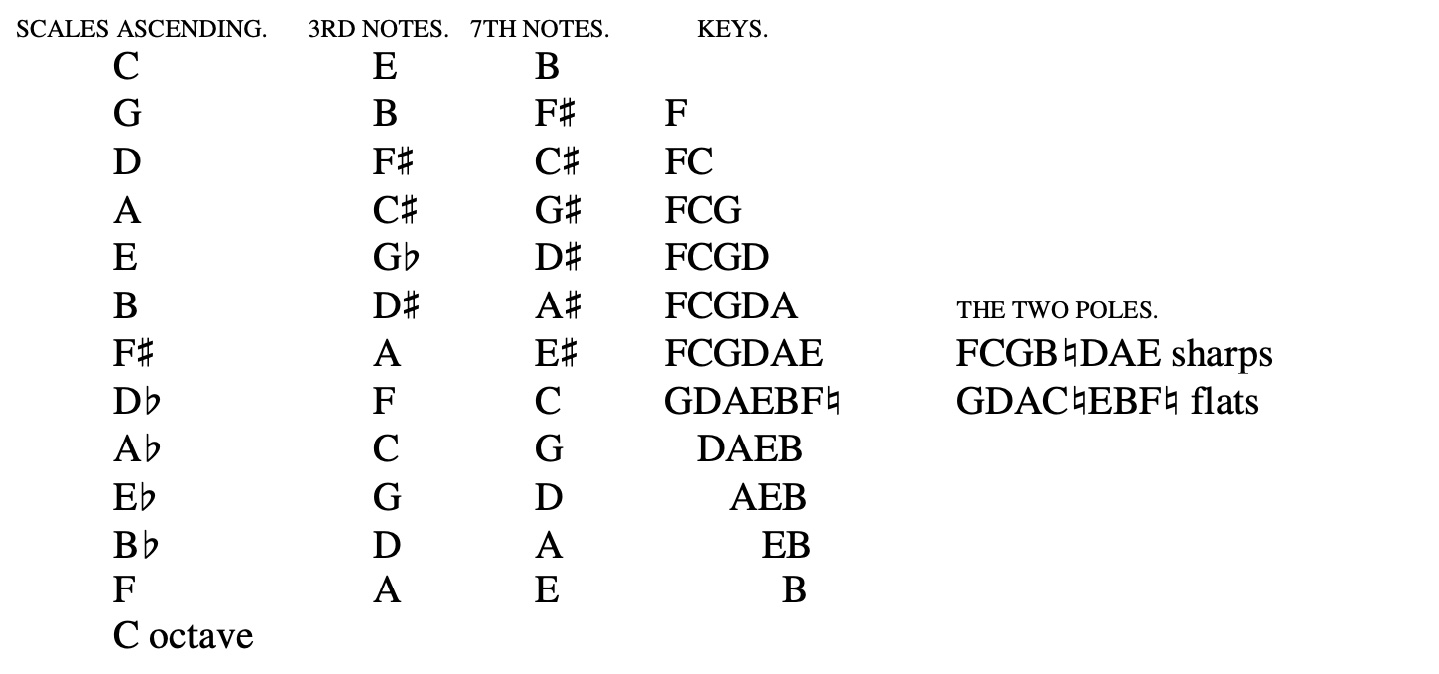
[Harmonies of Tones and Colours, The Twelve Scales Meeting by Fifths, page 31a]
The keys of C and G meeting are coloured, and show the beautiful results of colours arising from gradual when meeting by fifths. Each key-note and its trinities have been traced as complete in itself, and all knit into each other, the of each rising a tone and developing seven times through seven octaves, the keys mingled. The twelve scales have been traced, developing seven times through seven octaves, all knit into each other and into the key-notes and their trinities. The chords have also been traced, each complete in itself, and all knit into each other and into the key-notes, trinities, and scales. And lastly, one of the twelve keys, no longer mingled, but modulating into each other, have been traced, closely linked into each other by fifths through seven octaves, three keys always meeting. Mark the of notes thus linked together, and endeavour to imagine this of tones meeting from the various notes. [Harmonies of Tones and Colours, The Twelve Scales Meeting by Fifths, page 31a]
THE term "key" in the minor developments must be taken in the sense in which it is understood by musicians, although it will be seen that it is only the seven of the harmony that are the relative minor keys of the majors, the scales with their chords sounding other keys. The grandeur, combined with simplicity, of the laws which develope musical are strikingly exhibited in the minor keys. Although at first they appear most paradoxical, and, comparing them with the majors, we may almost say contradictory in their laws of development, when they are in some understood, the intricacies disappear, and the twelve keys follow each other (with the thirteenth octave), all exactly agreeing in their mode of development. I shall endeavour to trace them as much as possible in the same manner as the majors, the lowest developments of the minor keys being notes with scales and chords, the notes always sounding their major harmonies in tones. Here an apparently paradoxical question arises. If the major keys are gained by the notes sounding the tones, how are the minor keys obtained? Strictly speaking, there are no minor key-notes: the development of a harmony is but a mode of succession within the octave, caused by each minor key-note employing the sharps or flats of the fourth major key-note higher; and with this essential difference, it will be seen in how many points the developments of major and minor harmonics agree. I have carefully followed the same laws, and if any capable mind examines the results, I am prepared for severe criticism. I can only express that it was impossible to gain any other results than the seven of the harmony, the and the descending scale and the chords combining three different keys. [Harmonies of Tones and Colours, Diagram VIII - On the Development of the Twelve Minor Harmonies, page 32]
The seven of each harmony, with its scale. Sharps or flats, which vary in the scales from the , are written to each note, and only govern that one note. The scales are written as they . [Harmonies of Tones and Colours, The Seven of Each Harmony, page 35e]
CHAPTER XVI.
[Harmonies of Tones and Colours, Diagram XIII - The Twelve Keynotes with Their Trinities, page 38a]
IF we strike the as written in musical , beginning with the lowest A in the bass clef, each key-note, with its trinities, scale, and chords, sounds three harmonics. We may follow with the twelve keys as they rise, and descend by following the keys upwards as written in musical , each key falling lower. [Harmonies of Tones and Colours, Diagram XIII - The Twelve Keynotes with Their Trinities, page 38a]
The twelve key-notes with their Trinities and Scales repeated, with the addition of the chords. [Harmonies of Tones and Colours, The Twelve Keynotes with Their Trinities and Scales Repeated, page 38c]
BEGINNING with the lowest A in the bass clef, let us strike the trinities, scale, and chords, carrying each key-note a higher, counting the belonging to its harmony. If the silent notes are included, each is the eighth meeting. [Harmonies of Tones and Colours, Diagram XIV - The Modulating Gamut of the Twelve Minor Keys by Fifths1, page 39]
Secondly, we have the one of the twelve keys as they meet by fifths through the seven octaves. The keys are no longer mingled; the scales meet by fifths in the same keys and their trinities. [Harmonies of Tones and Colours, Diagram XV - The Twelve Major and the Twelve Minor Keys, page 42a]
My first plan was to take away entirely the present development of the Minor Keys; but, on consideration, it seems best to leave them exactly as they are, and to add fresh musical developments of the Minors, explaining them, and leaving it needless, for those who do not wish to look deeper into the subject, to examine the former development. Should they do so, however, they will see that not a single note is altered, the only difference being the Scales developing by fifths instead of by . [Harmonies of Tones and Colours, Supplementary Remarks, page 54]
DIAGRAM XVI.—The of each harmony, with its scale—The pairs of the trinities and scales. [Harmonies of Tones and Colours, Additional Diagrams, page 57]
DIAGRAM XVIII.—The 12 key-notes with their trinities and scales repeated, with the addition of the chords. [Harmonies of Tones and Colours, Additional Diagrams, page 57]
The seven of each Harmony, with its Scale. The pairs of the Trinities and Scales. [Harmonies of Tones and Colours, The Seven of each Harmony with its Scale, page 59]
In the Minor Scale, the Trinities and Scale develope five pairs; the last become the higher key-note and its , consequently the would develope the higher key.[Harmonies of Tones and Colours, The Seven of each Harmony with its Scale, page 59]
The twelve key-notes with their Trinities and Scales repeated, with the addition of the chords. [Harmonies of Tones and Colours, The Twelve Keynotes with Their Trinities and Scales Repeated, page 63]
Diverse Scales in SVPwiki
There are a number of scales or orderings of vibratory phenomena that are of interest. These tables and scales are useful in that they put related data sets into classifications, perspective and order revealing many relationships not otherwise seen.
12.01 - Scale of Locked Potentials
chromatic scale
compound scale
Diatonic scale
Enhanced Electromagnetic Spectrum Table
Etheric Elements
Genesis of the Scale
genetic scale
Major Scale
masculine scale
melodic scale
minor scale
natural scale
octave scale
primitive scale
Ramsay - CHAPTER VIII - SCALES
Ramsay - PLATE XXII - Mathematical Table of the Twelve Major Scales and their relative Minors
Ramsay - PLATE XXIII - The Mathematical and Tempered Scales
Ramsay - PLATE XXVII - The Mathematical Scale of Thirty two notes in Commas, Sharps and Flats
scale of A
scale of B sharp
scale of D
scale of G
Scale of Locked Potentials
scale of mathematical intonation
Scale of vitalized focalized intensity
Table 11.01 - Scale of Infinite Ninths its Structure and Base
three chords of the Diatonic Scale
twelve major scales
twelve minor scales
Keely's Scale of the Forces in Octaves
Pond's Etheric Vibratory Scale
See
Click Here to Calculate Music Intervals in any Octave
[NOTE: the above list is not a complete list]
[A Dictionary of Music]
"The graduated sounds used in music. To give a history of the scale would be to give a history of music itself; it must suffice, therefore, to say a few words on the growth of the scale to its present shape. Nothing is known with certainty of the nature of the scales of any of the most ancient nations. If it be admitted that the Greeks obtained their notions from the Egyptians, it may be hazarded, merely as a supposition, that the Egyptian scale was tetrachordal, that is, consisting of groups of four notes.
The octave system became practically a part of the ancient tetrachordal system, which it was destined afterwards to supersede entirely. Although our modern scale was unquestionably a development of the Diatonic scale of the Greeks, yet for several centuries, a hexachordal system was in use. The modes were probably the connecting link between the ancient Greek music and the modern Diatonic scale. The division of the octave into twelve parts, called semitones, each of which can be used as a keynote, became only feasible when keyed instruments were tuned on the system known as equal temperament. This gives to the chromatic notes of our scale a far greater value than the chromatic or enharmonic notes of the ancients, as it is probable they were never used but as passing or auxiliary notes. The whole system of music hangs upon the relationship of the sounds used to a , which, in modern music, is always the first note of whatever octave system (key) is chosen, but in Greek music and early Church-song was a note at or near the middle of the scale.
The old Church mode corresponding to the modern scale was the Ionic or Iastian, but when this was finally adopted as the normal scale, a still older form was retained for use with it, founded on the Dorian and HypoDorian modes, to which, now slightly modified, we give the name minor mode, and by starting from any one note in the semitonal scale, we can have twelve minor modes. As a minor mode largely consists of the notes of the major scale beginning on its third degree, it is said to be relative to that scale. The form of the minor mode has varied from time to time and even now cannot be said to be definitely settled.
The musical scales of extra-European countries are so varied in character that it is impossible to draw any reliable conclusions from their form. The Arabs, Indians, and many uncultured tribes in all quarters of the globe have more than twelve divisions in the octave, that is, use enharmonic scales. The Chinese have the old five-note scale, called by Engel, . This five-note scale is also associated with Scotch and other Celtic melodies.
In some nations the natural harmonic, known as the sharp eleventh, which we discard, is in use, probably because it is produced upon their simple tube instruments.
The degrees of the ascending scale are distinguished in harmony by the following names:
| First | Tonic |
|---|---|
| Second | |
| Third | |
| Fourth | |
| Fifth | |
| Sixth | |
| Seventh | or Leading Note |
[A Dictionary of Music]
A = <432> or 440? <432> vs 440 - is determined by having low numbers. High numbers therefore equal . A is a composite or of its aliquot parts.<432> = 2^4 * 3^3 all low numbers 440 = 2^3 * 55 * 11 dangling higher numbers Therefore 432 is has greater than 440. Of course, there is a lot more to this but the above ought to get you thinking. see Law of Harmony
| Note | 12 Step | Type | 7 Step | JUST | EqualTemp | Pyth/Step | Pythagorean | ||
|---|---|---|---|---|---|---|---|---|---|
| C | 12/12 | diatonic | 7/7 | 523.25 | 523.25 | 2/1 | Tone/Octave | 512 | |
| B | 11/12 | diatonic | 6/7 | 490.55 | 493.88 | 243/128 | Hemitone | 486 | |
| Bf | 10/12 | chromatic | 470.93 | 466.16 | |||||
| A | 9/12 | diatonic | 5/7 | 436.05 | 440.00 | 27/16 | Tone | 432 | |
| G# | 8/12 | chromatic | 418.60 | 415.30 | |||||
| G | 7/12 | diatonic | 4/7 | 392.44 | 392.00 | 3/2 | Tone | 384 | |
| F# | 6/12 | chromatic | 367.92 | 369.99 | |||||
| F | 5/12 | diatonic | 3/7 | 348.83 | 349.23 | 4/3 | Tone | 341.33 | |
| E | 4/12 | diatonic | 2/7 | 327.03 | 329.63 | 81/64 | Hemitone | 324 | |
| D# | 3/12 | chromatic | 313.96 | 311.13 | |||||
| D | 2/12 | diatonic | 1/7 | 294.33 | 293.66 | 9/8 | Tone | 288 | |
| C# | 1/12 | chromatic | 272.63 | 277.18 | |||||
| C | 1/1 | diatonic | 1/1 | 261.63 | 261.63 | 1/1 | Tone | 256 |
See Also
Diatonic Scale Ring
Diatonic scale
Etheric Vibratory Scale
Figure 1.8 - Electromagnetic Scale in Octaves
Figure 12.01 - Russells 4 Power Centered Scale
Figure 12.02 - 0 Inertia Centered Scale
Figure 12.03 - Scale Showing Relations of Light Color and Tones
Overtones Developed Musically
Figure 18.06 - Hubbard Tone Scale of Degrees or Levels of Consciousness
Figure 9.12 - Scale of Locked Potentials over Time
harmony scale
leader of the scale
mathematical scales
Major Scale
minor fifth
Minor Second
Minor Seventh
Minor Sixth
Minor Third
musical scale
octave tonal scale
Overtone series
Part 11 - SVP Music Model
Part 12 - Russells Locked Potentials
scale divisions
Scale of Locked Potentials
Scale of the Forces in Octaves
Scale of vitalized focalized intensity
Table 11.01 - Scale of Infinite Ninths its Structure and Base
Table 11.05 - Comparison of Scale Structural Components and Relations
thirteen scales
three-fold chord of the scale
twelve major scales
05 - The Melodic Relations of the sounds of the Common Scale
11.02 - Attributes of the Scale of Infinite Ninths
11.03 - Development of the Scale of Infinite Ninths
11.04 - Nature Dances to a Natural Music Scale
11.11 - Explanations of the Scale of Infinite Ninths
12.01 - Scale of Locked Potentials
12.03 - Russell scale divisions correspond to Keelys three-way division of currents
18.03 - Hubbard Scale of Consciousness