Large divergence of satellite and Earth system model estimates of global terrestrial CO2 fertilization (original) (raw)
- Letter
- Published: 07 December 2015
- Sasha C. Reed3,
- Cory C. Cleveland1,
- Ashley P. Ballantyne ORCID: orcid.org/0000-0003-1532-51261,
- William R. L. Anderegg4,
- William R. Wieder5,6,
- Yi Y. Liu7 &
- …
- Steven W. Running1
Nature Climate Change volume 6, pages 306–310 (2016) Cite this article
- 10k Accesses
- 398 Citations
- 170 Altmetric
- Metrics details
Subjects
Abstract
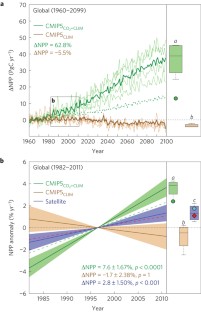
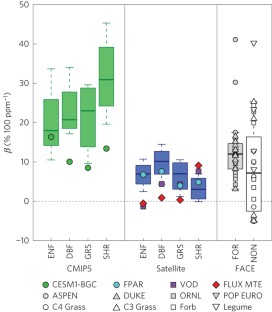
Atmospheric mass balance analyses suggest that terrestrial carbon (C) storage is increasing, partially abating the atmospheric [CO2] growth rate1, although the continued strength of this important ecosystem service remains uncertain2,3,4,5,6. Some evidence suggests that these increases will persist owing to positive responses of vegetation growth (net primary productivity; NPP) to rising atmospheric [CO2] (that is, ‘CO2 fertilization’)5,6,7,8. Here, we present a new satellite-derived global terrestrial NPP data set9,10,11, which shows a significant increase in NPP from 1982 to 2011. However, comparison against Earth system model (ESM) NPP estimates reveals a significant divergence, with satellite-derived increases (2.8 ± 1.50%) less than half of ESM-derived increases (7.6 ± 1.67%) over the 30-year period. By isolating the CO2 fertilization effect in each NPP time series and comparing it against a synthesis of available free-air CO2 enrichment data12,13,14,15, we provide evidence that much of the discrepancy may be due to an over-sensitivity of ESMs to atmospheric [CO2], potentially reflecting an under-representation of climatic feedbacks16,17,18,19,20 and/or a lack of representation of nutrient constraints21,22,23,24,25. Our understanding of CO2 fertilization effects on NPP needs rapid improvement to enable more accurate projections of future C cycle–climate feedbacks; we contend that better integration of modelling, satellite and experimental approaches offers a promising way forward.
This is a preview of subscription content, access via your institution
Access options
Subscribe to this journal
Receive 12 print issues and online access
$259.00 per year
only $21.58 per issue
Buy this article
- Purchase on SpringerLink
- Instant access to the full article PDF.
USD 39.95
Prices may be subject to local taxes which are calculated during checkout
Additional access options:
Figure 1: Temporal changes in NPP.
The alternative text for this image may have been generated using AI.
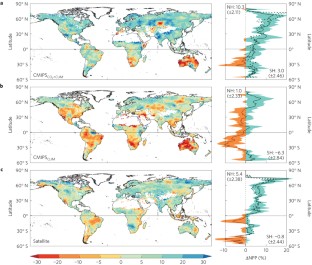
Figure 2: Spatial and latitudinal changes in NPP from 1982 to 2011.
The alternative text for this image may have been generated using AI.
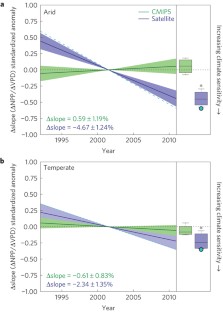
Figure 3: The sensitivity of NPP to VPD.
The alternative text for this image may have been generated using AI.
Figure 4: The sensitivity of NPP to atmospheric [CO2].
The alternative text for this image may have been generated using AI.
References
- Ballantyne, A. P., Alden, C. B., Miller, J. B., Tans, P. P. & White, J. W. C. Increase in observed net carbon dioxide uptake by land and oceans during the past 50 years. Nature 488, 70–72 (2012).
Article CAS Google Scholar - Arora, V. K. et al. Carbon–concentration and carbon–climate feedbacks in CMIP5 Earth System Models. J. Clim. 26, 5289–5314 (2013).
Article Google Scholar - Friedlingstein, P. et al. Uncertainties in CMIP5 climate projections due to carbon cycle feedbacks. J. Clim. 27, 511–526 (2014).
Article Google Scholar - Friend, A. D. et al. Carbon residence time dominates uncertainty in terrestrial vegetation responses to future climate and atmospheric CO2 . Proc. Natl Acad. Sci. USA 111, 3280–3285 (2014).
Article CAS Google Scholar - Sitch, S. et al. Evaluation of the terrestrial carbon cycle, future plant geography and climate-carbon cycle feedbacks using five Dynamic Global Vegetation Models (DGVMs). Glob. Change Biol. 14, 2015–2039 (2008).
Article Google Scholar - Piao, S. et al. Evaluation of terrestrial carbon cycle models for their response to climate variability and to CO2 trends. Glob. Change Biol. 19, 2117–2132 (2013).
Article Google Scholar - Schimel, D., Stephens, B. B. & Fisher, J. F. Effects of increasing CO2 on the terrestrial carbon cycle. Proc. Natl Acad. Sci. USA 112, 436–441 (2014).
Article Google Scholar - Keenan, T. F. et al. Increase in forest water-use efficiency as atmospheric carbon dioxide concentrations rise. Nature 499, 324–327 (2013).
Article CAS Google Scholar - Zhao, M. & Running, S. W. Drought-induced reduction in global terrestrial net primary production from 2000 through 2009. Science 1667, 2–5 (2010).
Article Google Scholar - Running, S. W. et al. A continuous satellite-derived measure of global terrestrial primary production. Bioscience 54, 547–560 (2004).
Article Google Scholar - Zhu, Z., Bi, J., Pan, Y., Ganguly, S. & Anav, A. Photosynthetically active radiation (FPAR) 3g derived from global inventory modeling and mapping studies (GIMMS) normalized difference vegetation index. Remote Sens. 5, 927–948 (2013).
Article Google Scholar - Norby, R. J. et al. Forest response to elevated CO2 is conserved across a broad range of productivity. Proc. Natl Acad. Sci. USA 102, 18052–18056 (2005).
Article CAS Google Scholar - Reich, P. B. et al. Do species and functional groups differ in acquisition and use of C, N and water under varying atmospheric CO2 and N availability regimes? A field test with 16 grassland species. New Phytol. 150, 435–448 (2001).
Article CAS Google Scholar - Zaehle, S. et al. Evaluation of 11 terrestrial carbon–nitrogen cycle models against observations from two temperate free-Air CO2 enrichment studies. New Phytol. 202, 803–822 (2014).
Article CAS Google Scholar - Morgan, J. A. et al. C4 grasses prosper as carbon dioxide eliminates desiccation in warmed semi-arid grassland. Nature 476, 202–205 (2011).
Article CAS Google Scholar - Donohue, R. J., Roderick, M. L., McVicar, T. R. & Farquhar, G. D. Impacts of CO2 fertilization on maximum foliage cover across the globe’s warm, arid environments. Geophys. Res. Lett. 40, 1–5 (2013).
Article Google Scholar - Poulter, B. et al. Contribution of semi-arid ecosystems to interannual variability of the global carbon cycle. Nature 509, 600–603 (2014).
Article CAS Google Scholar - Ahlström, A. et al. The dominant role of semi-arid ecosystems in the trend and variability of the land CO2 sink. Science 348, 895–899 (2015).
Article Google Scholar - Reich, P. B., Hobbie, S. E. & Lee, T. D. Plant growth enhancement by elevated CO2 eliminated by joint water and nitrogen limitation. Nature Geosci. 7, 920–924 (2014).
Article CAS Google Scholar - Williams, A., Allen, C. & Macalady, A. Temperature as a potent driver of regional forest drought stress and tree mortality. Nature Clim. Change 3, 292–297 (2013).
Article Google Scholar - Norby, R. J., Warren, J. M., Iversen, C. M., Medlyn, B. E. & Mcmurtrie, R. E. CO2 enhancement of forest productivity constrained by limited nitrogen availability. Proc. Natl Acad. Sci. USA 107, 19368–19373 (2010).
Article CAS Google Scholar - Oren, R. et al. Soil fertility limits carbon sequestration by forest ecosystems in a CO2-enriched atmosphere. Nature 411, 469–472 (2001).
Article CAS Google Scholar - Wieder, W. R. et al. Future productivity and carbon storage limited by terrestrial nutrient availability. Nature Geosci. 8, 441–444 (2015).
Article CAS Google Scholar - Hungate, B. A., Dukes, J. S., Shaw, M. R., Luo, Y. & Field, C. B. Nitrogen and climate change. Science 302, 1512–1513 (2003).
Article CAS Google Scholar - Cleveland, C. C. et al. Patterns of new versus recycled primary production in the terrestrial biosphere. Proc. Natl Acad. Sci. USA 110, 1–5 (2013).
Article Google Scholar - Beer, C. et al. Terrestrial gross carbon dioxide uptake: global distribution and covariation with climate. Science 329, 834–838 (2010).
Article CAS Google Scholar - Jung, M. et al. Global patterns of land-atmosphere fluxes of carbon dioxide, latent heat, and sensible heat derived from eddy covariance, satellite, and meteorological observations. J. Geophys. Res. 116, 1–16 (2011).
Article Google Scholar - Liu, Y. Y. et al. Global vegetation biomass change (1988–2008) and attribution to environmental and human drivers. Glob. Ecol. Biogeogr. 22, 692–705 (2013).
Article Google Scholar - Fisher, J. B., Badgley, G. & Blyth, E. Global nutrient limitation in terrestrial vegetation. Glob. Biogeochem. Cycles 26, GB3007 (2012).
Article Google Scholar - Medlyn, B. E. et al. Using ecosystem experiments to improve vegetation models. Nature Clim. Change 5, 528–534 (2015).
Article Google Scholar - Hilker, T. et al. Vegetation dynamics and rainfall sensitivity of the Amazon. Proc. Natl Acad. Sci. USA 111, 16041–16046 (2014).
Article CAS Google Scholar - Zhou, L. et al. Widespread decline of Congo rainforest greenness in the past decade. Nature 509, 86–90 (2014).
Article CAS Google Scholar - Friedl, M. A. et al. MODIS Collection 5 global land cover: Algorithm refinements and characterization of new datasets. Remote Sens. Environ. 114, 168–182 (2010).
Article Google Scholar - Peel, M. C., Finlayson, B. L. & McMahon, T. A. Updated world map of the Köppen–Geiger climate classification. Hydrol. Earth Syst. Sci. 11, 1633–1644 (2007).
Article Google Scholar - Liu, Y. Y. et al. Recent reversal in loss of global terrestrial biomass. Nature Clim. Change 5, 470–474 (2015).
Article Google Scholar - Koven, C. D. Boreal carbon loss due to poleward shift in low-carbon ecosystems. Nature Geosci. 6, 452–456 (2013).
Article CAS Google Scholar - Cleveland, C. C. et al. A comparison of plot-based, satellite and Earth system model estimates of tropical NPP. Glob. Biogeochem. Cycles 21, 2111–2121 (2015).
Google Scholar - Cavaleri, M. A., Reed, S. C., Smith, W. K. & Wood, T. E. Urgent need for warming experiments in tropical forests. Glob. Change Biol. 29, 626–644 (2015).
Google Scholar - Van der Sleen, P. et al. No growth stimulation of tropical trees by 150 years of CO2 fertilization but water-use efficiency increased. Nature Geosci. 8, 24–28 (2015).
Article CAS Google Scholar - Clark, D. A., Clark, D. B. & Oberbauer, S. F. Field-quantified responses of tropical rainforest aboveground productivity to increasing CO2 and climatic stress, 1997–2009. J. Geophys. Res. 118, 783–794 (2013).
Article Google Scholar - Hoffman, F. M. et al. Causes and implications of persistent atmospheric carbon dioxide biases in Earth System Models. J. Geophys. Res. 119, 141–162 (2014).
Article CAS Google Scholar - Carvalhais, N. et al. Global covariation of carbon turnover times with climate in terrestrial ecosystems. Nature 514, 213–217 (2015).
Article Google Scholar
Acknowledgements
This work was supported by the US Geological Survey Ecosystems Mission Area, US Department of Energy Terrestrial Ecosystem Sciences Program (Award no. DE-SC-0008168), the US Geological Survey John Wesley Powell Center for Analysis and Synthesis, and the NASA Earth Observing System MODIS project (grant no. NNX08AG87A). Y.Y.L. is supported by an Australian Research Council DECRA Fellowship (project number DE140100200). We also acknowledge the World Climate Research Programme’s Working Group on Coupled Modelling, which is responsible for CMIP, and we thank the climate modelling groups (listed in Supplementary Table 1 of this paper) for producing and making available their model output. For CMIP, the US Department of Energy’s Program for Climate Model Diagnosis and Intercomparison provides coordinating support and led development of software infrastructure in partnership with the Global Organization for Earth System Science Portals. Any use of trade, firm, or product names is for descriptive purposes only and does not imply endorsement by the US Government. All data presented in this analysis are publicly available; satellite estimates are available at the NTSG data portal (http://www.ntsg.umt.edu/data); CMIP5 experimental scenario data are available at the ESGF data portal (http://esgf.llnl.gov).
Author information
Authors and Affiliations
- Department of Ecosystem and Conservation Sciences, University of Montana, Missoula, Montana 59812, USA
W. Kolby Smith, Cory C. Cleveland, Ashley P. Ballantyne & Steven W. Running - Institute on the Environment, University of Minnesota, St Paul, Minnesota 55108, USA
W. Kolby Smith - Southwest Biological Science Center, US Geological Survey, Moab, Utah 86001, USA
Sasha C. Reed - Department of Ecology and Evolutionary Biology, Princeton University, Princeton, New Jersey 08544, USA
William R. L. Anderegg - National Center for Atmospheric Research, Boulder, Colorado 80307, USA
William R. Wieder - Institute for Arctic and Alpine Research, University of Colorado, Boulder, Colorado 80309, USA
William R. Wieder - ARC Centre of Excellence for Climate Systems Science & Climate Change Research Centre, University of New South Wales, Sydney, New South Wales 2052, Australia
Yi Y. Liu
Authors
- W. Kolby Smith
- Sasha C. Reed
- Cory C. Cleveland
- Ashley P. Ballantyne
- William R. L. Anderegg
- William R. Wieder
- Yi Y. Liu
- Steven W. Running
Contributions
W.K.S., S.C.R., C.C.C., A.P.B. and S.W.R. designed the study. W.K.S. carried out the analysis and wrote the paper. W.R.L.A. contributed to the climate sensitivity analysis. W.R.W. contributed to the nutrient limitation discussion. Y.Y.L. provided the vegetation optical depth data and helped with associated data interpretation. All authors contributed significantly to the final revisions of the manuscript.
Corresponding author
Correspondence toW. Kolby Smith.
Ethics declarations
Competing interests
The authors declare no competing financial interests.
Supplementary information
Rights and permissions
About this article
Cite this article
Kolby Smith, W., Reed, S., Cleveland, C. et al. Large divergence of satellite and Earth system model estimates of global terrestrial CO2 fertilization.Nature Clim Change 6, 306–310 (2016). https://doi.org/10.1038/nclimate2879
- Received: 23 December 2014
- Accepted: 02 October 2015
- Published: 07 December 2015
- Issue date: March 2016
- DOI: https://doi.org/10.1038/nclimate2879