maniple - Weblio 英和・和英辞典 (original) (raw)
 単語を追加
単語を追加
発音記号・読み方
× この辞書を今後表示しない
※辞書の非表示は、設定画面から変更可能
maniple
× この辞書を今後表示しない
※辞書の非表示は、設定画面から変更可能
maniple
出典:『Wiktionary』 (2024/08/14 21:47 UTC 版)
発音

- (Received Pronunciation) IPA: /ˈmænɪp(ə)l/
- (General American) IPA: /ˈmænəpəl/
- ハイフネーション: man‧i‧ple
語源 1
From Late 中期英語 maniple, manyple (“scarf worn as vestment, maniple”), borrowed from Middle French, Old French maniple, manipule (“handful; troop of soldiers; scarf worn as vestment”) (modern French manipule), from Latin manipulus (“bundle, handful; troop of soldiers”), from manus (“hand”) (ultimately from Proto-Indo-European *(s)meh₂- (“to beckon, signal”)) + the weakened root of pleō (“to fill; to fulfil”) (ultimately from Proto-Indo-European *pleh₁- (“to fill”)). The English word is cognate with Italian manipulo (“scarf worn as vestment”) (obsolete), manipolo (“handful; troop of soldiers; scarf worn as vestment”).
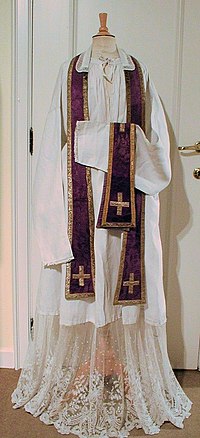
Sense 2 (“part of a priest’s vestments”) is probably from the fact that the item was originally carried in the hand. It may originate from a handkerchief or napkin worn by Roman consuls as an indication of rank.
名詞
- (Ancient Rome, military) A division of the Roman army numbering 120 (or sometimes 60) soldiers exclusive of officers; (generally, obsolete) any small body of soldiers.
Holonym: legion
Coordinate terms: century, cohort- 1655, Clement Edmond[e]s, “The Second Commentary of the Wars in Gallia. [Observation.]”, in Julius Caesar, translated by Clement Edmond[e]s, The Commentaries of C. Julius Cæsar, of His Warres in Gallia, and the Civile Warres betwixt Him and Pompey, Translated into English: […], revised edition, London: […] R[oger] Daniel; and are to be sold by Henry Tvvyford, […], Nathaniel Ekins […], and Iohn Place […], →OCLC, book II, page 43:
[T]hey divided the Haſtati, Principes, and Triaris, each of them into 10 companies, making of thoſe three ſorts of ſouldiers 30 ſmall regiments, which they called Manipuli: And again, they ſubdivided each maniple into two equall parts, and called them Ordines, which was the leaſt company in a legion, and according to the rate ſet down by Polybius, contained 60 ſouldiers. […] By this therefore it may appear that a legion conſiſted of four ſorts of ſouldiers, which were reduced into ten cohorts, and every cohort contained three maniples, and every maniple two orders, and every order had his Centurion marching in the head of the troop, and every Centurion had his Optionem, or Lieutenant, that ſtood in the tail of the troop. - 1709, Caius Crispus Sallustius [i.e., Gaius Sallustius Crispus], “The History of Caius Crispus Sallustius: Containing an Account of the Jurgurthine War”, in John Rowe, transl., Caius Crispus Sallustius the Historian Made English. […], London: […] Richard Sare, […], →OCLC, page 126:
- 1828, Titus Livius [i.e., Livy], “Book XXV.—Chapter XIV.”, in [anonymous], transl., The History of Rome by Titus Livius, the Twentieth to the Thirtieth Books Inclusive, […], volume I, Oxford, Oxfordshire: […] D. A. Talboys and J. Vincent, →OCLC, page 317:
- 1833 June, “Art. II.—_Documents Communicated to Congress by the President, at the Opening of the Second Session of the Twenty-second Congress, Accompanying the Report of the Secretary of War._”, in American Quarterly Review, volume XIII, number XXVI, Philadelphia, Pa.: [Henry Charles] Carey, [Isaac] Lea & Blanchard […], →OCLC, page 298:
- 1945, H. Burn-Murdoch, “Ignatius, Bishop and Martyr, a.d. 110”, in Church, Continuity & Unity, 1st paperback edition, Cambridge, Cambridgeshire: University Press, published 2014, →ISBN, page 120:
- 1655, Clement Edmond[e]s, “The Second Commentary of the Wars in Gallia. [Observation.]”, in Julius Caesar, translated by Clement Edmond[e]s, The Commentaries of C. Julius Cæsar, of His Warres in Gallia, and the Civile Warres betwixt Him and Pompey, Translated into English: […], revised edition, London: […] R[oger] Daniel; and are to be sold by Henry Tvvyford, […], Nathaniel Ekins […], and Iohn Place […], →OCLC, book II, page 43:
- (Christianity, chiefly historical) In Western Christianity, an ornamental band or scarf worn upon the left arm as a part of the vestments of a priest in the Roman Catholic Church, and sometimes the Church of England.
Synonym: (one sense) fanon- 1590, Edward Deering [i.e., Edward Dering], “The Three and Twentie Lecture, vpon the 4. 5. and 6. Verses”, in XXVII. Lectvres, or Readings, vpon Part of the Epistle Written to the Hebrues, London: […] Thomas VVoodcocke, →OCLC:
[T]hey, as men thinking baſelie of ſuch ſimple dealing, adde a great deale more to making of their prieſts: they muſt haue oyle, candels, baſens, tovvels, amices, albes, ſtoals, gyrdles, maniples, miters, bookes, croſſes, linnen, bandes, chalices, patens, ſinging cakes, vvine and vvater, flovver, and ſuch other thinges, trifled and toyed with all, […] - 1685, William Howel, “Sect. XII. The Monarchy of the English Saxons Restored in Britain. […]”, in An Institution of General History, or The History of the Ecclesiastical Affairs of the World. […], London: […] [F]or the authors widdow, by Miles Flesher, →OCLC, paragraph 156, page 332:
[T]hen ſhall the Juſtice of the Biſhop (his Officer he means) cauſe a Proceſſion to be made with a Prieſt, habited in an Albe Maniple, and Stole, and Clerks in their Surplices, with Holy-water and a Croſs, the Candleſticks and Incense-pot, with Fire and Incenſe going before, and the Friends of the dead having taken his Body up, ſhall put it on a Biere, and carry it to the Church, where Maſs being ſaid for him, and other Rites performed, they ſhall Inter him as becomes a Chriſtian. - 1731, Philip a Limborch [i.e., Philipp van Limborch], “How the Process Ends against a Relapsed Penitent”, in Samuel Chandler, transl., The History of the Inquisition. […], volume I, London: […] J. Gray, […], →OCLC, page 268:
- 1812, James Bentham, James Bentham [Jr.], “Abbots of Ely”, in The History and Antiquities of the Conventual & Cathedral Church of Ely: […], 2nd edition, Norwich, Norfolk: […] Stevenson, Matchett, and Stevenson, […], →OCLC, page 91:
- 1829, [John Chambers [_et al._]], “City or Norwich”, in A General History of the County of Norfolk, […], volume II, Norwich, Norfolk: […] John Stacy; London: […] Longman, Rees, Orme, Brown, and Green, →OCLC, page 1041:
- 1829–1830, [Jean] Duchesne, senior, “Stoning of St. Stephen”, in Museum of Painting and Sculpture, […] = Musée Peinture et de Sculpture, […], volume VI, London: Bossange, Barthès and Lowell, […]; Paris: Audot, […], →OCLC, number 382:
- 2010, Irving S. Cooper, “The Vestments”, in Dean Bekken, editor, Ceremonies of the Liberal Catholic Rite, 6th edition, San Diego, Calif.: The St. Alban Press, →ISBN, part I (General Instructions Regarding Ceremonies), page 15:
- 1590, Edward Deering [i.e., Edward Dering], “The Three and Twentie Lecture, vpon the 4. 5. and 6. Verses”, in XXVII. Lectvres, or Readings, vpon Part of the Epistle Written to the Hebrues, London: […] Thomas VVoodcocke, →OCLC:
- (obsolete, informal) A hand; a fist.
別の表記
- manyple [Late Middle English–16th c.]
- mainipul, manypule [16th c.]
- manaple, manipul [17th c.]
- manipule [17th–18th c.]
- manuple [17th and 19th c.]
- manipil (Scotland) [before 18th c.]
参考
- (part of a priest's vestments): epimanikion
名詞
- (obsolete) A handful.
- 1658, Thomas Browne, “To My Worthy and Honored Friend Nicholas Bacon of Gillingham [i.e., Sir Nicholas Bacon, 1st Baronet, of Gillingham] Esquire”, in Hydriotaphia, Urne-buriall, […] Together with The Garden of Cyrus, […], London: […] Hen[ry] Brome […], →OCLC:
- 1819, Abraham Rees, “M [letter]”, in The Cyclopædia; or, Universal Dictionary of Arts, Sciences, and Literature. [...] In Thirty-nine Volumes, volume XXI, London: Printed for Longman, Hurst, Rees, Orme, & Brown, […] [_et al._], →OCLC, column 1:
参照
- ^ “maniple, n.”, in MED Online, Ann Arbor, Mich.: University of Michigan, 2007.
- ↑ “maniple, n.”, in OED Online
 , Oxford, Oxfordshire: Oxford University Press, September 2000.
 - ^ “maniple, n.”, in Lexico, Dictionary.com; Oxford University Press, 2019–2022.
Further reading
manipleのページの著作権
英和・和英辞典 情報提供元は参加元一覧 にて確認できます。
| ピン留めアイコンをクリックすると単語とその意味を画面の右側に残しておくことができます。 | | | ------------------------------------------- | |
non-member
maniple