4.1 Step 1: Computation of the targeted human demand (original) (raw)
Worksheets in the FABLE Calculator:
⇒ 1_calc_human_demand
⇒ 1_data_demand
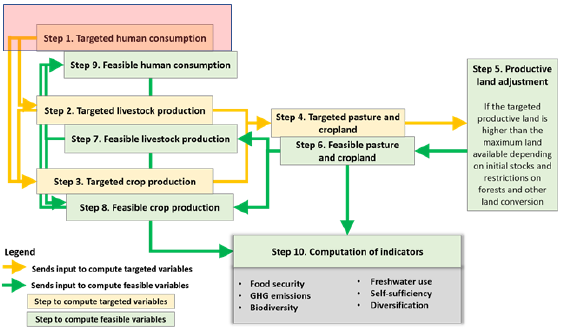
The computation of the annual demand for food and non-food human consumption is the first step of the FABLE Calculator. This means that all computed changes in the food and land-use systems modeled in the FABLE Calculator are caused by human demand (i.e. the underlying assumption is that human demand is the key driver of change in food and land-use systems). Human demand has three components: food, biofuels, and other non-food consumption (Figure 7). Most of the agricultural products in the FABLE Calculator are food products but can also be used for other purposes and some agricultural products are not fit for human consumption (e.g. fiber crops). Food and non-food demand per product per capita for the historical years is computed based on the commodity balance of the FAOSTAT.
Figure 7. Computation of the targeted human demand
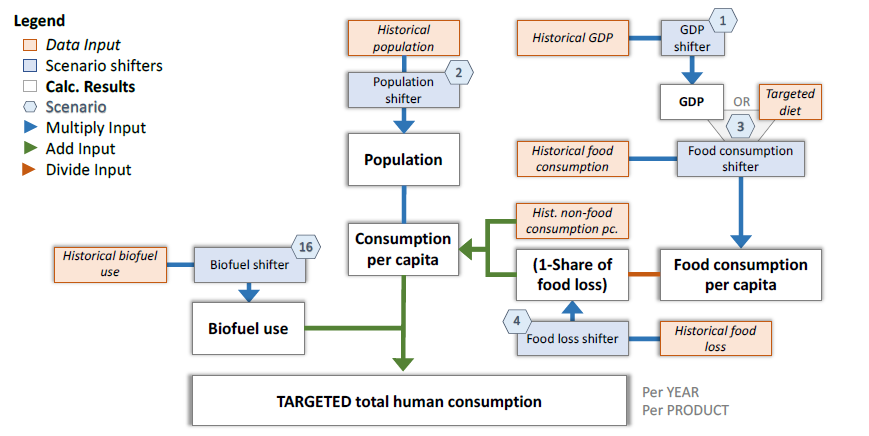
Note: When an arrow passes through a box or is sourced from more than one, it means that two parameters are used together in order to compute the next parameter e.g. population shifter times historical population equals the population and population times consumption per capita plus biofuel use equals the targeted total human consumption. The numbers within the blue hexagons refer to the scenario table numbers in the worksheet Scenarios Selection, as labeled in the Open FABLE Calculator 2020 (e.g. 1 for Table S.1). The numbers may differ in other versions of the FABLE Calculator.
The evolution of food consumption per capita depends on which scenario is selected. It is computed as the historical food demand in 2010 (without food waste) times the shifter corresponding to the selected scenario (cf. Diets). The evolution of biofuels does not depend on the population but is solely driven by the biofuel scenario that is selected. In the Open FABLE Calculator 2020, the other non-food demand per capita is fixed at the 2010 level. The final demand per capita per year per product is computed as the sum of non-food consumption per capita plus food consumption per capita augmented by the share of consumption that is wasted(cf. Food waste). Finally, the total demand is computed by multiplying average demand per capita by total population (cf. Population) plus the demand to produce biofuels. Historical consumption levels are directly taken from the FAOSTAT for 2000, 2005, and 2010 and future demand is computed for each 5-year time step over 2015-2050 for each of the 76 raw and processed agricultural products (cf. Appendix 1).