Star Graph (original) (raw)
Algebra Applied Mathematics Calculus and Analysis Discrete Mathematics Foundations of Mathematics Geometry History and Terminology Number Theory Probability and Statistics Recreational Mathematics Topology
Alphabetical Index New in MathWorld
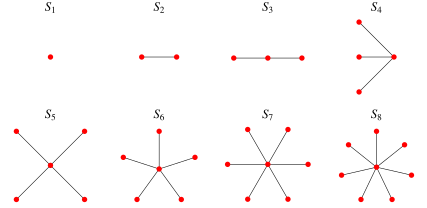
The star graph  of order
  , sometimes simply known as an "
 -star" (Harary 1994, pp. 17-18; Pemmaraju and Skiena 2003, p. 248; Tutte 2005, p. 23), is a tree on
 nodes with one node having vertex degree
  and the other
  having vertex degree 1. The star graph
  is therefore isomorphic to the complete bipartite graph
  (Skiena 1990, p. 146).
Note that there are two conventions for the indexing for star graphs, with some authors (e.g., Gallian 2007), adopting the convention that  denotes the star graph on
  nodes.
 is isomorphic to "the" claw graph. A star graph is sometimes termed a "claw" (Hoffman 1960) or a "cherry" (Erdős and Rényi 1963; Harary 1994, p. 17).
Star graphs  are always graceful and star graphs on
  nodes are series-reduced trees. Star graphs are also dominating unique.
Star graphs can be constructed in the Wolfram Language using StarGraph[_n_]. Precomputed properties of star graphs are available via GraphData[ "Star", n
 ].
].
The chromatic polynomial of  is given by

and the chromatic number is 1 for  , and
, and  otherwise.
The line graph of the star graph  is the complete graph
  . The simplex graph of
  is the book graph
  .
.
Note that  -stars should not be confused with the "permutation"
  -star graph (Akers et al. 1987) and their generalizations known as
  -star graphs (Chiang and Chen 1995) encountered in computer science and information processing.
A different generalization of the star graph in which  points are placed along each of the
  arms of the star (as opposed to 1 for the usual star graph) might be termed the
  -spoke graph.
See also
Banana Tree, Cayley Tree, Claw Graph, Firecracker Graph, Nauru Graph, Permutation Star Graph, Shuffle-Exchange Graph,Spoke Graph, Tree
Explore with Wolfram|Alpha
References
Akers, S.; Harel, D.; and Krishnamurthy, B. "The Star Graph: An Attractive Alternative to the  -Cube." In Proc. International Conference of Parallel Processing, pp. 393-400, 1987.Chiang, W.-K. and Chen, R.-J. "The
  -Star Graph: A Generalized Star Graph." Information Proc. Lett. 56, 259-264, 1995.Erdős, P. and Rényi, A. "Asymmetric Graphs."Acta Math. Acad. Sci. Hungar. 14, 295-315, 1963.Gallian, J. "Dynamic Survey of Graph Labeling." Electronic J. Combinatorics, Dynamic Survey DS6, Oct. 30, 2025. https://doi.org/10.37236/27.Harary, F. Graph Theory. Reading, MA: Addison-Wesley, 1994.Hoffman, A. J. "On the Uniqueness of the Triangular Association Scheme." Ann. Math. Stat. 31, 492-497, 1960.House of Graphs. Star Graphs. S5, S6,S7, S8,S9, S10,S11, ....Pemmaraju, S. and Skiena, S. "Cycles, Stars, and Wheels." §6.2.4 in Computational Discrete Mathematics: Combinatorics and Graph Theory in Mathematica. Cambridge, England: Cambridge University Press, pp. 248-249, 2003.Skiena, S. "Cycles, Stars, and Wheels." §4.2.3 in Implementing Discrete Mathematics: Combinatorics and Graph Theory with Mathematica. Reading, MA: Addison-Wesley, pp. 83 and 144-147, 1990.Tutte, W. T.Graph Theory. Cambridge, England: Cambridge University Press, 2005.
Referenced on Wolfram|Alpha
Cite this as:
Weisstein, Eric W. "Star Graph." FromMathWorld--A Wolfram Resource. https://mathworld.wolfram.com/StarGraph.html