Accounting (original) (raw)
Last Updated : 7 May, 2026
Accounting is the process of recording, classifying, summarising, analysing, and interpreting financial transactions of a business. It is often called the “language of business” because it communicates financial information to users such as owners, managers, investors, and creditors for decision-making.
**Objectives of Accounting
Accounting is not only about keeping records. Its objectives are to plan, control, measure, and communicate financial information, helping organisations make better decisions, protect assets, and ensure accountability
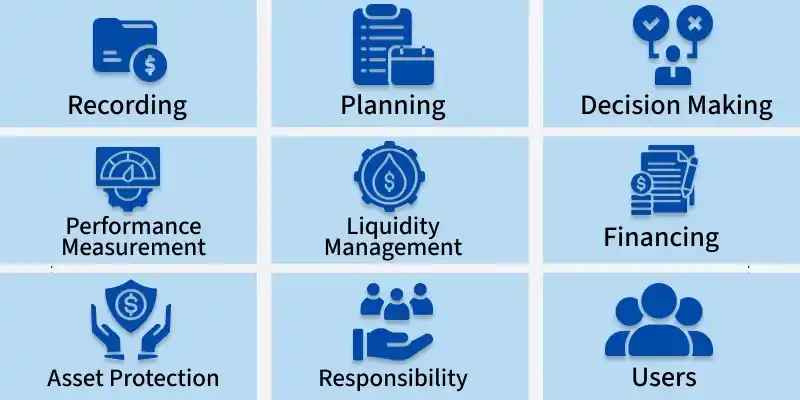
**1. Record: The basic role of accounting is to keep a systematic, complete, accurate, and permanent record of all business transactions so that it can be searched and checked at any time. Reliable financial records are the backbone of any accounting system.
**2. Planning: Organisations must plan to use their limited resources (eg, cash, labour, materials, machinery, and equipment) for competitive needs in the future. This is mainly done through budgeting, which allows organisations to anticipate expenses, income, and resource requirements in advance, it also helps in coordinating different departments of the organisation so that all activities work together toward common goals.
**3. Decision: Accounting helps managers make a number of business decisions and create policies to make organisational processes more efficient such as what price should be charged for products and services to achieve maximum profit; Which products should be produced when resources such as cash, labour, or materials are limited to maximise profit, etc.
**4. Performance: Accounting helps determine how well a business is doing by summarising financial information into quantifiable indicators (e.g., sales revenue, profit, costs, etc.). It is important for organisations to have a reliable source for measuring their KPIs so that they can improve by comparing their past performance and their competition.
**5. Liquidity: Poor cash management is one of the reason for the failure of many businesses. Accounting helps organisations know how much cash and other liquid resources they have available to pay their financial obligations. This information is essential for working capital management and helps reduce the risk of bankruptcy by early detection of financial shortages.
**6. Financing: Accounting information is necessary to raise loans. Whether an organisation is applying for a bank loan or shareholder investment, it will need to provide past financial records such as profit and loss statement of past years as well as future expected sales computations.
**7. Management: One of the key objectives of accounting is to protect the assets of an organisation by establishing effective internal controls. Business resources such as cash, buildings, and inventory are exposed to risks like theft, fraud, errors, damage, and mismanagement. Accounting helps reduce these risks by implementing proper control measures across the organisation. For example, requiring senior management approval for large payments helps ensure accuracy and reduces the chances of fraudulent transactions.
**8. Responsibility: Accounting provides a basis for evaluating the performance of a business over a period of time, which promotes accountability at several levels of the organisation. Shareholders can ultimately hold directors accountable for the overall performance of their company based on the accounting information disclosed in the financial statements.
**9. Users: The role of accounting is not limited to the informational needs of the company's employees and investors. it also useful for investors, creditors, suppliers, government authorities, customers, and diverse group of stakeholders, who use accounting information to evaluate profitability, financial stability, creditworthiness.
Advantages of Accounting
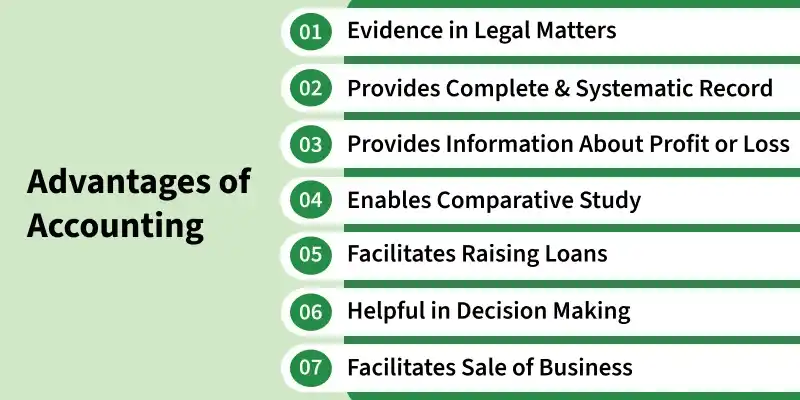
**1. A complete and systematic record: Accounting keeps complete and systematic recording of all business transactions. These helps the users for easy reference, comparison, and verification of financial information.
**2. Helps in decision making: The main function of management is decision-making. Accounting helps and guides management in making decisions about setting the selling price, deducting costs, increasing sales and making decisions related to business operation etc.
**3. Valuation of the enterprise: At the time of the sale ,conversion or merger of businesses , the actual and fair valuation of the business net worth is required. Through accounting, the true picture of value of a business's assets and liabilities are displayed on the balance sheet, and thus the purchase price can be determined.
**4. It helps in obtaining a loan: For further expansion, the business often needs additional funds which may not available to them in such case it may obtained by borrowing from some financial institutions, like banks, IDBI, ICICI, etc. These financial institutions lend money based on the profitability and reliability of the business. Accounting provides this information through the Profit & Loss Statement and Balance Sheet, showing the true financial position of the business.
**5. Evidence in court: Business transactions are recorded in accounting books supported by certified documents such as vouchers, bills, receipt etc. These records provide reliable proof of transactions in case of disputes or legal issues. Accounts can thus be used as evidence in court.
**6. In accordance with the law: Every business has to deal with various government departments, like Income Tax, Sales Tax, Customs and Excise, etc. Various regular returns need to be filed with these departments. Accounting helps in the preparation and filing of such returns.
**7. Inter-company or intra-company comparison: Accounting helps in comparing business performance by analysing trading and profit & loss accounts. . Inter-company comparison involves Comparing the accounts of two different companies for the same year and intra-company comparison involves comparing two different periods for the same company. The company's performance is then compared with predetermined goals, and any deficiencies can be corrected accordingly.
**8. Facilitates auditing: Certification of the books of account is called audit is done based on size, nature, and type of business. The audit certificate issued by the auditor is a clean document of the organisation, which proves that there are no irregularities in the organisation. Auditing is mandatory to ensure accuracy and transparency in financial records. .
**9. Effective management: Accounting supports effective management by providing accurate financial information and feedback. It helps management in planning and controlling business activities, evaluating company performance, and taking timely actions to correct any deficiencies, ensuring the enterprise runs efficiently.
**Limitations of Accounting
- **Accounting Information may be Unrealistic: As Records are prepared according to certain principles, conventions, and concepts. It might possible the information shown in the accounts maynot reflect the actual or real situation of the business
- **Possibility of Window Dressing of the Financial Position: Financial statements can be manipulated to show a better financial position than the actual one, which may mislead users. As the financial statements do not provide a true picture of the organization.
- **Does not Consider the Qualitative Elements: The Accounting process only considers the monetary values or transactions and ignores the qualitative aspects of an organization.
- **Affected by Personal Judgment
Different accountants may adopt different accounting policies and methods , which can affect the final results.
**Role of Accounting in business
**1. Evaluates business performance: Accounting provides financial statements that show the business’s financial situation. Once you have a clear idea of what is going on in your business financially, you can easily plan your future accordingly. This helps track expenses, allocate budgets efficiently, and plan future activities.
**2. Create budget projections: Accounting also helps in creating future projections and analyse the business trends. It helps to evaluate business to keep the operations profitable.
**3. Maintain financial statements: Every business must file its records with tax authorities. Accounting helps to maintain proper records of financial statement.
**4. Ensure compliance with the law: Businesses need legal compliance to ensure their accounting system is validated against various laws and regulations. All liabilities, such as income tax, sales tax, pensions, employee funds, etc., can be easily dealt with if we have a structured accounting system.