Systems and Basis of Accounting | Single and Double Entry System (original) (raw)
Last Updated : 15 Apr, 2026
Basis of Accounting
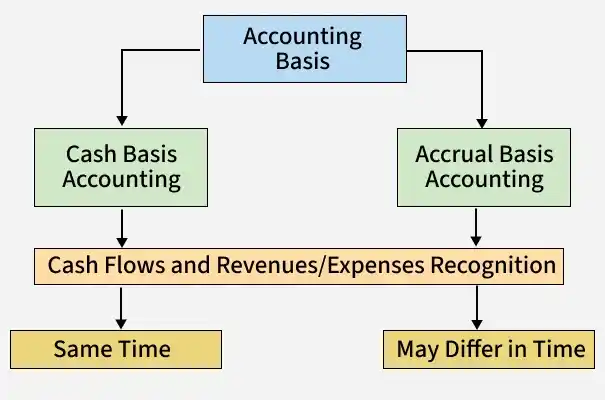
These refers to the method or convention under which financial transactions are recorded and reported in the books of accounts. It is concerned with a specific time period at which all the incomes and expenses are recorded by a business enterprise. There are two basis for recording the transactions in Accountancy:
1. Cash Basis of Accounting
The cash basis records only cash transactions, i.e., all the expenses paid in cash and all the revenues that have been received in cash. This means that there are no records of income receivables and expenses payable. Thus, the profit on a cash basis is the difference between the cash receipt and the cash payments. Moreover, taxes on income are paid on the receipt of cash and not when the income is accrued. The cash basis of accounting is suitable for the professionals such as lawyers, doctors, etc.
_Example: Rent for April 2022 is payable on 31st December 2022.
_On a cash basis, this transaction shall be recorded on 31st December 2022 in an event of actual cash payment, i.e., rent shall be treated as an expense for the period when it is paid.
2. Accrual Basis of Accounting
The accrual basis records all business transactions, whether cash or credit transactions. This means incomes are recorded as soon as they are accrued, irrespective of the fact whether cash is received or not. Similarly, expenses are recorded when they become due even though not yet been paid. Thus, profit under this basis is the difference between all the income earned (received in cash or not) and all the expenses incurred (paid in cash or not) during the period. Taxes on income gets due as soon as income is earned. The accrual basis is suitable for all the business units working with an objective to earn profit.
_Example: Commission accrued in January 2022, receivable in July 2022.
_On an accrual basis, a commission is recorded as an income for the period of January, i.e., as soon as it is earned.
Systems of Accounting
The system of accounting refers to the method or framework used to record, classify, and summarize financial transactions. It defines how the accounting records are maintained and ensures that all transactions are properly documented to prepare financial statements.
1.Single Entry System
The single entry system is a system of bookkeeping in which only one aspect of each transaction is recorded. The accounting details are maintained only by preparing a cash book and personal accounts of debtors and creditors. The profit ascertained under the single entry system is pretty inaccurate, as only one aspect of all the transactions is taken into account. Preferably, small businesses and shopkeepers adopt this method of bookkeeping, as there are no set rules to maintain hence is comparatively much easier than the double-entry system. Accounting records maintained under this system are also known as incomplete records.
2.Double Entry System
The double entry system is a method where every transaction affects at least two accounts. One of them is debited and another one is credited with an equal amount. The three basic accounts- personal account, real account, and nominal account are all recognized under the double entry system, and hence, a profit ascertained is much more accurate. Generally, professionals are hired to maintain accounts under this system, as a strict set of rules is to be followed. A trial balance can be prepared under this system of bookkeeping, which makes it possible to check the arithmetic accuracy of the accounting records as the debit side is always equal to the credit side under the double entry system. Under the double entry system, all the necessary accounts, like Journal, Ledger, Trial Balance, Financial Statement, and Balance Sheet are prepared to compute the profit and know about the financial position of any business unit.
Definition of Double Entry System
"The Double Entry System seeks to record every transaction in money or money's worth in its double aspect- The receipt of a benefit by one account and the surrender of alike benefit by another account, the former entry being to the debit of the account receiving and the latter to the credit of that account surrendering." -William Pickles
"Every business transaction has a two-fold effect and that it affects two accounts in opposite directions and if a complete record were to be made of each such transaction, it would be necessary to debit one account and credit another account. It is this recording of the two-fold effect of every transaction that has given rise to the term Double Entry System." -J.R. Batliboi
Difference between Single Entry System and Double Entry System:
| **Basis | Single Entry System | Double Entry System |
|---|---|---|
| Meaning | System of bookkeeping that consider only one aspect of the financial transactions. | Considers at least two aspects of all the financial transactions of a business unit. |
| Number of accounts affected | Only one account is affected | At least two accounts are affected, i.e., one of them is debited, and another is credited. |
| Accounts Recognition | The single entry system recognizes only personal accounts. | Both personal accounts and impersonal accounts(real and nominal accounts) are recognized. |
| Nature of recording | Incomplete records are maintained. | Complete bookkeeping of accounts. |
| Based on specific rules | No set of rules is followed for bookkeeping | Specific rules are followed while preparing accounts |
| Checking Arithmetic Accuracy | It is not possible to check arithmetic accuracy of accounts . | Trial Balance is prepared to check the arithmetic accuracy of accounts. |
| Ease of maintaining accounts | Easy to maintain as no set of rules is to be followed. | A specific set of rules is to be followed, making it a complex task. |
| Cost of maintaining | The owner himself can maintain the accounts, hence no or less cost is incurred to maintain the books of account. | Professionals are hired to maintain the books of account, so it is expensive in nature. |
| Accuracy of Profit/loss | Profit and loss ascertained are inaccurate due to incomplete records. | The accuracy of the Profit/loss computed is high. |
| Suitability | It is suitable for small businesses and shopkeepers. | It is suitable and adopted by large firms. |