3D Mensuration (original) (raw)
Last Updated : 3 Dec, 2025
3D Mensuration is the branch of mathematics that deals with the measurement of three-dimensional geometric shapes, including their surface area, volume, lateral surface area, and other related parameters. Unlike 2D shapes (flat figures), 3D objects have length, width, and height (or depth), making them solid structures.
3D Shapes: Cube, Cuboid, Sphere, Cylinder, Cone, Pyramid, Prism, etc.
Mensuration Terminologies
Here is the list of terms you will come across in mensuration class. We have provided the term, it's abbreviation, unit, and definition for easy understanding.
| Terms | Abbreviation | Unit | Definition |
|---|---|---|---|
| **Volume | V | cm3 or m3 | A 3D shape's space is referred to as its volume. |
| **Curved Surface Area | CSA | m2 or cm2 | The overall area is known as a Curved surface area if there is a curved surface. Example: Sphere. |
| **Lateral Surface area | LSA | m2 or cm2 | The term "Lateral Surface area" refers to the combined area of all lateral surfaces that encircle the provided figure. |
| **Total Surface Area | TSA | m2 or cm2 | The total surface area is the total of all the curved and lateral surface areas. |
| **Square Unit | - | m2 or cm2 | A square unit is the area that a square of side one unit covers. |
| **Cube Unit | – | m3 or cm3 | The space taken up by a cube with a single side. |
Mensuration Formula for 3D Shapes
The following table provides a list of all mensuration formulas for 3D shapes:
| **Shape | **Volume | **Curved Surface Area or Lateral Surface Area | **Total Surface Area | **Figure |
|---|---|---|---|---|
| **Cube | a3 | LSA = 4 a2 | 6a2 | 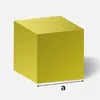 cube dimensions cube dimensions |
| **Cuboids | l × b × h | LSA = 2h(l + b) | 2(lb +bh +hl) | 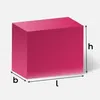 cuboid dimensions cuboid dimensions |
| **Sphere | (4/3)πr3 | 4πr2 | 4πr2 | 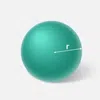 sphere dimensions sphere dimensions |
| **Hemisphere | (⅔)πr3 | 2πr2 | 3πr2 |  hemisphere dimensions hemisphere dimensions |
| **Cylinder | πr2h | 2πrh | 2πrh + 2πr2 | 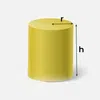 cylinder dimensions cylinder dimensions |
| **Cone | (⅓)πr2h | πrl | πr(r + l) | 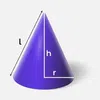 cone dimensions cone dimensions |
Mensuration 3D - Questions and Answers
**Q1: Find the length of the largest rod that can be kept in a cuboidal room of dimensions 10 x 15 x 6 m.
**Solution :
_Largest rod would lie along the diagonal.
_=> Length of largest rod = Length of diagonal of the room = (L 2 + B 2 _+ H 2 )1/2
_=> Length of the largest rod = (102 + 152 + 62)1/2 = (100 + 225 + 36)1/2 = (361)1/2
_=> Length of the largest rod = 19 m
**Q2: Find the number of bricks of dimension 24 x 12 x 8 cm each that would be required to make a wall 24 m long, 8 m high and 60 cm thick.
**Solution :
_Volume of 1 brick = 24 x 12 x 8 = 2304 cm _3
_Volume of wall = 2400 x 800 x 60 = 115200000 cm 3
_Therefore, number of bricks required = 115200000 / 2304 = 50000
**Q3: A rectangular sheet of paper measuring 22 cm x 7 cm is rolled along the longer side to make a cylinder. Find the volume of the cylinder formed.
**Solution:
_Let the radius of the cylinder be ‘R’.
_The sheet is rolled along the longer side.
_=> 2 π R = 22
_=> R = 3.5 cm
_Also, height = 7 cm
_Therefore, volume of the cylinder = π R2 H = π (3.5)2 7 = 269.5 cm 3
**Q4: If each edge of a cube is increased by 10 %, what would be the percentage increase in volume?
**Solution:
_Let the original edge length be ‘a’
_=> Original volume = a 3
_Now, new edge length = 1.1 a
_=> New volume = (1.1 a) 3 _= 1.331 a 3
_=> Increase in volume = 1.331 a 3 – 1 a 3 = 0.331 a 3
_Therefore, percentage increase in volume = (0.331 a 3 / a 3) x 100 = 33.1 %
**Q5: Three metal cubes of edge lengths 3 cm, 4 cm, and 5 cm are melted to form a single cube. Find the edge length of such a cube.
**Solution:
_Volume of new cube = Volume of metal generated on melting the cubes = Sum of volumes of the three cubes
_=> Volume of new cube = 3 _3 + 4 _3 _+ 5 _3 = 216
_=> Edge length of new cube = (216) 1/3 = 6 cm