Cone in Maths (original) (raw)
Last Updated : 18 Feb, 2026
A cone is a three-dimensional geometric solid that consists of one circular base and a single pointed top called the apex. The surface of the cone gradually narrows from the circular base to the apex, giving it a smooth, tapered shape.
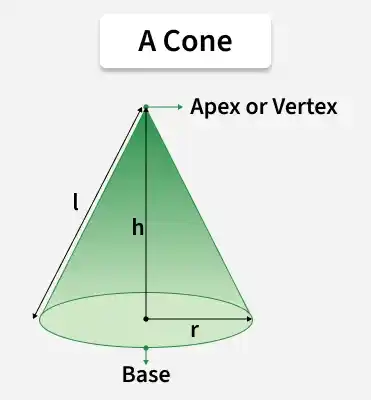
Cone
**Note: A cone has one flat face, one curved face, an edge, and a vertex.
**Parts of a Cone
- **Base: The flat, circular surface of the cone. It is the largest cross-section of the cone.
- **Vertex (Apex): The pointed top of the cone where it converges to a single point, directly above the center of the base.
- **Axis: The imaginary line joining the vertex and the center of the circular base. A cone has circular symmetry around its axis.
- **Radius (r): The distance from the center of the circular base to any point on its circumference.
- **Height (h): The perpendicular distance from the vertex to the center of the circular base.
- **Slant Height (l): The distance from the vertex to any point on the circumference of the base, measured along the curved surface of the cone.
Slant Height of a Cone
The slant height of a right circular cone is the distance from the apex to any point on the circumference of its base, measured along the curved surface. It is calculated using the Pythagoras Theorem because the radius, height, and slant height form a right-angled triangle.
The slant height is given by:
(Slant height) l = √(r² + h²).
Slant Height vs Height of a Cone
Key differences between both slant height and the height of a cone are given as follows:
| Slant Height | Height |
|---|---|
| Slant Height is the distance along the curved surface of the cone. | Height is the vertical distance between the vertex and the center of the base. |
| It is the longest distance between the base and the vertex. | It is the shortest distance between the base and the vertex. |
| Slant Height is also called hypotenuse. | Height is also called altitude. |
| It is denoted by ‘l’. | It is denoted by ‘h’. |
Surface Area of a Cone
The surface area of a right circular cone is the sum of its curved (lateral) surface area and the area of its circular base. The curved surface area is πrl and the area of the base is πr².
Now, the total surface area of the cone can be given by:
Total Surface Area (TSA) = Base area + CSA
(TSA) = πr2 + πrl
(TSA) = πr(r + l)Where
- r is Radius of Base
- l is Slant Height of Cone
By substituting the value of the slant height, the total surface area of the cone can be calculated easily.
Volume of a Cone
The volume of a cone is the amount of space it occupies. It depends on the radius of its circular base and its height. A cone has one-third the volume of a cylinder with the same base and height. The volume of a cone is measured in cubic units such as m³, cm³, or in³.
The volume of a cone is given by:
Volume of cone = 1/3) πr²h
Types of Cone
Based on the position of the vertex with respect to the circular base, cones are broadly classified into two types:
- Right Circular Cone
- Oblique Cone
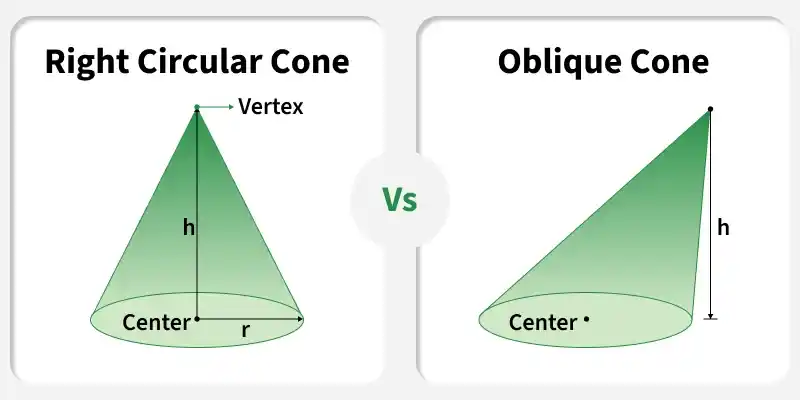
Types of cone
The table below shows the key differences between these two types of cones.
| Right Circular Cone | Oblique Cone |
|---|---|
| Its vertex is directly above the center of the base. | Its vertex is not directly above the center of the base. |
| Its altitude and axis coincide with each other. | Its altitude and axis do not coincide with each other. |
| The Axis of the right circular cone always makes a right angle with the base. | The Axis of an oblique cone does not makes a right angle with the base. |
Double Napped Cone
A double-napped cone is a three-dimensional geometric shape formed when two identical cones are joined at their common vertex. It is produced by rotating an oblique straight line, called the generator, about a fixed axis, which results in two cones, one above the vertex (upper nappe) and one below the vertex (lower nappe).
A hourglass is a common real-life example of a double-napped cone.
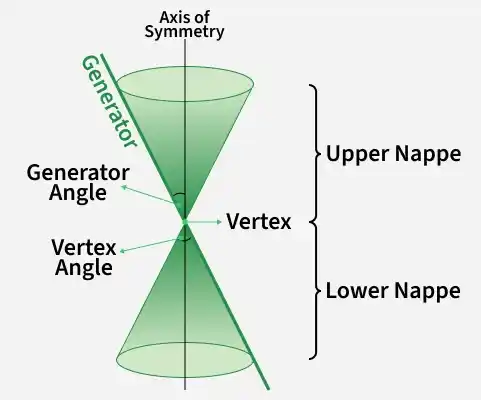
Double Napped Cone
**Parts of a double-napped cone are given below:
- **Vertex: The common point where the two cones meet.
- **Upper nappe: The cone formed above the vertex.
- **Lower nappe: The cone formed below the vertex.
- **Generator: The slant line that rotates to form the cone.
- **Generator angle: The angle between the generator and the axis.
- **Vertex angle: The angle formed at the vertex by the two cones.
- **Axis of symmetry (central axis): The straight line passing through the vertex and the centers of both cones.
**Related Articles
Solved Examples on Cone
**Example 1: Find the slant height of a cone whose Curved Surface Area is 330m 2 and whose diameter of base is 10 m.
**Solution:
Given,
Curved Surface Area (CSA) = 330 m2Diameter = 10 m
**radius (r) = diameter/2
r = 10/2 = 5 mAlso, CSA = πrl
Putting given values we get
330 = 22/7 × 5 × l
⇒ 330 = 22/7 × 5 × l
⇒ 330 × 7 = 110 × l
⇒ 2310/110 = l
⇒ l = 21 mHence, slant height (l) is 21 m
**Example 2: Calculate the height of a frustum of a cone whose volume is 616 cm 3 and the radii of the two bases are 3 cm and 5 cm respectively.
**Solution:
Radius of Upper Base (r) = 3 cm
Radius of Lower Base (R) = 5 cmVolume (V) = 616 cm3
We know that,
Volume of Frustum of Cone (V) = 1/3 × h π(R2 + r2 + Rr)
Putting given values we get616 = 1/3 × h × 22/7(52 + 32 + 5×3)
⇒ 616 = 1/3 × h × 22/7(25 + 9 + 15)
⇒ 616 = 1/3 × h × 22/7 × 49
⇒ 616 × 3 × 7 = h × 22 × 49
⇒ 12936 = 1078 × h⇒ h = 12936/1078
⇒ h = 12 cmHence, the height of the frustum of the cone is 12 cm.