Representing Knowledge in an Uncertain Domain in AI (original) (raw)
Last Updated : 29 Jul, 2025
Real-world AI systems rarely function under perfect conditions. Instead, they must act in environments filled with incomplete information, noisy data and unpredictable events. Traditional deterministic approaches assumes full and accurate knowledge, often fail in such scenarios. This challenge has led to the development of complex techniques for reasoning under uncertainty.
Understanding Uncertain Domains
An uncertain domain refers to an environment where information is incomplete or unpredictable. Unlike deterministic systems where outcomes are precisely predictable, AI systems operating in uncertain domains must handle:
- **Incomplete Information: Missing data needed for fully informed decisions
- **Ambiguity: Inputs that support multiple interpretations
- **Noise: Data corruption due to measurement errors or external factors
- **Stochastic Processes: Events with probabilistic outcomes that can’t be predicted deterministically
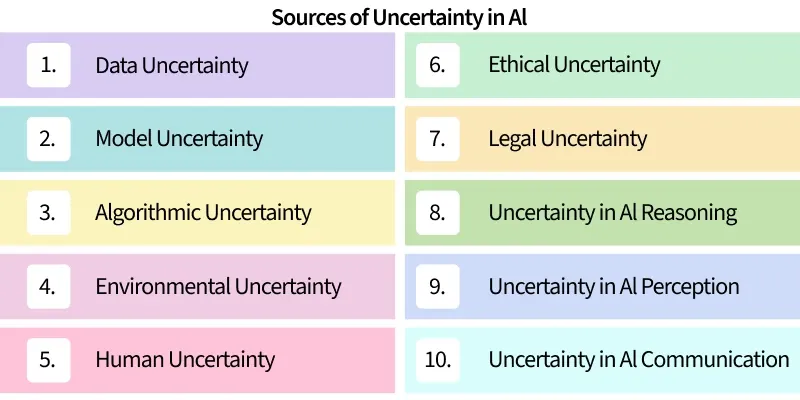
Sources of uncertainity
**Example: A medical diagnosis system must interpret symptoms that suggest multiple diseases, cope with noisy test results and account for incomplete patient histories.
Why Uncertainty Management Matters?
Effective uncertainty handling enables AI systems to make robust decisions even when data is imperfect. Key benefits include:
- Quantifying confidence in predictions to improve decision trustworthiness
- Dynamically updating beliefs as new information arrives
- Maintaining performance where deterministic systems typically fail
This capability is crucial in complex domains like autonomous driving, medical diagnostics and financial forecasting.
Probabilistic Reasoning Approaches
Uncertainty management often relies on probabilistic reasoning, which uses probability theory to represent and manipulate uncertain knowledge.
1. Bayesian Networks
Bayesian networks use directed acyclic graphs to model probabilistic relationships. Each node represents a variable and edges represent conditional dependencies.
- Enable both predictive (cause to effect) and diagnostic (effect to cause) reasoning
- Efficiently compute posterior probabilities when new evidence is introduced
**Example: In medical diagnosis, symptoms like fever and cough link to diseases such as flu or pneumonia. The network estimates probabilities based on observed symptoms.
2. Hidden Markov Models (HMMs)
HMMs handle sequential data where the true system states are hidden. They assume a Markov process, where the next state depends only on the current one.
- Widely used in speech recognition, where sounds are observed but underlying phonetic states are hidden
- Also applied in bioinformatics, NLP and financial modeling
They model both temporal dependencies and uncertainty, making them ideal for time-series analysis.
3. Markov Decision Processes (MDPs)
MDPs model decision-making under uncertainty through:
- States, Actions, Transition Probabilities and Rewards
- Agents learn optimal policies by evaluating possible outcomes over time
**Example: An autonomous robot uses MDPs to plan routes through an office, accounting for movement uncertainty and reward-based goals (like avoiding obstacles).
MDPs are foundational to reinforcement learning, where agents learn through interaction with their environment.
Fuzzy Logic and Approximate Reasoning
While probabilistic methods can quantify uncertainty in numerical values, fuzzy logic deals with uncertainty arising from imprecision or vagueness in concepts.
1. Fuzzy Sets and Membership Functions
- Allow partial membership, assigning degrees between 0 and 1
- Reflect human intuition better than rigid, binary logic
**Example: For a temperature control system, “warm” might be defined fuzzily, with 25°C having 0.8 membership and 30°C having full membership.
2. Fuzzy Inference Systems
Use linguistic rules for decision-making under uncertainty, such as:
"If temperature is high and humidity is low, then increase cooling moderately."
These systems:
- Combine rule outputs based on input conditions
- Are especially useful in control systems where human expertise is hard to formalize mathematically
Advanced Uncertainty Frameworks
Beyond classical probability and fuzzy systems, advanced frameworks allow richer handling of incomplete data.
1. Dempster-Shafer Theory
Dempster-Shafer Theory generalizes probability by modeling degrees of belief, accounting for incomplete knowledge.
- Useful for combining evidence from multiple sources
- Does not require prior probabilities, making it effective for domains with high uncertainty
**Example: In fault diagnosis, sensor data can be combined to assess the likelihood of different failures, accounting for uncertainty and sensor reliability.
2. Belief Networks
Belief networks extend Bayesian networks by allowing imprecise probabilities or intervals rather than exact values.
- Handle uncertainty in relationships between variables
- Enable reasoning even when exact distributions are unknown
**Example: In intelligent tutoring systems, belief networks model student understanding with uncertain links between concepts.
3. Case-Based Reasoning (CBR) Under Uncertainty
CBR solves new problems by referencing past cases, adapting known solutions to current situations.
- Must handle missing or incomplete case data
- Often combined with probabilistic methods to assign confidence scores
**Example: A support system retrieves similar past issues but adjusts recommendations based on current, possibly incomplete, information.
Modern CBR systems integrate machine learning to improve case similarity assessment and solution adaptation under uncertainty.
Applications Across Domains
Uncertainty management techniques have been successfully applied across various industries:
- **Medical Diagnosis: Systems use Bayesian networks to model probabilistic relationships between symptoms and diseases. Fuzzy logic helps interpret vague patient inputs, while Dempster-Shafer theory integrates multiple test results with differing reliability levels.
- **Autonomous Systems: Probabilistic localization methods handle GPS and sensor noise to estimate vehicle position. Fuzzy controllers enable smooth navigation by processing imprecise inputs from the environment.
- **Natural Language Processing (NLP): Hidden Markov Models (HMMs) are employed for tasks like speech recognition by modeling sequential word patterns. Probabilistic grammars handle syntactic ambiguity and fuzzy matching improves performance in information retrieval and search engines.
- **Financial Systems: Bayesian models dynamically update predictions based on evolving market conditions. Monte Carlo simulations quantify risk in uncertain financial environments. Fuzzy rule-based systems capture expert trading heuristics for decision-making support.
Implementation Considerations and Challenges
Despite their effectiveness, uncertainty management techniques face implementation hurdles:
- **Bayesian Networks: Become computationally intensive with many variables, often needing approximation methods
- **Fuzzy Systems: Depend on well-designed membership functions and expert-defined rules
- **Model Selection: The right framework depends on data availability, domain knowledge and desired interpretability
Modern systems often combine approaches:
- Ensemble methods integrate probabilistic, fuzzy and neural models
- Deep learning incorporates uncertainty using dropout or Bayesian neural nets.