Agentic RAG (original) (raw)
Last Updated : 1 May, 2026
Agentic RAG enhances traditional Retrieval Augmented Generation by enabling AI agents to not only retrieve information but also decide how to use it, introducing autonomous decision making for more flexible and intelligent responses.
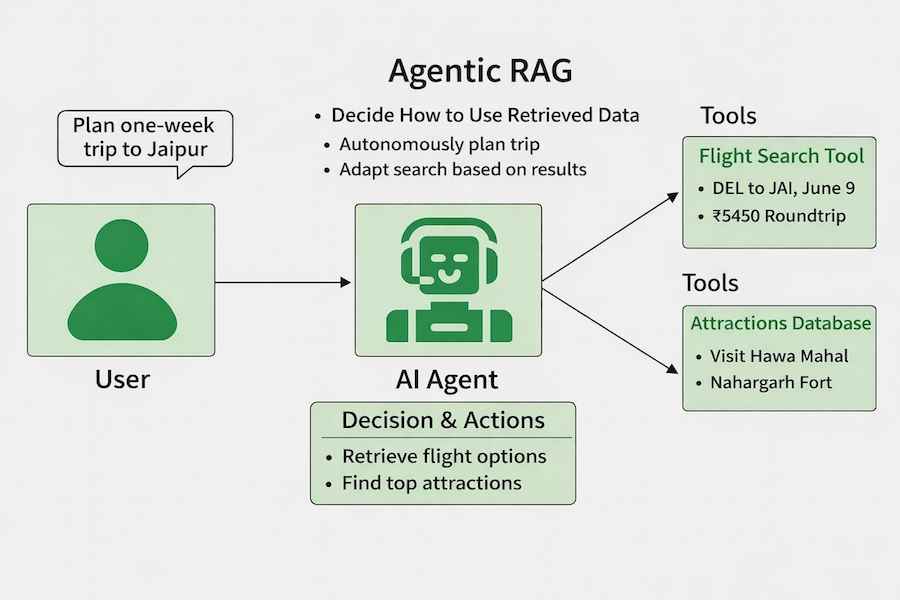
Agentic RAG
- **Agentic AI: Refers to AI systems capable of autonomous decision making, adapting actions based on real time data instead of fixed instructions.
- **Agents: Autonomous entities that retrieve, process and act on information, actively interacting with their environment to generate better outcomes.
- **Example: An AI assistant retrieves relevant data for a query and decides how to use it to produce the most accurate and context aware response.
Architecture of Agentic RAG
Agentic RAG architecture enhances adaptability by combining autonomous agents with retrieval and tool integration, enabling coordinated planning, decision making and information retrieval.
1. Single Agent RAG (Router)
A single intelligent agent routes each query to the most appropriate data source or tool, making it efficient for simple tasks.
- Acts as a central dispatcher for query routing.
- Suitable for straightforward, well defined queries.
- Selects from predefined retrieval sources like databases or search engines.
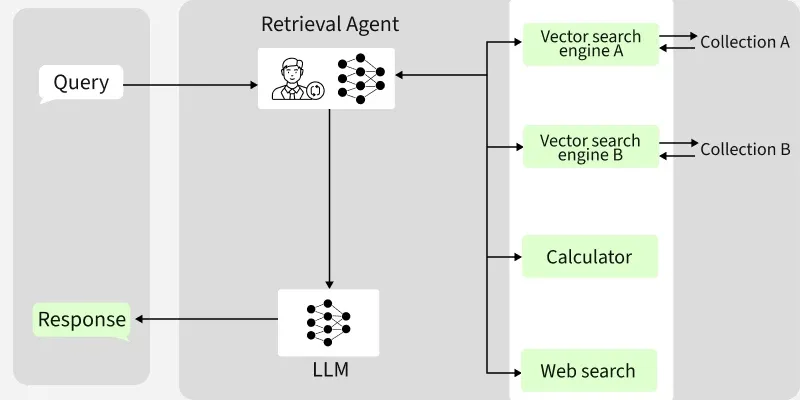
Single-Agent RAG
2. Multi Agent RAG
A master agent coordinates multiple specialized sub agents, each handling specific tools or data sources, enabling efficient processing of complex queries.
- Master agent manages and delegates tasks to sub agents.
- Supports parallel processing of multiple sub tasks.
- Combines results from different sources for comprehensive answers.
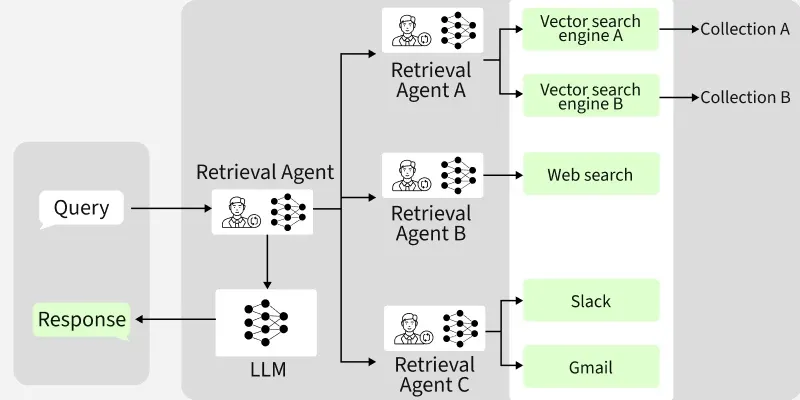
Multi-Agent RAG
3. Agentic Orchestration
Agentic orchestration coordinates agents to plan, validate and refine workflows dynamically, enabling adaptive and intelligent responses.
- Supports multi step planning with feedback and iteration.
- Uses memory and validation of intermediate results.
- Handles multimodal data like text, images and real time inputs.
Working
Agentic RAG follows an intelligent, multi step process where an agent refines queries, retrieves information and validates responses for better accuracy.

Working of Agentic RAG
- **Query Input: The user submits a query, initiating the process.
- **Query Refinement: An LLM agent reviews and rewrites the query for clarity, if needed, ensuring optimal data retrieval.
- **Information Sufficiency: The agent checks if further details are needed. If so, more information is gathered before proceeding.
- **Source Selection: The agent determines the best source for the query vector database, APIs/tools or internet based on context.
- **Data Retrieval: The chosen source is queried and relevant context is collected.
- **Context Integration: Retrieved context is combined with the updated query to enrich understanding.
- **Response Generation: The LLM produces a response using the enhanced context and query.
- **Answer Validation: The agent verifies whether the response is relevant to the original question.
- **Final Output: If validated, the system delivers a precise, context aware final response.
Types of Agents in Agentic RAG
Agentic RAG uses different types of agents, each designed to handle specific roles in the workflow for efficient and intelligent processing.
- **Routing Agent: Analyzes queries and routes them to the most suitable RAG pipeline, such as summarization or question answering.
- **One-Shot Query Planning Agent: Breaks complex queries into independent subqueries, processes them in parallel and combines results into a final answer.
- **Tool Use Agent: Integrates external tools like APIs or databases to fetch real time or specialized data before generating responses.
- ReAct Agent (**Reason + Act**):** Iteratively reasons and takes actions, selecting tools and refining steps to handle multi step queries.
- **Dynamic Planning and Execution Agent: Creates detailed step by step plans for complex workflows, coordinating tools and data sources systematically.
Traditional RAG vs. Agentic RAG
| Feature | Traditional RAG | Agentic RAG |
|---|---|---|
| Decision-Making | Reactive, no autonomous decisions. It follows predefined workflows. | Proactive, autonomously decides what to retrieve and how to act. |
| Data Retrieval | Uses fixed, predefined sources like documents and databases. | Dynamically retrieves from multiple, diverse external sources. |
| Flexibility | Low flexibility; static retrieval and generation methods. | High flexibility; adapts retrieval and processing strategies |
| Adaptability | Limited adaptability; struggles with new or dynamic inputs. | Highly adaptable; continuously refines and improves performance. |
| Autonomy | Dependent on explicit user queries; no self-initiated action. | Operates independently, learns and adapts in real-time. |
| Use Case | Suitable for FAQs, simple Q&A and static search. | Ideal for dynamic chatbots, recommendation systems and complex workflows. |
Frameworks for Agentic RAG
Agent frameworks provide structured environments for building, managing and deploying AI agents in Agentic RAG systems, improving development efficiency and system capabilities.
1. LangChain
- LangChain Simplifies integration of agents with LLMs, APIs and data sources.
- Supports prompt management and chaining of model calls.
- Enables flexible and scalable agent-based workflows.
2. LlamaIndex
- LlamaIndex connects LLMs with external data through efficient indexing.
- Supports fast and context aware information retrieval.
- Improves accuracy and responsiveness in RAG systems.
3. LangGraph
- LangGraph orchestrates multi agent workflows and interactions.
- Manages state and supports complex, asynchronous operations.
- Enhances scalability and coordination in advanced agent systems.
Advantages
- Agents can independently process data and make decisions, improving efficiency and context awareness.
- Supports parallel task execution with multiple agents, enabling efficient handling of large scale data.
- Generates more relevant and personalized responses using advanced retrieval and reasoning.
- Adapts to changing environments, making it suitable for applications like chatbots and recommendation systems.
Limitations
- Managing multiple agents, workflows and data sources increases system complexity.
- Poor data quality can lead to inaccurate or unreliable responses.
- Multi agent processing may introduce latency and slower response times.
- Requires significant computational resources due to multiple agents and models.