Lampbrush Chromosome (original) (raw)
Last Updated : 23 Jul, 2025
**Lampbrush Chromosomes are large, meiotic **chromosomes primarily observed in the oocytes of amphibians and birds. They were first described by **Walther Flemming and Ruckert in 1882. They are characterized by extended lateral loops resembling a brush, they reveal actively transcribing genes during crucial stages of oogenesis. These chromosomes play a pivotal role in **synthesizing RNA necessary for early **embryonic development. Their unique structure allows detailed investigation of gene expression. In this article, we will read about Lampbrush Chromosomes, its structure, importance, and functions.
Table of Content
- Define Lampbrush Chromosomes
- What are Lampbrush Chromosomes?
- Diagram of Lampbrush Chromosome
- Structure of Lampbrush Chromosome
- Types of Lampbrush Chromosomes
- Importance of Lampbrush Chromosome
- Functions of Lampbrush Chromosome
- Diseases associated with Lampbrush chromosomes
- Difference between Lampbrush and Polytene Chromosomes
Define Lampbrush Chromosomes
**Lampbrush chromosomes are the largest known chromosomes found in the developing oocytes of most animals, except mammals. Lampbrush chromosomes can be found in the nuclei of vertebrates like fish, amphibians, reptiles, and birds' oocytes.
What are Lampbrush Chromosomes?
**Lampbrush chromosomes are different from the usual chromosomes. They are the **largest known chromosomes found in the **developing oocytes of most animals, except mammals. Lampbrush chromosomes are also called **diplotene chromosomes because they are **formed during the diplotene stage of prophase 1 of meiosis cell division due to the active transcription of many genes.
These chromosomes are seen during the early prophase stage and are bivalent, having **two conjugating homologues joined at chiasmata. They are found in the developing oocytes of most animals (except mammals).
Diagram of Lampbrush Chromosome
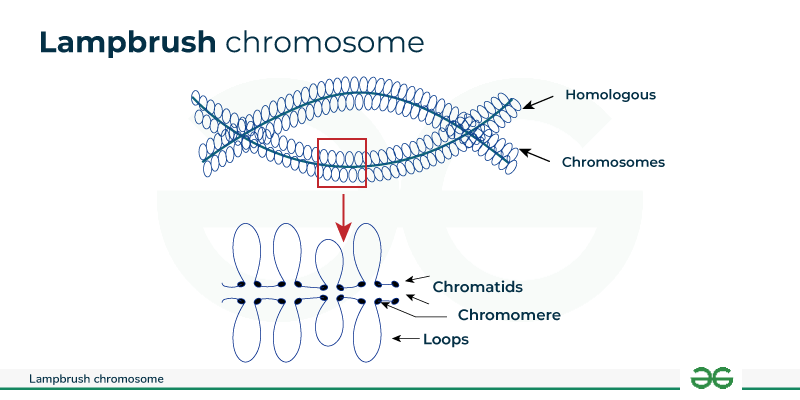
The labelled diagram of lambrush chromosome is given below:
Structure of Lampbrush Chromosome
The Lampbrush chromosomes instead of being small and tight, look like long brushes with lots of tiny bristles. Thus, they are characterised by fine lateral loops. These loops give it a brush-like appearance and are called **lampbrush chromosomes.
- Lampbrush chromosomes are variants that have both maternal and paternal chromosomes. Thus there are **4 chromatids, two each from the two conjugating homologues held together by chiasmata.
- These highly condensed **chromatin threads from the **chromosomal axis that have an array of bead-like chromomeres.
- From each chromosome **two lateral loops of **DNA **project out.
- These lateral loops are formed as a result of acute **RNA **synthesis. The lateral loops are absent on the centromere.
- These chromosomes are transcriptionally active and can be observed even under a **compound microscope****.**
- Lampbrush chromosomes are present in the **nucleus of Acetabularia, a giant **single-celled alga, in the oocytes of both **vertebrates and invertebrates and also in **spermatocytes of many species.
- Lampbrush chromosomes are made up of different things like **DNA, histones, and special **proteins. They also have something called **Balbiani rings, which are like little hubs for making **proteins. These chromosomes are like a busy factory, working hard to produce important materials for the cell.
**Also Read: Difference Between Chromatin And Chromosomes
Types of Lampbrush Chromosomes
Lampbrush chromosomes are primarily observed in the **oocytes (egg cells) of amphibians and some other non-mammalian organisms. While the term ****"lampbrush chromosome"** is commonly associated with amphibians, similar structures with looped configurations have been identified in various organisms. Specific types include:
- **Amphibian Lampbrush Chromosomes: Commonly studied in **amphibians like frogs and salamanders, lampbrush chromosomes exhibit prominent looped structures during stages of oocyte development.
- **Bird Lampbrush Chromosomes: **Found in the oocytes of birds, lampbrush chromosomes play a role in the regulation of gene expression during the formation of egg cells.
- **Invertebrate Lampbrush Chromosomes: Similar structures have been identified in invertebrates, such as **insects and some lower organisms, contributing to their reproductive processes.
Each type of lampbrush chromosome shares the characteristic looped morphology, but the specific details and functions may vary among different species.
Importance of Lampbrush Chromosome
Lampbrush chromosomes are crucial during a process called **meiosis. Meiosis is when cells divide to make eggs or sperm, and lampbrush chromosomes help in this important job. Here are the some importance of lampbrush chromosomes.
- **Gene Expression Studies: In gene expression studies, Lampbrush chromosomes provide a direct visualisation of actively transcribing genes. The elongated lateral loops allow real-time observation of transcriptional activity, contributing to insights into gene regulation and RNA synthesis dynamics.
- **RNA Synthesis and Processing: The chromosomes are actively involved in RNA synthesis and processing. Their unique structure allows researchers to study the spatial and temporal aspects of transcription, shedding light on **post-transcriptional modifications, such as splicing, and offering a detailed view of RNA maturation processes.
- **Chromatin Structure and Organization: Lampbrush chromosomes contribute to understanding chromatin structure and organisation. The extended loops provide a three-dimensional perspective on chromatin, aiding in the exploration of the dynamic relationship between **chromatin structure and gene activity, as well as the role of **epigenetic modifications.
- Meiotic Cell Division: During meiotic **cell division, lampbrush chromosomes play a central role. They allow for the study of chromosomal events like pairing, **recombination, and segregation, contributing to our knowledge of genetic diversity and inheritance.
- **Reproductive and Developmental Biology: In reproductive and developmental biology, lampbrush chromosomes are instrumental in studying oocyte maturation and embryonic development, providing insights into the molecular events governing reproduction and early life.
- **Cytological and Molecular Research: Lampbrush chromosomes serve as excellent subjects for cytological and molecular research, offering a detailed platform for the characterization of cellular structures and the isolation of specific chromosomal regions for **molecular studies. Overall, lampbrush chromosomes are indispensable in advancing our understanding of fundamental biological processes across various scientific disciplines
Functions of Lampbrush Chromosome
The functions of Lampbrush Chromosome are as follows:
- **Synthesis of RNA: The synthesis of **protein and RNA by the loops on lampbrush chromosomes is one of their roles. Only at the thin insertion does RNA start to synthesise; it is then transported to the thick insertion by loops. There, it might be released into the nucleus or destroyed.
- **Formation of yolk material: There are some probabilities that lampbrush chromosomes help in the formation of a certain amount of **yolk material for the egg.
- **Gene Expression and Transcription: Visualises active genes during transcription. Studies real-time transcriptional dynamics
- **Chromatin Structure and Organization: Reveals dynamic chromatin structure. Provides insights into epigenetic regulation.
- **Meiotic Cell Division: Visualises meiotic events like **pairing and recombination. Aids in understanding genetic diversity.
- **Molecular and Cytological Studies: Enables isolation of chromosomal regions for molecular analysis. Serves as a subject for detailed **cytological characterization.
- **Evolutionary Studies: Offers a comparative genomics perspective. Contributes to understanding genetic variation and evolutionary processes
Diseases Associated with Lampbrush Chromosomes
Lampbrush chromosomes **are not typically linked to **diseases in humans. They primarily play a role in the regulation of gene expression during oocyte development in non-mammalian organisms. Genetic disorders in humans are more commonly associated with conventional **mitotic chromosomes, such as **aneuploidies or structural abnormalities, rather than Lampbrush chromosomes.
Difference between Lampbrush and Polytene Chromosomes
The differences between **Lampbrush and Polytene Chromosomes are as follows:
| Characteristic | Lampbrush chromosomes | Polytene chromosome |
|---|---|---|
| **Structure | Exhibit a highly extended and looped structure, resembling a "brush." They have numerous lateral loops that contain actively transcribing chromatin. | Have a characteristic banding pattern resulting from repeated DNA replication without cell division. They appear as thick, parallel strands due to the multiple chromatids being closely aligned. |
| **Occurrence | Mainly observed during specific stages of oocyte development in amphibians, birds, and some invertebrates. | Typically found in certain tissues of dipteran insects (such as Drosophila), where they play a role in increasing gene expression through multiple rounds of replication. |
| **Function | Primarily associated with high transcriptional activity. They are involved in the synthesis of RNA during oocyte development. | Facilitate increased gene dosage by having multiple copies of DNA aligned in parallel, allowing for elevated transcription levels. |
| **Replication | The loops in lampbrush chromosomes are not the result of DNA replication but rather a consequence of intense transcriptional activity. | Formed through repeated rounds of DNA replication without cell division, leading to the visible banding pattern. |
Conclusion - Lampbrush chromosome
In the big world of tiny cells and genes, lampbrush chromosomes are like superheroes with unique powers. They help create diversity among animals, play a big role in making sure infants have a mix of traits, and are essential in understanding how genes work. As technology advances, we'll keep uncovering the mysteries of lampbrush chromosomes, opening doors to exciting possibilities in medicine and beyond. Lampbrush chromosomes **are not typically linked to diseases in humans. They primarily play a role in the regulation of gene expression during oocyte development in non-mammalian organisms.
**Also Read: