Animal Cell (original) (raw)
Last Updated : 24 Apr, 2026
An animal cell is the basic structural and functional unit of an animal's body. It is a eukaryotic cell, meaning it contains a well-defined nucleus enclosed within a membrane. Animal cells are generally round or irregular in shape and are usually smaller than plant cells. Unlike plant cells, animal cells do not have a cell wall or chloroplasts.
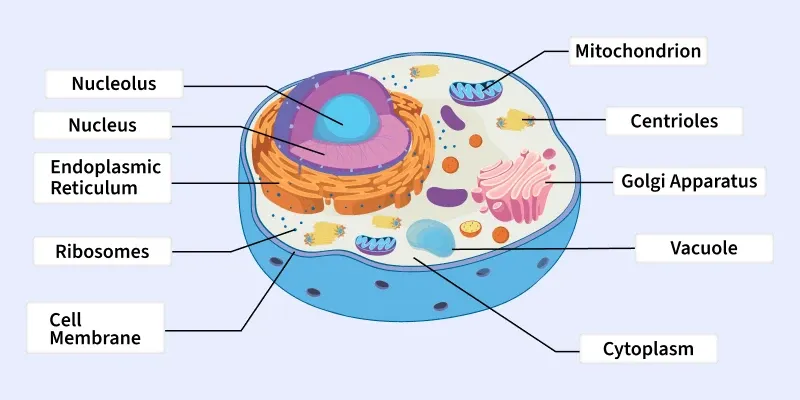
Structure of Animal Cell
Animal cells consist of cellular structure and various organelles that carry out the basic functions of life. The various organelles present in animal cells are as follows:
**Cell Membrane
- A thin, lipid and protein-rich membrane covering the outer layer of the cell is called the cell membrane.
- It is semi-permeable and protects the cell from its environment.
- It also regulates the passage of material in and out of the cell.
**Nucleus
- The nucleus is referred to as the cell's control centre.
- It contains genetic material (DNA) that regulates various cell activities and protein synthesis.
**Nuclear Membrane
- The nucleus is surrounded by a double membrane.
- It controls the passage of substances between the nucleus and the cytoplasm.
**Centrosome
- A centrosome is a small organelle present close to the nucleus.
- It has a dense centre, which is surrounded by radiating tubules.
- Microtubules are formed at the centrosomes.
**Lysosomes
- Lysosomes are spherical, membrane-bound organelles.
- The enzymes present in the lysosome break down cellular debris, waste products, and foreign substances.
**Cytoplasm
- Cytoplasm is a gel-like substance.
- The substance that contains various cell organelles.
- It is protected by the cell membrane.
**Golgi Apparatus
- The Golgi Apparatus is a flat, layered, sac-like organelle present close to the nucleus.
- It modifies, transports, and packs lipids and proteins.
**Mitochondria
- The mitochondrion is a double-membrane organelle present in both plant and animal cells.
- It is spherical or rod-shaped.
- They are a cell's powerhouse responsible for producing ATP (energy) through cellular respiration.
**Ribosomes
- Ribosomes are small organelles present in the ER as well as in cytoplasm of the cell.
- It helps in protein synthesis in plant and animal cells.
**Endoplasmic Reticulum
- Endoplasmic Reticulum is of two types: rough and smooth endoplasmic reticulum.
- Rough ER consists of ribosomes and takes part in protein synthesis.
- Smooth ER is involved in lipid metabolism.
**Vacuole
- Vacuole are membrane-bound sac that stores water, food, ions, nutrients, and waste products.
- Unlike plant cells, they're smaller and less prominent in animal cells.
**Nuclear pores
- The passage of nucleic acids and proteins through the nuclear membrane is facilitated by these microscopic holes present on the membrane.
Types of Animal Cells
Animal cells can be categorised into various types. Each animal cell has a specific function. The various types of animal cells are as follows:
- **Skin Cells: The animal cell that forms the epidermis is referred to as a "skin cell." The cells can be squamous, columnar, or cuboidal in shape. It performs specific functions like protection, absorption, and secretion.
- **Muscle Cells: Muscle cells are of three types: skeletal muscle cells, smooth muscle cells, and cardiac muscle cells. They are also known as muscle fibres and perform contraction and movement of muscles.
- **Blood Cells: Blood cells are of three types: red blood cells, white blood cells, and platelets. The function of red blood cells is to transport oxygen, white blood cells provide an immune response, and platelets aid in blood clotting.
- **Nerve Cells: Nerve cells carry signals in the form of electrical impulses. It is divided into different parts, such as the cell body, dendrites, and an axon.
- **Fat Cells: Fat cells store energy in the form of fat. It plays an important role in insulation, protection, and hormone regulation.
Characteristics of an Animal Cell
Robert Hook observed dead cork cells (plant cells) under a microscope and coined the term “cell.**” Theodor Schwann and Matthias Schleiden gave the cell theory, which states that cells are the basic units of life in both plants and animals. It helps us understand the animal cell in detail.
- Animal cells perform multiple functions essential for the survival and adaptation of organisms.
- An animal cell is eukaryotic in nature and exhibits DNA within the nucleus.
- It also contains various cellular structures and organelles, like the cytoplasm, Golgi apparatus, ribosomes, mitochondria, etc.
- Animal cells function together to carry out various cellular processes and sustain life.
- It lacks a cell wall and chloroplasts.
- In animal cells, these organelles function together to perform essential cellular processes like energy production, immune response, protein synthesis, and cellular communication.
- The largest known animal cell is the ostrich egg.
Functions of an Animal Cell
Animal cells perform multiple functions essential for the survival and adaptation of organisms. Important functions of animal cells are:
- Mitochondria present in the animal cell produce energy through cellular respiration, that is, ATP, the energy currency of the cell.
- The plasma membrane of the animal cell regulates the entry and exit of substances and maintains cellular homeostasis.
- The nucleus contains DNA, which regulates cellular activities through transcription and translation.
- The ER helps in protein synthesis, and the Golgi apparatus packs the molecules for transport.
- Centrioles in the cell organise microtubules during cell division, which ensures chromosome separation.
- Animal cells work together to maintain a stable internal environment, which is necessary for overall organism health.