Cytoplasm (original) (raw)
Last Updated : 24 Apr, 2026
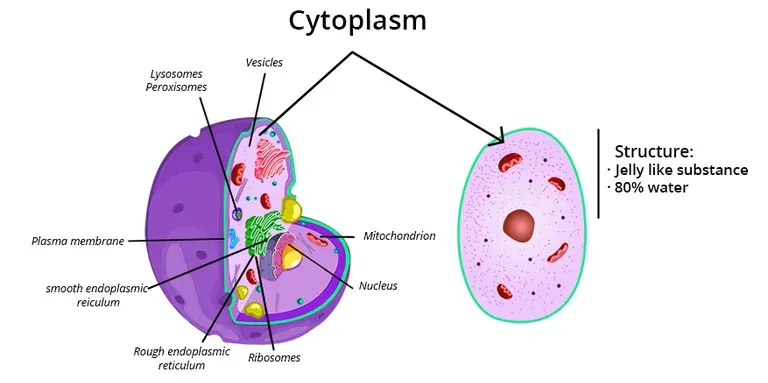
Cytoplasm is a semi-fluid substance found within cells. It includes all organelles except the nucleus and plays a central role in various cellular processes, like metabolism and intracellular transport. It acts as the medium in which various cellular processes, like protein synthesis, metabolism, and many chemical reactions, take place. The cytoplasm contains water, ions, nutrients, and various molecules necessary for cellular activities.
**Structure of the Cytoplasm
The structure of the cytoplasm is as follows:
- Cytosol is the main component of the cytoplasm, which is semi-fluid or gel-like in consistency. It forms the bulk of the cytoplasm.
- Cytoplasm serves as a medium for various chemical reactions and suspends various organelles within it.
- Cytoplasm contains various organelles, including endoplasmic reticulum (ER), mitochondria, Golgi apparatus and vacuoles, etc.
- The organelles present in the cytoplasm perform their specific functions.
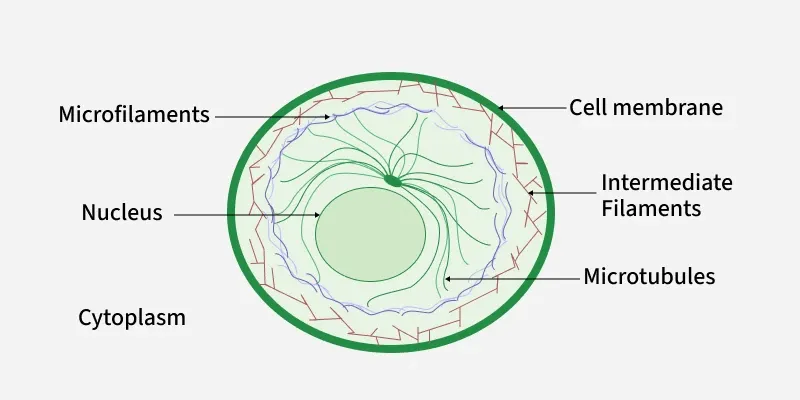
- The cytoskeleton consists of a network of protein filaments that provide structural support to the cell and play a role in cell motility, shape maintenance, and intracellular transport.
- Enzymes are present in the cytoplasm that take part in various metabolic reactions and processes such as glycolysis, protein synthesis, and lipid metabolism.
Characteristics of Cytoplasm
The characteristics of cytoplasm are given below:
- Cytoplasm is a semi-fluid in consistency and is found in both prokaryotic and eukaryotic cells.
- It fills the space between the cell membrane and the nucleus and consists of ions, water, enzymes, and molecules essential for various cellular activities.
- It serves as a suspension medium for various cell organelles, such as mitochondria, ribosomes, and the endoplasmic reticulum, which allow them to function effectively.
- In the cytoplasm, various metabolic reactions like glycolysis and protein synthesis take place.
- It facilitates the movement of molecules and organelles within the cell.
**Functions of the Cytoplasm
The functions of the cytoplasm are as follows:
- Cytoplasm is a jelly-like substance in which all the components of the cells are embedded. It is present within the cell membrane and is made up of salt and water.
- It serves as the site for numerous metabolic reactions like glycolysis, which produces energy in the form of ATP.
- The cytoplasm supports the cytoskeleton, which gives the cell its shape and motility to the cell.
- It acts as a medium for the intracellular movement of molecules and organelles. The movement takes place through processes like diffusion and active transport.
- Cytoplasm stores various cellular materials, like nutrients, ions, and waste products.
- Protein synthesis occurs in the cytoplasm, through translation, where ribosomes assemble amino acids into proteins.
- Signalling molecules and organelles present in it enable cellular communication.
**Organelles in the Cytoplasm
The various cell organelles present in the cytoplasm are as follows:
**Mitochondria
As it generates energy in the form of ATP for the cell, mitochondria are referred to as the powerhouses of the cell. In many species, the mitochondrial genome is transmitted from the mother. It is a sausage-shaped organelle with two membranes linked to it that is present in practically all eukaryotic cells.

**Endoplasmic Reticulum
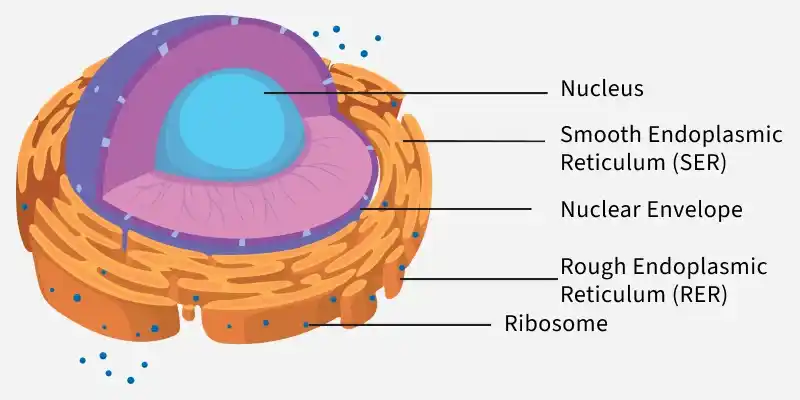
The Endoplasmic Reticulum is a network of fluid-filled membranous tubes. They are the cell's transport system and are responsible for moving materials around the cell. There are two types of ER: Rough ER and Smooth ER. The production of proteins is carried out by the rough endoplasmic reticulum, and the synthesis of lipids and steroids is carried out by the smooth endoplasmic reticulum.
**Plastids
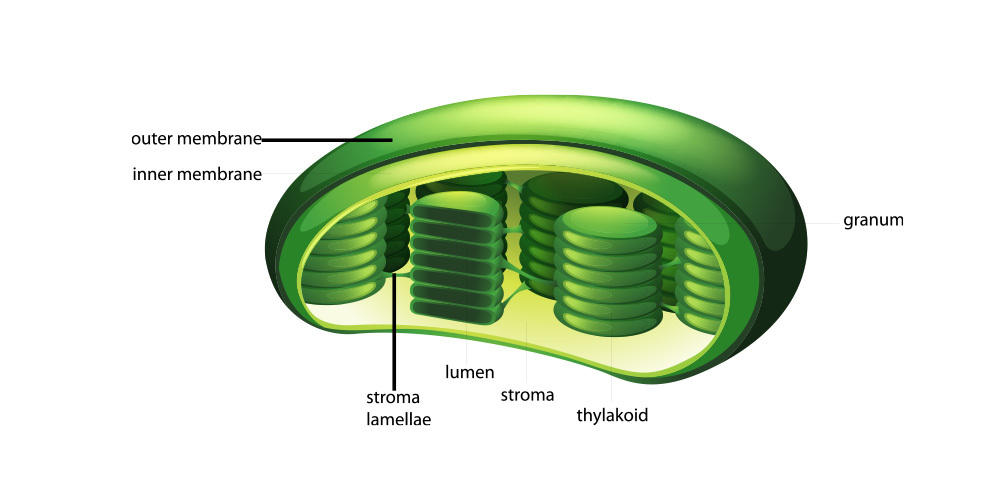
Plastids are DNA-containing membrane-bound organelles of a plant cell. They help in photosynthesis and store starch. Additionally, it is employed in the synthesis of several compounds, which serve as cellular building blocks. The diagram of a Chloroplast is given below:
Plastids can be classified into three groups based on the sort of pigments they contain:
- **Chloroplast: Chloroplasts are dual membrane-bound organelles present in the mesophyll cells of leaves. The stroma of chloroplasts likewise has dual circular DNA, 70S ribosomes, including enzymes necessary for the production of carbs, similar to the mitochondrial matrix.
- **Chromoplasts: This comprises low-saturated carotene compounds, such as xanthophylls and carotene, which give plants their distinctive colours, such as yellow and red.
- **Leucoplasts are colourless plastids that serve as food storage. Aleuroplasts retain proteins, elaioplasts hold oils and lipids, and amyloplasts hold carbs (such as the starch in potatoes).
**Ribosomes
In proximity to the endoplasmic reticulum are ribosomes, significant non-membrane-bound cytoplasmic organelles. Numerous cells have microscopic particles called ribosomes, which are primarily made up of 2/3 RNA and 1/3 protein. They are referred to as the 70s (found in prokaryotes) or the 80s (found in eukaryotes). In all living cells, the function of the ribosomes is to synthesise proteins.

**Golgi Apparatus
The Golgi Apparatus is a membrane-bound organelle made up of cisternae, which are a series of flat, piled pouches. Proteins and lipids are transported and packaged by this organelle to reach specific locations. The shape and size of the Golgi complex depend upon the physiological state of the cells. The Golgi apparatus is made up of cisternae and associated vesicles and tubules.

**Cytoskeleton
The cytoskeleton consists of protein filaments found in the cytoplasm of eukaryotic cells. The cytoskeleton provides structural support to the cell, helps maintain cell shape, and is essential for intracellular transport, cell motility, and cell division. The cytoskeleton is composed of three components: microtubules, microfilaments and intermediate filaments.
**Centrosome and Centriole
The centrosome found in animal cells consists of two centrioles. They are cylindrical structures composed of microtubules. Centrioles take part in cell division and organise and direct the formation of the mitotic spindle, which ensures accurate chromosome segregation. The centrosomelocation is near the nucleus.
