Animals Nervous System (original) (raw)
Last Updated : 23 Jul, 2025
An **animal's nervous system is a complex structure of tissues and cells that is essential to its ability to operate. Animals nervous system parts and functions consist of the brain, spinal cord, and nerves, coordinating sensory input, processing information, and generating responses to maintain homeostasis and regulate bodily functions. The nervous system regulates every bodily function, from basic reflexes to intricate actions. In this article, we will cover the **animal nervous system, its parts, classification, and more. You can also find Animals Nervous System notes here.
Table of Content
- What is Animal Nervous System?
- Functions of the Animal Nervous System
- Anatomy of the Nervous System
- Types of Peripheral Nervous System
- Neurons: The Building Blocks
- Parts of the Brain and Their Functions
- Types of Nerves
What is Animal Nervous System?
The animal nervous system is a complex structure of tissues, cells, and organs that plan and direct an animal's motions. It is an important component of animal biology that allows animals to receive and respond to stimuli from their surroundings, control their bodies, and show a range of behaviours. The complicated structure of an animal's nervous system can differ significantly among species.
This can range from simple nerve networks seen in cnidarians like jellyfish to highly developed central nervous systems found in vertebrates like mammals. The basic nervous system functions remain unchanged, despite its complexity. It involves generating responses, interpreting information, and planing the body's movements.
Functions of the Animal Nervous System
The functions include:
- Coordinate bodily functions and responses to stimuli.
- Process sensory information from the environment.
- Generate and regulate behaviors essential for survival.
- Maintain homeostasis by integrating signals and coordinating physiological processes.
- Control voluntary movements and involuntary bodily functions.
- Facilitate communication between different parts of the body.
- Enable learning, memory, and cognition.
Animal Nervous System Parts and Functions
The peripheral nervous system (PNS) and the central nervous system (CNS) are the two primary parts of the nervous system. Together, these elements control how the body reacts to stimuli and operates.
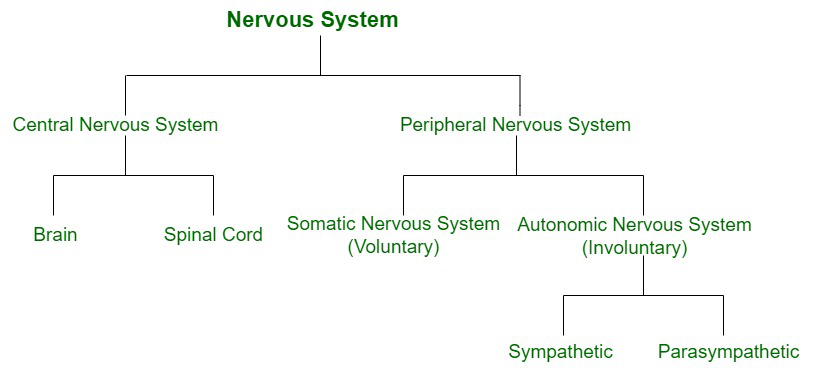
Central Nervous System (CNS)
- **Skull and vertebral column: The skull and vertebral column, among other bone components, surround and protect the brain and spinal cord, which make up the central nervous system (CNS).
- **Brain: The brain coordinates motor responses, processes sensory data, and controls higher order cognitive processes like memory and emotion. It is the CNS command center.
- **Brainstem: It is composed of areas, each with an autonomous purpose. Basic physiological processes such as heart rate and respiration are controlled by the brainstem.
- **Forebrain: The brain's anterior region is made up of the **thalamus, hypothalamus, and cerebrum.
- **Midbrain: It is the more compact and central region of the brain.
- **Hindbrain: It is the core area of the brain, consisting of the **Pons, Medulla, and Cerebellum.
- **Cerebrum: while the cerebrum is in charge of conscious cognition and voluntary movements.
- **Cerebellum: The cerebellum is important in balance and coordination.
- **Spinal cord: The brain and the rest of the body communicate with each other through the spinal cord.
- It coordinates reflex reactions and voluntary movements by carrying motor impulses from the brain to muscles and glands and sensory data from peripheral nerves to the brain.
Peripheral Nervous System (PNS)
- Outside the CNS, the PNS is made up of **ganglia and nerves.
- The nerves that connect the c**entral nervous system (CNS) to the rest of the body are composed of bundles of axons, or nerve fibers.
- The PNS is made up of two primary types of nerves:
- **Spinal nerves, which come from the spinal cord.
- **Cranial nerves, which come from the brain.
- The PNS has touch, pain, and temperature receptors in addition to the sensory receptors that are present throughout the body.
- These receptors provide signals to the central nervous system (CNS) for processing after detecting environmental inputs.
- Moreover, the PNS's autonomic nerves regulate involuntary functions of the body including breathing, digestion, and heart rate.
- **Autonomic nervous system: The sympathetic and parasympathetic are the branches of the autonomic nervous system have conflicting impacts on physiological functions that maintain homeostasis.
Types of Peripheral Nervous System
The somatic nervous system and the autonomic nervous system are the two primary types of the peripheral nervous system (PNS).
Somatic Nervous System (SNS)
- The somatic nervous system is responsible for the voluntary control of skeletal muscles in addition to transmitting motor commands from the CNS to muscles and sensory information from the body to the CNS.
- It is composed of motor neurons that transmit commands from the brain to the skeletal muscles to control voluntary movements, and sensory neurons that transfer information from the CNS to sense receptors (such as touch, pain, temperature, and proprioception).
Autonomic Nervous System (ANS)
- The autonomic nervous system controls involuntary body processes such as **glandular production, breathing, heartbeat, and digestion.
- It maintains homeostasis and reacts correctly to both internal and external stimuli.
- Sympathetic and parasympathetic nerve systems are the two additional branches that make up the ANS.
Sympathetic Nervous System
- In stressful or dangerous situations, the sympathetic nervous system primes the body for "fight or flight" reactions.
- It quickens the pulse, widens the airways, reroutes blood flow to the skeletal muscles, and promotes the release of glucose into the bloodstream for energy.
- The lumbar and thoracic portions of the spinal cord are the source of sympathetic neurons.
Parasympathetic Nervous System
- The parasympathetic nervous system promotes "rest and digestion" responses to improve relaxation and save energy.
- It enhances digestive processes, lowers heart rate, narrows airways, and supports body processes related to relaxation and recuperation.
- The brainstem and the sacral area of the spinal cord are the source of parasympathetic neurons.
Neurons: The Building Blocks
In nervous system, neurons are in charge of signal transmission and enabling communication between various body sections. They are essential for information processing and transmission, which allows living beings to sense their surroundings, respond, and synchronize physiological processes.
Structure of Neurons
- **Cell Body (Soma): The nucleus and other organelles necessary for cellular repair and function are located in the cell body, which is the core portion of the neuron.
- **Dendrites: Dendrites are branching projections that extend from the cell body and are the primary locations for receiving information from neighboring neurons or sense receptors.
- **Axon: A neuron's axon is a long, thin projection that projects from the cell body and sends messages to neighboring neurons, muscles, or glands.
- A lipid substance called **myelin may coat axons, causing them to become myelinated. This process improves the speed and effectiveness of signal transmission.
**Also Read: Difference Between Axon and Dendrite

Function of Neurons
The following processes are involved in the process known as **neurotransmission, which is how neurons send signals:
Signal Reception
- Neurons' dendrites carry impulses that are received from other neurons or sensory receptors.
- These signals can be inhibitory, which lowers neuronal activity, or stimulating, which promotes the generation of an electrical impulse.
Integration
- The neuron connects the inputs before determining whether to generate an action potential, which is a brief electrical impulse that travels down the axon. .
Action Potential Generation:
- The neuron initiates an action potential when signals exceeds a certain threshold.
- Voltage-gated ion channels in neurons cause a sudden shift in the membrane potential when their membranes open, allowing ions such as potassium and sodium to enter and exit the cell, respectively.
Axon Conduction
- The opening and shutting of ion channels causes the action potential to move down the axon in a wave-like pattern.
- Saltatory conduction, which occurs when the action potential in myelinated neurons hops across nodes of gaps in the myelin sheath, speeds up signal transmission.
Synaptic Transmission:
- Neurotransmitters are released into the synaptic cleft the narrow space between one neuron's axon terminal and the dendrites of another when the action potential reaches the axon terminals.
- When neurotransmitters attach to postsynaptic neuron receptors, they either change the activity of the neuron or produce a new electrical signal.
**Also Read: Nerve Impulse - Conduction and Transmission Of Nerve Impulses
**Parts of the Brain and Their Functions
The human brain is a very complicated organ with many separate components, each of which performs a specific purpose. The main components of the human brain are listed below.

Cerebrum
- The left and right hemispheres comprise the biggest portion of the brain.
- Higher order cognitive processes such as language, thinking, solving problems, and conscious cognition are handled by this organ.
Cerebellum
- Situated toward the rear of the brain, under the cerebrum.
- Primarily in charge of synchronizing posture, balance, and voluntary motions.
Brainstem
- Acts as a channel for information traveling from the brain to the rest of the body, connecting the brain to the spinal cord.
- Consisting of the medulla oblongata, pons, and midbrain as its three primary components.
Diencephalon
- Situated halfway between the brainstem and the cerebrum.
- Consists of the thalamus, hypothalamus, and epithalamus, among other structures.
Limbic System
- It is made up of interrelated structures related to motivation, memory, and emotions.
- Comprises the hippocampus, which is involved in learning and memory consolidation, the hypothalamus, which is involved in emotion regulation and the stress response, and the amygdala, which is involved in pain processing and fear response.
**Types of Nerves
Based on their roles and the kinds of messages they carry, nerves are categorized. The peripheral nervous system (PNS) has three primary types of nerves: mixed, motor, and sensory nerves.

Sensory Nerves
- A**fferent nerves, sometimes referred to as sensory nerves, provide sensory data from sensory receptors to the central nervous system (CNS).
- These nerves provide messages about pressure, temperature, touch, pain, and proprioception, or the sense of one's own body's position and movement.
- Sensory nerves receive perceptions from outside environments or from within the body, sending this data for processing to the brain and spinal cord.
Motor Nerves
- Motor nerves, often referred to as **efferent nerves, provide information to muscles and glands in the central nervous system (CNS), regulating both voluntary and involuntary movements and glandular production.
- The impulses that motor neurons provide to muscles cause them to contract, enabling activities like walking, speaking, and holding items.
- They also work in concert with smooth muscles and glands to control involuntary processes including breathing, digestion, and heart rate.
Mixed Nerves
- In order to transmit motor orders from the CNS to muscles and glands as well as sensory data to the CNS, mixed nerves must have both motor and sensory fibers.
- Combining sensory and motor capabilities into a single nerve bundle, mixed nerves make up the majority of PNS nerves.
- Through the coordination of sensory input and motor output, these neurons provide bidirectional communication between the central nervous system and peripheral tissues.
**Also Read: Difference Between Sensory And Motor Neurons
Conclusion-Animals Nervous System
The nervous system is an essential part of animal biology that enables living things to sense, interpret, and react to their surroundings. The peripheral nervous system (PNS), which is made up of nerves and ganglia outside the central nervous system (CNS), and the central nervous system (CNS), which is made up of the brain and spinal cord. Understanding the organization and function of the nervous system sheds light on the complexities of animal biology and behavior, highlighting its crucial role in maintaining homeostasis and ensuring survival in diverse environments.
**Also Read: