CAM Plants (original) (raw)
Last Updated : 1 Jun, 2026
CAM plants are specially adapted plants that survive in hot, dry, and water-deficient environments through a unique photosynthetic pathway called Crassulacean Acid Metabolism (CAM). In these plants, stomata remain closed during the daytime to reduce water loss and open at night to absorb carbon dioxide. The absorbed carbon dioxide is stored as organic acids during the night and released during the day for photosynthesis and carbohydrate synthesis.
Characteristics of CAM Plants
CAM plants possess several important structural and physiological adaptations that enable them to survive in dry habitats.
- The stomata of CAM plants remain open during the night and closed during the daytime. This adaptation reduces transpiration because water loss is lower at night due to lower temperatures and higher humidity.
- Most CAM plants are succulent, meaning they possess thick and fleshy leaves or stems capable of storing large quantities of water. This stored water helps the plants survive long periods of drought.
- Since stomata remain closed during the day, transpiration is greatly reduced. This helps conserve water in extremely dry environments.
- In CAM plants, carbon dioxide fixation occurs during the night, while the Calvin cycle takes place during the daytime. This temporal separation is a major characteristic of CAM metabolism.
- The cells of CAM plants contain large vacuoles that store malic acid formed during nighttime carbon dioxide fixation.
- CAM plants utilise water very efficiently because they lose very little water during photosynthesis.
Examples of CAM Plants
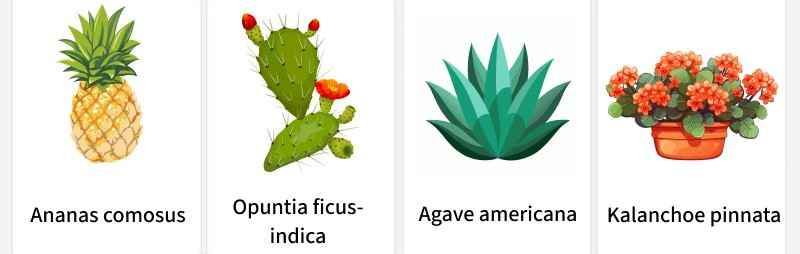
CAM plants are mainly found in xerophytic habitats where water is scarce and temperatures are high. They are especially common in deserts and dry tropical regions. These plants are adapted to withstand prolonged periods of drought and extreme heat. These plants typically have thick, fleshy, succulent leaves or stems that facilitate water storage.
Examples of CAM plants include:
- Opuntia (Cactus)
- Pineapple
- Aloe vera
- Agave
- Bryophyllum
- Jade plant
- Euphorbia
- Kalanchoe
Structure and Adaptations of CAM Plants
CAM plants possess several structural adaptations that help them survive in dry conditions.
- **Thick Cuticle: The epidermis is covered with a thick, waxy cuticle that minimises water loss by evaporation.
- **Sunken Stomata: Many CAM plants possess sunken stomata that reduce transpiration further.
- **Reduced Leaves: In some CAM plants, leaves are reduced to spines, as seen in cactus plants. This reduces the surface area available for water loss.
- **Photosynthetic Stems: In cactus plants, green stems perform photosynthesis because leaves are absent or highly reduced.
- **Extensive Root System: CAM plants often possess extensive root systems capable of absorbing water rapidly whenever rainfall occurs.
Mechanism of CAM Photosynthesis
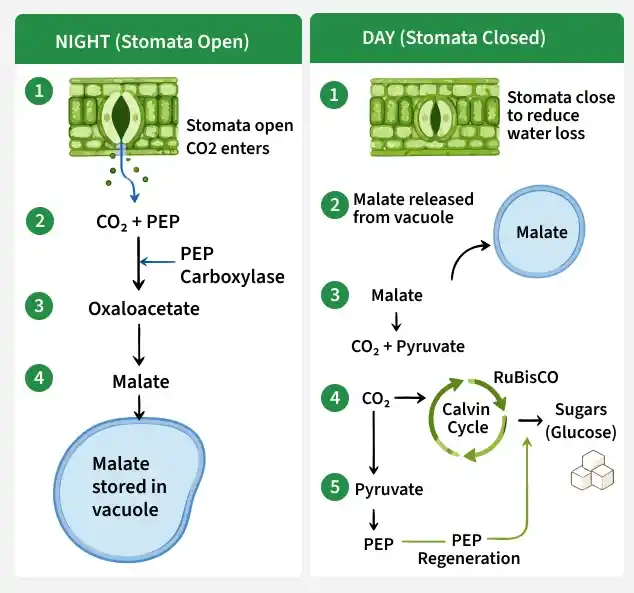
The CAM pathway consists of two major phases: the night phase and the day phase.
Night Phase
During the night, environmental conditions are cooler and more humid. Therefore, stomata open during this period.
- **Entry of Carbon Dioxide: Carbon dioxide enters the plant tissues through open stomata.
- **Formation of Oxaloacetic Acid: Carbon dioxide combines with phosphoenolpyruvate (PEP) in the presence of the enzyme PEP carboxylase.
PEP + CO2 → Oxaloacetic Acid
- **Formation of Malic Acid: Oxaloacetic acid is converted into malic acid, which is stored inside the vacuoles. The accumulation of malic acid increases the acidity of plant tissues during the night.
Oxaloacetic Acid → Malic Acid
Day Phase
During the daytime, temperatures rise, and stomata remain closed.
- **Breakdown of Malic Acid: Stored malic acid is broken down to release carbon dioxide.
Malic Acid → CO2 + Pyruvate
- **Calvin Cycle: The released carbon dioxide enters the Calvin cycle inside chloroplasts and is used for the synthesis of carbohydrates.
- **Regeneration of PEP: Pyruvate is converted back into phosphoenolpyruvate using ATP so that the cycle can continue.
Importance of CAM Plants
CAM plants are extremely important both ecologically and economically.
- CAM plants can survive in deserts and arid regions where ordinary plants cannot survive due to severe water scarcity.
- The CAM pathway is one of the most efficient mechanisms for reducing water loss during photosynthesis.
- CAM plants help maintain ecological balance in desert ecosystems and provide food and shelter for many organisms.
- Some CAM plants, such as pineapple, are economically important crops.
- Many CAM plants like Aloe vera possess medicinal properties and are used in traditional and modern medicine.
- Several CAM plants are cultivated as ornamental plants because of their attractive appearance and ability to survive with minimal watering.