Community Ecology (original) (raw)
Last Updated : 2 Dec, 2025
Community ecologyis the study of the functioning and organisation of communities, which are assemblages of interacting populations of species living in a particular habitat. Community ecology is mainly concerned with how certain genotypic and phenotypic features affect interactions within populations. It represents the populations of all species living and interacting in an area at a particular time.
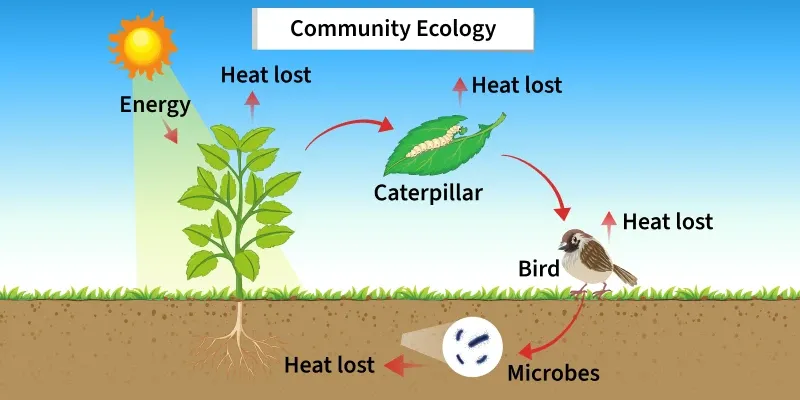
The primary features of community ecology are species diversity, trophic organisation, dominance, self-sufficiency, growth shape and structure, and relative abundance. A pond, a forest, and a desert are examples of natural communities. A community's development, organisation, and behaviours are all distinct.
- **Variability in Species: Every community consists of a variety of organisms, such as bacteria, plants, and animals. They differ from one another in terms of taxonomy. There may be a local or regional diversity of species.
- **Growth Form and Organisation: A community can be examined using primary growth forms, such as trees, shrubs, and herbs. Each growth form found in trees may contain a variety of plant species, including broadleaf trees, evergreen trees, etc.
- **Dominion: Within a community, species vary in importance. A community's traits are determined by a chosen few species. A few numbers of species regulate and rule over the community.
- **Self-Reliance: There are many different heterotrophic and autotrophic organisms in every group. Autotrophic plants can survive on their own.
- **Relative Abundance: The idea of relative abundance states that many populations coexist in a community in relative amounts.
- **Trophic Structure: The trophic organisation of each ecosystem regulates the flow of food and energy from plants to herbivores and then to carnivores.
There are two main types of community:
The smallest self-sustaining, self-regulating ecological unit is called a major community. These communities typically exist in relative isolation from other communities, such as lakes, ponds, forests, or grasslands.
- A major community is an amalgam of a microbiological community (also known as "microbiocenosis"),
- A floral community (also known as "phytocenosis")
- A faunal community (also known as "zoonenosis")
Smaller ecological entities that depend on interactions with other communities for survival, minor communities, also known as merocenoses, are the building blocks of big communities. An example of a minor community is the collection of organisms that live within a piece of deadwood on the forest floor.
The community structure describes the composition of a community by including a number of species and their relative abundances. Different ecological communities can have rather different kinds and numbers of species living there.
Trophic Pyramid
The trophic pyramid is a common structure found in all biological groups. Each pyramid comprises four or five layers. Food energy is passed from one food chain to the next.
- It requires a large number of species at a particular trophic level to support those in the next level, since every level of the pyramid loses energy to heat.
- Autotrophs are the basis species in every biological community; they are organisms that directly obtain heat from the sun through photosynthesis. Heterotrophs are the species that make up the remainder of the pyramid.
- Animals can have more than one meal at a time, depending on their developmental stage. A normal food chain has four or five links, with autotrophs at the base and carnivores at the top as the top predator. But many organisms eat more than one species.
**Food Chain and Food Web
Numerous species feed at different trophic levels, consuming both plants and animals. Because of this, food chains are often linked to form incredibly intricate food webs.
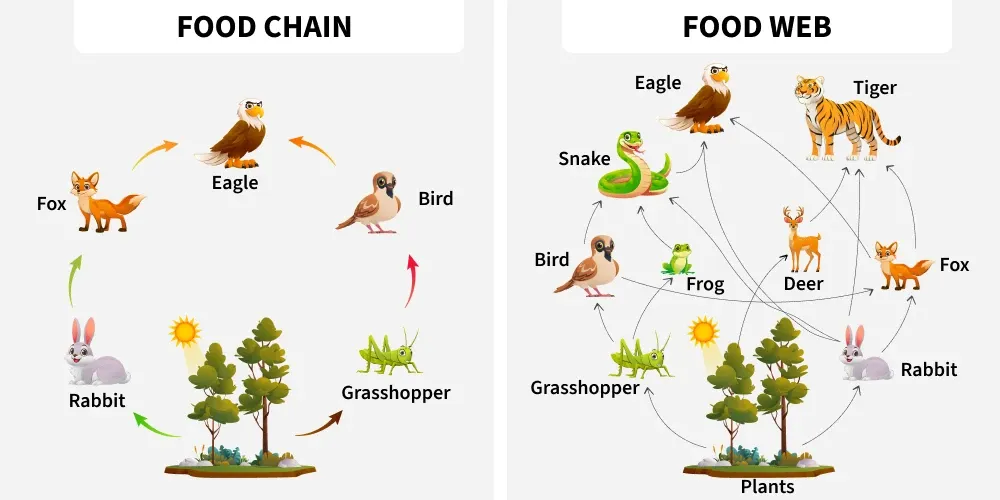
Animals in a society participate in interactions other than mutual consumption, such as competition for resources. Non-trophic relationships between species play an equally important role in determining the organisation of biological communities as do the trophic level food webs and food chains.
The community ecology is important because:
- It helps in the understanding of community structure and evolution by scientists. It also helps in understanding the causes, effects, and maintenance of species variety.
- The interactions and competition between organisms that coexist in a certain ecological niche are the main focus of community ecology.
- This is particularly important for invasive species, which, if they can fill certain niches held by native species, may be able to establish themselves in particular groups.
- Abiotic variables that affect species interactions or distributions are also taken into consideration in community ecology. For example, the soil pH or the annual temperature.