Ecological Succession Definition, Types, Characteristics, Causes (original) (raw)
Last Updated : 23 Jul, 2025
**Ecological succession is the process by which the structure and composition of a biological community change over time. Each of the **ecological succession stages is characterized by different species compositions and environmental conditions.
Understanding ecological succession and its types helps in learning the dynamic nature of ecosystems and the complex relationships between organisms and their environment. In this article, we will cover ecological succession in detail.
Ecological Succession
**Ecological succession is the gradual process of change in the species composition of an ecosystem over time. It occurs as a result of natural disturbances like fires, floods, or human activities such as farming or deforestation. In the initial stages of succession, pioneer species, like mosses and lichens, colonize barren environments, gradually paving the way for more complex communities of plants and animals.
As these communities develop, they change the environmental conditions which make it more suitable for different species to thrive. This process continues until a stable climax community is reached. It is characterized by a range of species which are well adapted to the prevailing environmental conditions. The ecological succession and its types include - **Primary and Secondary Succession.
**Types of Ecological Succession
The types of ecological succession are discussed below:
Primary Succession
**Primary succession is a gradual process of change by which a barren area is transformed into a thriving ecosystem. This types of ecological succession starts in places with no plants or animals, like bare land or new volcanic rocks. Over time, microorganisms break down these rocks and create soil in a process called **soil erosion.
Then, plants start to grow in the soil. It takes several hundred to 1,000 years for a full community of plants and animals to develop, depending on the area and climate. These plants support different animals, and the ecosystem evolves from simple to more complex. If the ecosystem is disturbed, like by a fire or human activity, secondary succession begin s.
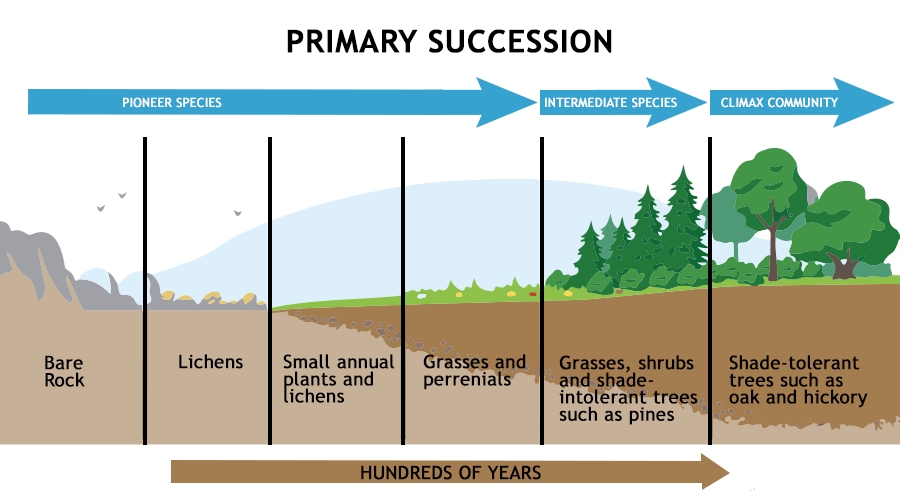
Primary Succession
Secondary Succession
**Secondary ecological succession occurs in areas where an existing ecosystem has been disturbed, but not completely destroyed. Examples of disturbances include forest fires, floods, landslides, or human activities like farming or logging. Unlike primary succession, secondary succession starts with some remaining and left over fertile soil and organisms (seeds, spores, etc.) from the previous community. This allows for faster recolonization by plants and animals.
**Process of Recolonization
The process of recolonization in secondary ecological succession involves:
- Following the disturbance, small, fast-growing plants like weeds and grasses are the first to establish themselves. They benefit from the increased sunlight penetration and readily available nutrients.
- Over time, these pioneer species are gradually replaced by larger plants and shrubs, as the environment becomes more shaded and soil conditions change.
- Through continued succession, the ecosystem progresses towards a stable climax community. This is a self-sustaining ecosystem characteristic of the region's climate and geography. The climax community represents a mature stage with a complex web of plant and animal life.
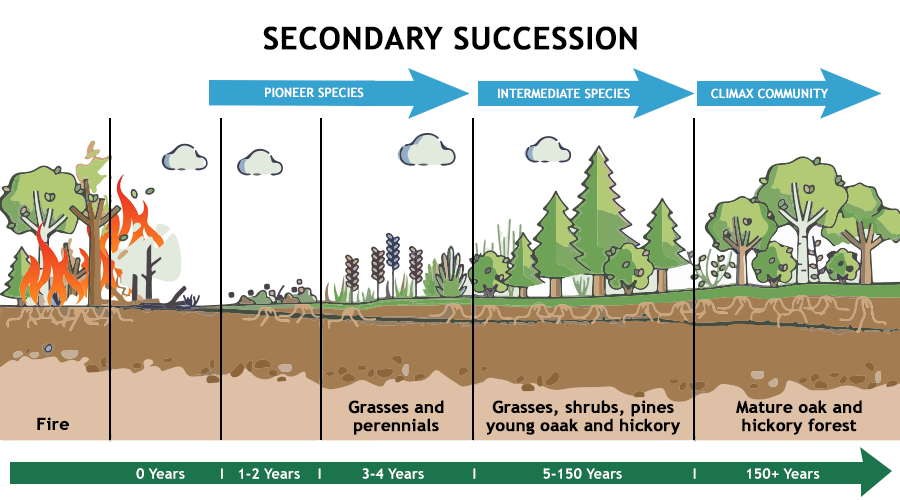
Secondary Ecological Succession
Cyclic Succession
Cyclic succession is a pattern of ecological change where the community of organisms in an ecosystem undergoes repeated cycles of growth and decline. Unlike linear succession, which moves towards a stable climax community, cyclic succession involves periodic fluctuations in species composition and environmental conditions. This phenomenon is often observed in ecosystems with recurring disturbances such as seasonal changes, periodic flooding, or regular wildfires.
Each cycle of disturbance starts a sequence of ecological changes with different species dominating at different stages of the cycle. For example, in a freshwater pond, algae may flourish in the summer, followed by a bloom of aquatic plants in the fall, and then a decline in vegetation during the winter.
In ecological succession, a seral community (or sere) is a transitional stage that represents the developing ecosystem at a particular point in time. These communities change and evolve as succession progresses towards a stable climax community. Seres reflect the movement of ecological communities through various stages, from pioneer species to the climax community.
Types of Seres
The various types of seres are:
- **Xerosere succession : Takes place in dry areas like rock lithosere, psammosere, and halosere.
- **Hydrosere succession: This type of succession starts in the aquatic habitat and progresses from hydric to mesic conditions.
- **Lithosere: This type of ecological succession develops on exposed rock surfaces.
- **Psammosere: This type of ecological succession starts on the sand.
- **Halosere: The plant succession that starts on salty soil and saline water.
- **Senile: This type of succession begins on a dead matter of microorganisms.
Stages of Ecological Succession
The process of ecological succession involves five stages, which are:
**Nudation
This is the development of a vacant area with no life. It can be caused by events like volcanic eruptions, landslides, floods, erosion, earthquakes, forest fires, or the spread of disease.
**Invasion or Intrusion
This stage involves the establishment of species in a barren area. The seeds or spores of various species arrive in the new or exposed area through air, water, etc., a process called migration. These species then adapt to the conditions, known as **ecesis, and multiply, which is called **aggregation.
**Competition and coaction
As species increase in number, they compete with each other for food, space, and other resources. This competition can be within the same species (intraspecific) or between different species (interspecific), along with interactions with the environment. New species of plants and animals continue to invade.
**Reaction
In this phase, living organisms alter the environment through their activities, which is called **reaction..
**Stabilization
This final stage occurs when the ecosystem becomes stable and balanced for a longer period, resulting in a climax community that is well adapted to the specific environment.
Ecological Succession Causes
The reasons for environmental progression are fundamentally three types. These are the following:
- **Initial Causes: These include both biotic and climatic factors, such as erosion, wind, fire, and natural disasters. These events significantly impact the population in an area.
- **Ecesis or Continuing Causes: Also known as ongoing causes, these factors help the population adapt to environmental conditions. They include accumulation, competition, and migration.
- **Climatic Causes: These involve factors like the local climate, soil fertility, and the availability of minerals.
Examples of Ecological Succession
The examples of ecological succession are as follows:
- **Coral Reefs: Small coral formations settle on rocks. These corals grow and divide to form larger colonies. The coral reefs attract small fish and shellfish, which then become food for bigger fish, creating a fully functioning coral reef ecosystem.
- **Tropical Forests: Tropical forests are examples of secondary succession where forests were cleared for lumber and farming. The forest regrowth happened at different rates, and it took several years for the community to be fully restored.
- **Acadia National Park: This park experienced a devastating wildfire. Nature was allowed to restore the forest. In the first few years, only small plants grew on the burned soil. Over time, the forest developed a variety of tree species. Before the fire, the trees were mostly evergreen, but after the fire, deciduous trees became more common.
Conclusion - Ecological Succession
Ecological succession is a dynamic process through which ecosystems recover from disturbances and evolve over time. Whether it's primary succession starting from barren landscapes or secondary succession following disruptions, each stage plays a crucial role in restoring ecological balance and biodiversity. Understanding these processes helps in effective conservation and management of natural habitats, ensuring that ecosystems remain resilient and sustainable. Examples like coral reefs, tropical forests, and the regeneration of Acadia National Park highlight the ability of nature to rebuild and thrive after disturbances, showcasing the continuous nature of ecological succession.