Ecological Pyramid (original) (raw)
Last Updated : 12 Mar, 2026
An ecological pyramid is a graphical representation that shows the relationship between different trophic levels in an ecosystem. It helps us understand how energy, biomass, or the number of organisms changes from producers to top consumers.
Ecological pyramids are an important concept in ecology, as they explain the structure and functioning of ecosystems.
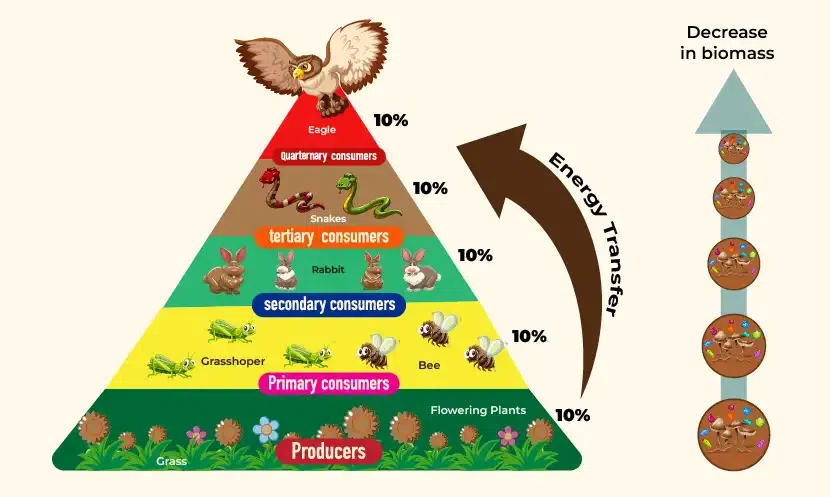
The base of every ecological pyramid is formed by producers (green plants), followed by primary consumers (herbivores), secondary consumers (carnivores), and finally tertiary consumers or top predators at the top.
Characteristics of the Ecological Pyramid
The following are the characteristics of an ecological pyramid:
- The ecological pyramid comprises two to four layers.
- Organisms that are dependent on the same type of food sources are placed at the same level.
- The producers are situated at the lowest level of an ecological pyramid with a huge population.
- The apex predators exist at the topmost level of an ecological pyramid with a relatively smaller population.
- The pointed shape of the pyramid is because the supply of energy or biomass becomes less with each passing level of the pyramid.
- In the case of the pyramid of numbers, the topmost level will have a lesser number of individuals, but their relative body size and volume will increase.
Types of Ecological Pyramid
The ecological pyramid is of three types: the pyramid of numbers, the pyramid of biomass, and the pyramid of energy.
1. Pyramid of Number
The Pyramid of Numbers denotes the total number of living individuals at various trophic levels in an ecological system. The producers are at the base, and the top carnivores are at the topmost level in this pyramid.
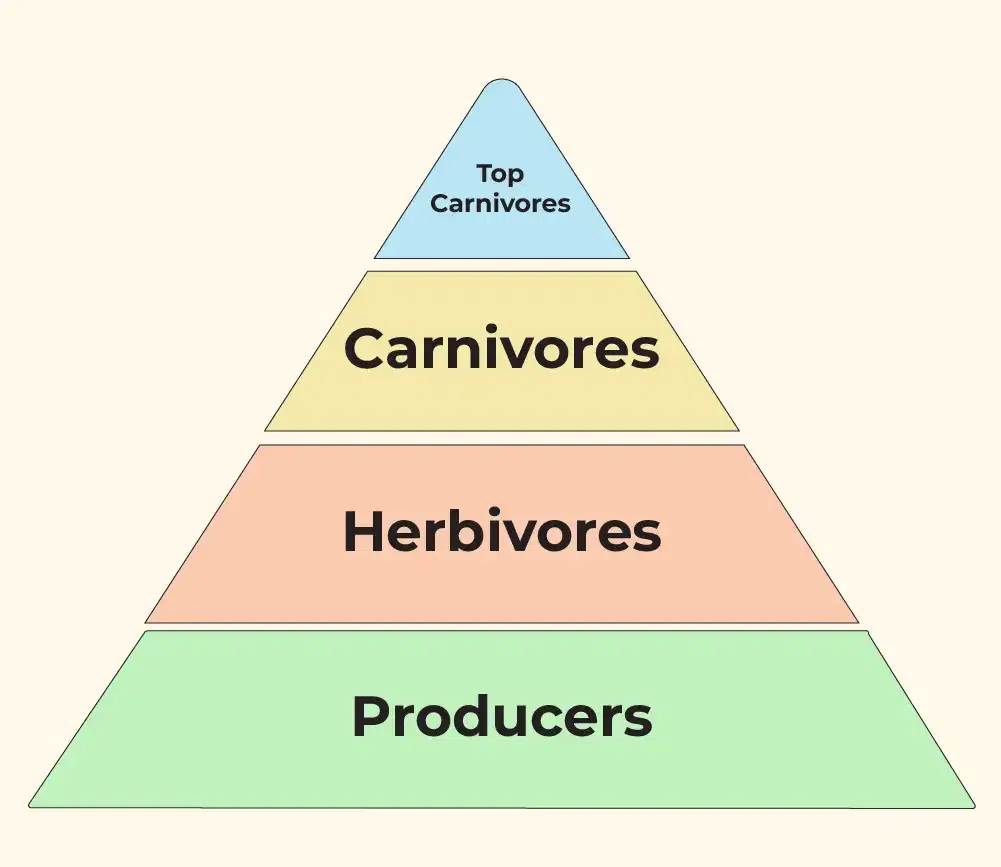
The pyramid of numbers can be both upright and inverted.
- **Upright Pyramid of Number: The upright pyramid has the largest number of producers at the base, and their numbers keep declining with each passing level, like a pond or grassland ecosystem.
- **Inverted Pyramid of Number: In the inverted pyramid, the base is pointed with a lesser number of producers, whereas the topmost level will have the largest number of individuals, as the size and food consumption of organisms in each level will decrease; i.e., in this system, one individual producer can support many primary consumers; similarly, one primary consumer can support many secondary consumers, and so on. This type of pyramid is seen in the case of a parasitic food chain.

2. Pyramid of Biomass
The ecological pyramid, which is made by considering the amount of biomass that is produced by the living system of each trophic level, is represented by the pyramid of biomass. The pyramid that demonstrates the total weight of every trophic level in a specific food chain in an ecosystem is the biomass pyramid.

Like the pyramid of numbers, the pyramid of biomass can be both upright and inverted.
- Forests and grasslands ecological systems are instances of upright biomass pyramids, as the number of producers is greater.
- The ocean ecosystem is an example of an inverted pyramid, as a large number of zooplankton are dependent on a lesser number of phytoplankton. Dependent on the trophic level of an ecosystem, only 15% to 20% of biomass per level goes to the following level.

3. Pyramid of Energy
The ecological pyramid, which is formed by determining the flow of energy from one trophic level to another, is known as the **pyramid of energy. The producers situated at the base of the pyramid of energy have the highest amount of energy, and the topmost consumer at the top has the least amount of energy.

The pyramid of energy is always uprigh**t. This pyramid addresses the complete energy content of each trophic level in an ecological system.
- The base of this pyramid, i.e., producers, has the most amount of energy acquired from the sun fixed by the help of photosynthesis.
- The flow of energy in this pyramid proves that energy can neither be created nor destroyed, as given by the law of thermodynamics.
- However, as indicated byLindeman's 10% regulation law, only 10% of the energy gets transferred from one level to another, as almost 90% is lost as heat energy is used in breathing, some is utilized in physiological cycles, and the rest is utilized by decomposers.
Importance of the Ecological Pyramid
The ecological pyramid is important in a biological system due to the following reasons:
- An ecological pyramid takes into account the dietary patterns of various living organisms.
- The ecological pyramids take into account the number of living creatures in an ecosystem.
- It gives clarity on how much energy is moved to start with one trophic level and then onto the next level of the ecosystem.
- It gives data about the biodiversity of a region.
- The ecological pyramid is framed based on the food-consumer relationship.
- If the food chain order is disturbed, the biological pyramid will be disturbed, and the entire environment will be seriously harmed.
- It helps in keeping up with equilibrium and helps in checking the entire state of a biological ecosystem.
Limitations of the Ecological Pyramid
The following are the limitations that the system of the ecological pyramid possesses:
- The ecological pyramid does not take into account the saprophytes and treats them as non-living components of the environment, even though they have a significant part in maintaining the equilibrium of the environment.
- There is no inclusion of diurnal or occasional varieties in this pyramid; the idea of environment or seasons is totally unassumed here.
- The ecological pyramid is relevant only in the event of straightforward food chains, not considering the complex food webs.
- This pyramid specifies nothing about the pace or speed at which energy moves from one trophic level to the next trophic level.
- Significant sources of energy like litter and humus are totally overlooked in the ecological pyramid, even though their significance in the environment is unrivalled.
- Similar species existing at various levels in a pyramid are not considered.