Endomembrane System (original) (raw)
Last Updated : 24 Feb, 2026
The endomembrane system is a group of membrane-bound organelles in eukaryotic cells that work together to modify, package, and transport proteins and lipids. These organelles are functionally connected either directly or through vesicles. The system ensures efficient intracellular transport and proper functioning of the cell.
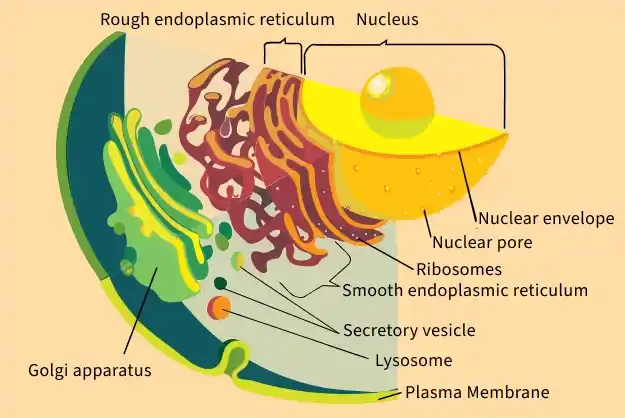
While each of the membranous organelles is distinct in terms of its structure and function, alarge number of these are considered together as an endomembrane system since their functions are coordinated. The endomembrane system comprises the endoplasmic reticulum (ER), the Golgi complex, lysosomes, and vacuoles. Since the functions of the mitochondria chloroplast and peroxisomes are not composed of the above parts, these are not considered as a part of the endomembrane system.
**Endoplasmic Reticulum
Endoplasmic Reticulum is a membranous structure that forms a significant part of the endomembrane arrangement of the Eukaryotic cell that separates the intracellular space into luminal and additional luminal (cytoplasm) compartments.
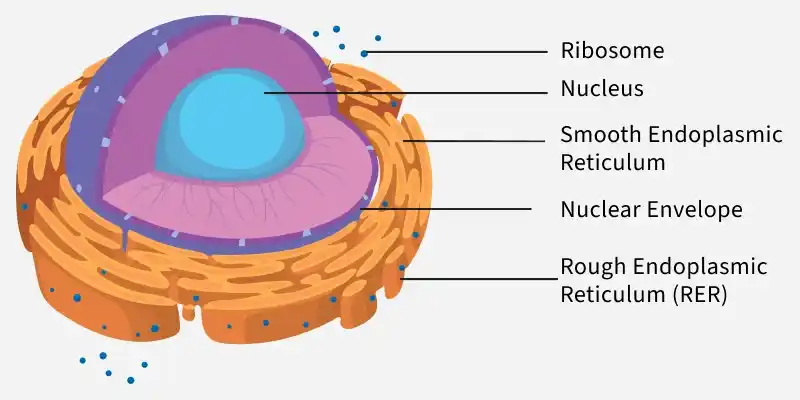
The structure of the endoplasmic reticulum is shaped like an ER, which is of two types: smooth endoplasmic reticulum and rough endoplasmic reticulum.
**1. Rough endoplasmic reticulum
- The rough endoplasmic reticulum is named so because of its appearance.
- It is an associated flattened sacs having a few ribosomes on its external surface, subsequently the name.
- It synthesises and secretes proteins in the liver, chemicals, and different substances in the glands.
- Rough ER is conspicuous in cells where protein synthesis occurs.
- The rough endoplasmic reticulum likewise assumes a crucial part in protein folding.
- The second most significant capability after protein synthesis and protein folding is protein arrangement.
**2. Smooth Endoplasmic Reticulum
- The smooth endoplasmic reticulum doesn't have ribosomes and has a tubular structure.
- It participates in the development of phospholipids, the main lipids in cell membranes, which are essential during digestion.
- Smooth ER transports the results of the rough ER to other cell organelles, particularly the Golgi apparatus.
- Smooth ER is essential in the synthesis of essential lipids such as phospholipids and cholesterol.
- Smooth ER is also responsible for the secretion of steroid hormones.
- It is also responsible for the metabolism of carbohydrates.
- The smooth ER stores and releases calcium ions. These are important for the nervous system and the muscular system.
**Golgi complex
It is a single membrane-bound organelle that forms a part of the endomembrane system. The Golgi complex is mainly found in the cytosol of the eukaryotic cells membrane sacs known as cisternae. A Golgi stack contains 4-8 cisternae.
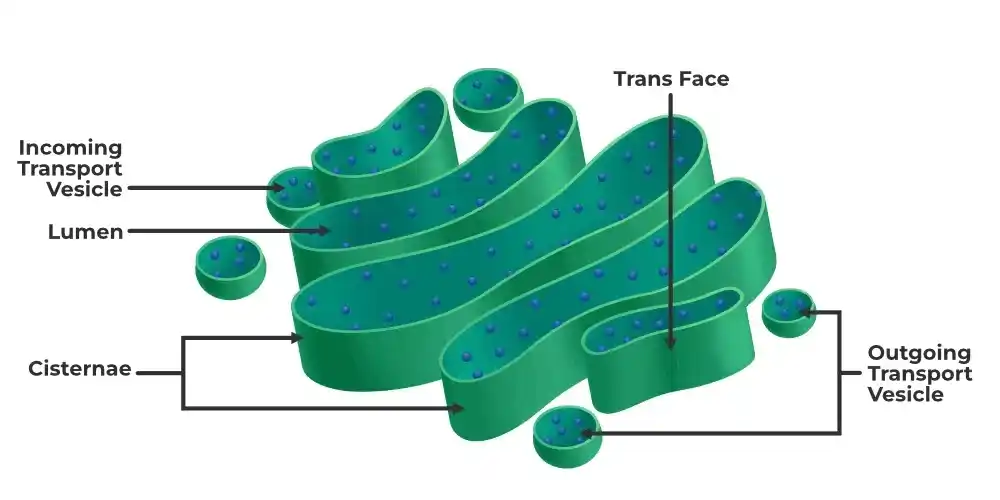
The shape and size of the Golgi complex depend upon the physiological state of the cells. Mainly, it is composed of four parts: cisternae, tubules, vesicles, and vacuoles. The structure of the Golgi apparatus is as follows:
- Golgi Apparatus consists of flat, disc-shaped sacs or cisternae of 0.5µm to 1.0µm diameter. These are stacked parallel to each other.
- The Golgi cisternae are concentrically arranged near the nucleus.
- They have distinct convex cis or the forming face and concave trans or the maturing face. These faces are completely different from each other, but are interconnected.
- The organelle has a cis face for receiving materials from the endoplasmic reticulum and a trans face for shipping vesicles to various cellular organs.
- Vesicles move from the cis to the trans face during processing.
- This distinctive structure of the Golgi apparatus allows for efficient processing, modifying, and packaging of macromolecules within the cell.
**Lysosomes
It is a single-membrane-enclosed organelle that contains hydrolytic catalysts that are responsible for the breakdown of different biomolecules. These hydrolytic proteins incorporate nucleases, proteases, lipases, glycosidases, phosphatases, phospholipases, and sulphatases.

Lysosomes are spherical and are enclosed by a single-layered membrane. The interior of lysosomes may be almost solid or differentiated into an outer denser region and a central, less dense mass with granular content called the lumen.
- The interior of the lysosome contains a variety of hydrolytic enzymes, known as lysosomal enzymes, which are responsible for breaking down and digesting various cellular components, including damaged organelles, waste materials, and foreign substances.
- Within the lysosome, there is an acidic environment maintained by specialised pumps that regulate the pH between 4.5 and 2.0.
- Their size may vary from each other, and they are responsible for various cellular processes like energy metabolism, cell signalling, etc.
**Vacuole
A vacuole is a membrane-bound structure found in the cytoplasmic membrane of a cell. The membrane encoded the vacuole is known as the tonoplast. The components of the vacuole, known as the cell sap, differ from those of the surrounding cytoplasm. The layers are made out of phospholipids. The layers are implanted with proteins that help in the transportation of molecules across the membrane. Various combinations of these proteins assist the vacuoles in holding various materials.

The structure of a vacuole in a cell is described as follows:
- The vacuole is enclosed by a membrane called the tonoplast. It is made up of phospholipids and proteins and separates the contents of the vacuole from the cytoplasm.
- The different components, like water, ions, pigments, sugars, toxins, and various dissolved substances present inside the vacuole, are collectively referred to as cell sap. The sap helps in maintaining turgor pressure in plant cells and storing essential nutrients.
- The composition of the cell sap within the vacuole differs from that of the surrounding cytoplasmic matrix.
- Vacuoles can vary in size and shape. For example, in plant cells, a vacuole occupies most of the cell's space, while animal cells have smaller and numerous vacuoles.
Functions of the Endomembrane System
The functions of Endomembrane S are given below:
- Synthesis of proteins and lipids
- Modification and packaging of macromolecules
- Transport of materials within the cell
- Digestion and recycling of cellular waste
- Storage of substances