Flagella (original) (raw)
Last Updated : 20 Dec, 2025
Flagella are long, thin, whip-like structures that extend from the surface of some cells and help in movement. They propel cells through liquids, aiding in navigation, nutrient acquisition, and sometimes in defence. Flagella are found in bacteria, archaea, and eukaryotic cells, and they show wide diversity in their structure and function.
Structure of Flagella
A hair-like helical structure called a flagellum (singular) arises from the cell membrane and cell wall. It controls the bacteria's ability to move. It is thin in size, 15–20 nm in diameter. Only after dyeing with a specific stain that increases the Flagella's diameter can a single flagellum be seen under a light microscope. There are three components to a flagellum: the basal body, the Hook, and the Filament.

Basal Body
- The basal body is made up of a central rod that is inserted into a series of rings, which are connected to the cell wall and cytoplasmic membrane.
- **L-ring: The outer ring that is only found in Gram-positive bacteria and is anchored in the lipopolysaccharide layer.
- **P-ring: The second ring in the cell wall's peptidoglycan layer.
- **M-S ring: Cytoplasmic membrane-anchored.
- **C ring: Cytoplasmic attachment.
Hook
- It is the larger area at the filament's base.
- It joins the filament to the base's motor protein.
- In gram-positive bacteria, the length of the hook is longer than in gram-negative bacteria.
Filament
- The long, helical screw that the bacteria are propelled by when the motor rotates it through the hook is called the flagellar filament.
- The filament is made up of 11 protofilaments that are almost parallel to the filament axis in the majority of the bacteria, including the Gram-negative Escherichia coli, Salmonella typhimurium, and Vibrio alginolyticus.
- A group of protein tandem chains make up each protofilament. Campylobacter jejuni, however, possesses seven protofilaments.
Motor
- At the flagellum's anchor point on the inner cell membrane, a protein-based rotary engine called the Mot complex propels the bacterial flagellum.
- Proton-motive force, or the flow of protons (hydrogen ions) across the bacterial cell membrane as a result of a concentration gradient set up by the cell's metabolism, powers the engine.
- Vibrio species have lateral and polar flagella, and some are driven by a sodium ion pump instead of a proton pump.
- Protons are transported through the membrane while being rotated by the rotor.
- The rotor may spin at a speed of 6,000 to 17,000 rpm on its own, but often only achieves 200 to 1000 rpm when the flagellar filament is attached.
Characteristics of Flagella
- Flagella are hair-like protrusions from the cell body with dimensions ranging from 5 to 20 μm and 10 to 30 nm.
- A variety of motile bacteria, including Selenomonas and Wolinella succinogenes, use it as a locomotive organelle.
- Bacteria can contain as few as one or two Flagella or hundreds of them.
- Only with a light or electron microscope can one directly view flagella after suitable staining.
- The flagellum is antigenic (for example, antigen H) and plays a role in the pathophysiology of various diseases.
- Flagellate bacteria include Vibrio cholerae and Campylobacter jejuni. They use a group of flagella to break through the mucus lining of the small intestine and reach the epithelium, where they produce toxins.
Flagella Location
Flagella can be found in various locations on a cell.
- In bacteria, they often protrude from the cell surface, extending outward to propel the cell through its environment.
- Some bacteria have flagella at one or both ends of the cell, allowing for efficient movement in different directions.
- In eukaryotic organisms like sperm cells, flagella are typically found as a single long tail-like structure extending from the cell body, facilitating locomotion through fluid environments.
Types of Flagella
Flagella exist in three different types: bacterial, archaeal, and eukaryotic.Dynein and microtubules in eukaryotic flagella move through bending. Bacterial and archaeal flagella lack dynein and microtubules, and they spin to move.
**1. Bacterial Flagella
- Each of the helical filaments that make up bacterial flagella has a rotary motor at its base that may rotate either clockwise or counter clockwise.
- They offer two of the several bacterial motility types.
- Found in bacteria like Escherichia coli
**2. **Eukaryotic Flagella
- Animal, plant, and protist cell eukaryotic flagella are intricate cellular appendages that lash back and forth.
- The construction of eukaryotic Flagella and motile cilia is the same; their lengths, waveforms, and uses vary.
- The 9+0 axoneme is present in immotile primary cilia.
- Present in organisms like sperm cells.
**3. Archaeal Flagella
- Although archaeal flagella (archaella) are thought to be non-homologous, they are superficially similar to bacterial Flagella in that they both include a rotary motor.
- Archaea, a group of single-celled microorganisms.
Arrangement of Flagella in Bacteria
Bacterial flagella are motile organelles made up of thousands of different protein subunits. The axial structure is the filamentous portion that protrudes from the cell membrane.
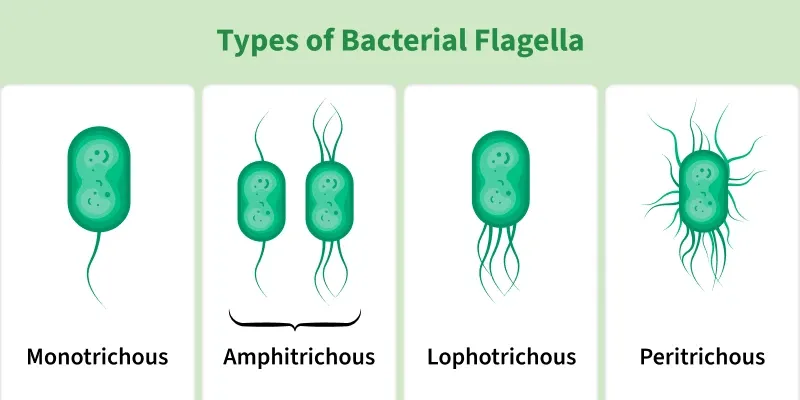
Variable bacterial species, called tricho (from the Greek word trichos - meaning hair), have variable flagella numbers and patterns:
- **Monotrichous Bacteria: They have just one polar flagellum, like Vibrio cholerae.
- **Amphitrichous Bacteria: One flagellum only functions at a time in amphitrichous bacteria (like Alcaligenes faecalis), which enables the bacterium to quickly change its direction by switching which flagellum is active.
- **Lophotrichous Bacteria: Helicobacter pylori is an example of a lophotrichous bacterium, which has many flagella that are all situated at the same location on the bacterial surface and work together to propel the bacteria in a single direction.
- **Peritrichous Bacteria: Flagella on peritrichous bacteria, such as E. coli, project in all directions.
Bacterial vs Archaeal vs Eukaryotic Flagella
The table below shows the comparison between Bacterial, Archaeal, and Eukaryotic Flagella, including their structure, movement, growth, presence, etc.
| Bacterial Flagella | Archaeal Flagella (Archaella) | Eukaryotic Flagella |
|---|---|---|
| Composed of flagellin protein. Thin and rigid structure. | Composed of archaellins. Thinner than bacterial flagella. | Composed of microtubules in a 9+2 arrangement. Thicker and more complex. |
| Rotates like a propeller. | Rotates like a propeller but is structurally and genetically distinct from bacterial flagella. | Waves in a whip-like motion. |
| Proton motive force (PMF). | ATP or possibly a different form of ion motive force. | ATP. |
| Grows from the base. | Grows from the base. | Grows from the tip. |
| Primarily for motility. | Primarily for motility. | Motility, but also plays roles in sensory functions. |
| Found in many bacteria. | Found in many archaea. | Found in eukaryotic cells, including animals, plants, and fungi (in sperm cells and some unicellular organisms). |
Functions of Flagella
Flagella conducts the following activities:
- They facilitate mobility in an organism.
- Few eukaryotes have a flagellum to speed up reproduction.
- They serve as sensory organs, detecting changes in pH and temperature.
- Recent studies have demonstrated that flagella can function as a secretory organelle as well. Example: Chlamydomonas.