Heterotrophic Nutrition (original) (raw)
Last Updated : 17 Feb, 2026
Heterotrophic nutrition is a type of nutrition in which organisms rely on other organisms for nutrition, either directly or indirectly. Heterotrophic nutrition is a mode of nutrition in which organisms are unable to synthesise their own food from inorganic substances and therefore depend on other organisms for their nutritional requirements. All animals, fungi, many bacteria, and some plants exhibit heterotrophic nutrition.
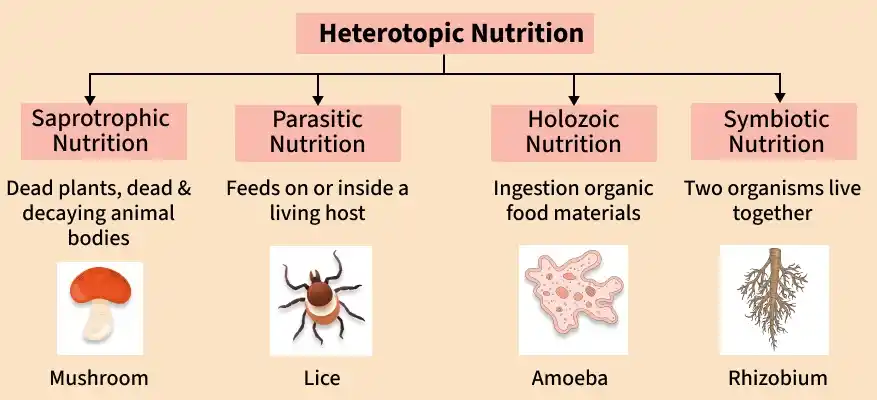
All heterotrophs (except blood and gut parasites) convert complex nutrients into simple compounds via Digestion that can be absorbed and utilised by the cells. The soluble products of digestion are then broken down for energy release (Respiration) and other developmental processes (Metabolism).
Types of Heterotrophic Nutrition
The heterotrophic mode of nutrition can be categorised into three types based on their technique of intaking nutrition :
**1. Saprophytic Nutrition
In the saprophytic mode of nutrition, organisms obtain nutrients from dead and decaying organic matter. These organisms are called saprophytes. In saprophytes, the digestive process entails dissolving complex organic materials into less complex nutrients outside their body by releasing their digestive juices. During the process of saprophytic nutrition, proteins, lipids, and carbohydrates are broken down into less complex molecules that can be easily absorbed by the organism.
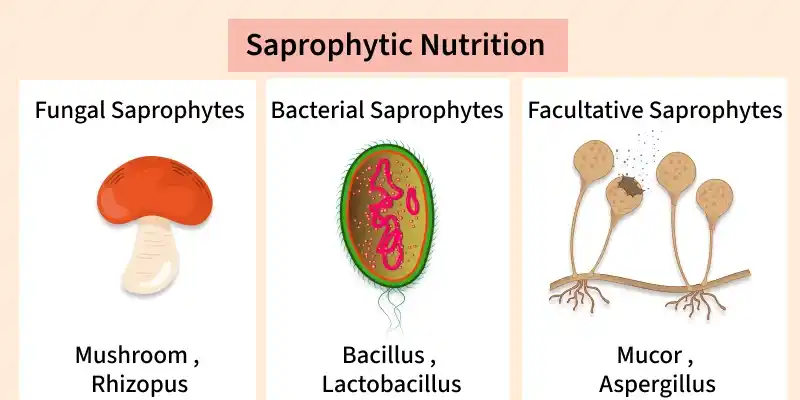
Three types of Saprophytes are given below:
- **Fungal Saprophytes: Obtain food from dead plants or animals. E.g. Rhizopus (bread mould), Penicillium, Mushrooms.
- **Bacterial Saprophytes: Bacteria decompose dead organic matter in soil or water. E.g. Bacillus, Pseudomonas, Lactobacillus.
- **Facultative Saprophytes: Can live on living hosts but switch to decaying matter when the host dies.E.g. Mucor and Aspergillus.
**2. Parasitic Nutrition
Parasites are organisms that feed on simple nutrients from the body of another organism, called the host, and cause harm to it. These organisms can be external or internal. A few examples of parasites are Ascaris (roundworms), which live in the human gut, causing Ascariasis, Cymothoa exigua, a rare parasite that is also known as tongue-eating louse because it lives in the mouth of the marine fish Lithognathus, etc. Parasites are completely dependent on their host organisms for their survival.
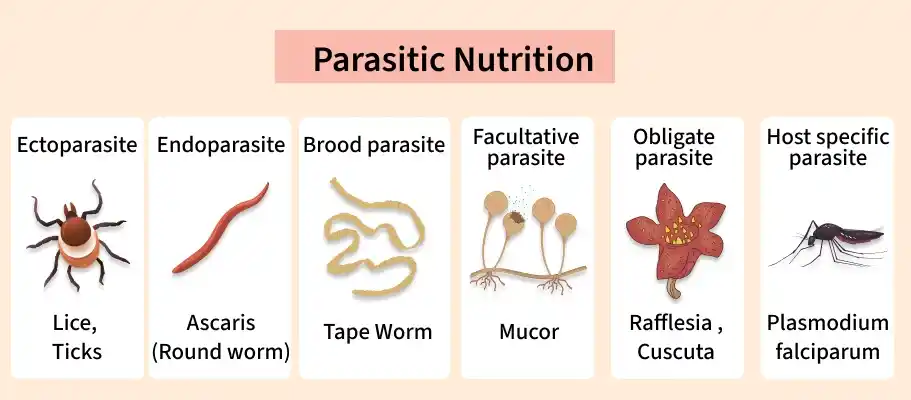
Six types of parasites are given below:
- **Ectoparasites: The parasites that infect the host's body externally to obtain their nutrition are called Ectoparasites. These include parasites like ringworm, bedbugs, lice, etc.
- Endoparasites: The parasites that infect the host body internally to obtain their nutrition are called Endoparasites. These include parasites like Tapeworms, Ascaris, etc.
- **Obligate Parasites: These types of parasites are organisms that are completely dependent on a living host for their survival, growth, and reproduction. These include parasites like _Plasmodium (the malarial parasite) and viruses, etc.
- **Facultative Parasites: These parasites are organisms that can live independently in the environment but may become parasitic when suitable conditions or a host are available. These include parasites like _Aspergillus and _Candida, etc.
- **Host-Specific Parasites: The parasites that can infect and survive in only a particular host species or a very narrow range of hosts. These include parasites like Plasmodium falciparum.
- **Broad-Host Parasites: The parasites that can infect and survive in a wide range of host species, rather than being restricted to a single host. These include parasites like tapeworms and roundworms, etc.
**3. Holozoic Nutrition
It is a type of heterotrophic nutrition in which complex food is consumed by the body and processed internally. Simple nutrients are absorbed by the body after digestion, whereas undigested substances are expelled from the body. Most vertebrate species, as well as single-celled creatures like Paramecium and Amoeba, exhibit this style of nourishment.
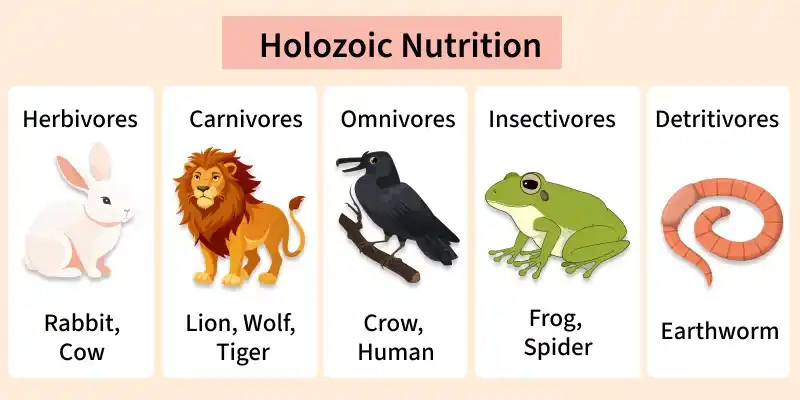
Holozoic nutrition is observed in these five types of organisms:-
- **Herbivores: The animals that are directly dependent on plants for their nutrition are called Herbivores. E.g. Zooplankton, Deer, Cow, etc.
- **Carnivores: The animals that feed on other animals are called Carnivores. E.g. Lion, Tiger, Shark, etc.
- **Omnivores: The animals that feed on both plants and animals are called Omnivores. E.g. Humans, Rats, etc.
- **Insectivores: The animals that feed mainly on insects. E.g. Frog, Lizard
- **Detritivores: The animals that feed on decaying organic matter. E.g. Earthworms, some crustaceans.
4. Symbiotic Nutrition
Symbiosis is referred to as a term that is a close, frequently ongoing relationship between two different species in an ecosystem. In simple words, it is a connection between two organisms. Symbiotic relationships play a critical role in the development of ecological communities, the promotion of biodiversity, and the overall health and harmony in ecosystems.

Three types of Symbiotic relationship are given below:
- **Mutualism: In a mutualistic symbiosis, both of the involved species benefit from the relationship. E.g. Bees and Flowers.
- **Commensalism: It is an interaction in which one species gains while the other is not severely damaged or benefited. E.g. Barnacles and Whales
- **Parasitism: In a parasitic relationship, one species gains at the expense of the other. E.g. Tick and Cat.
Functions of Heterotrophic Nutrition
The following points describe the key functions of heterotrophic nutrition in supporting life processes and body maintenance.
- **Provides Energy: Supplies energy required for vital life activities such as movement, growth, and metabolism.
- **Supports Growth and Development: Provides raw materials like proteins, carbohydrates, and fats necessary for body growth and cell formation.
- **Aids in Repair and Maintenance: Helps in the repair of damaged tissues and the replacement of worn-out cells.
- **Maintains Metabolic Activities: Supplies nutrients required for enzymatic and biochemical reactions inside the body.
- **Helps in Storage of Energy: Excess food is stored in the form of glycogen or fat for future use.
- **Supports Reproduction: Provides energy and materials required for the formation of reproductive cells and offspring development.
- **Maintains Ecological Balance: Heterotrophs act as consumers and decomposers, helping in energy transfer and nutrient recycling.