Nutrition In Plants (original) (raw)
Last Updated : 29 Apr, 2026
Nutrition in plants refers to the process through which plants get nourishment to stay healthy, grow, and repair damaged body parts. There are different modes of nutrition in plants: autotrophic and heterotrophic.
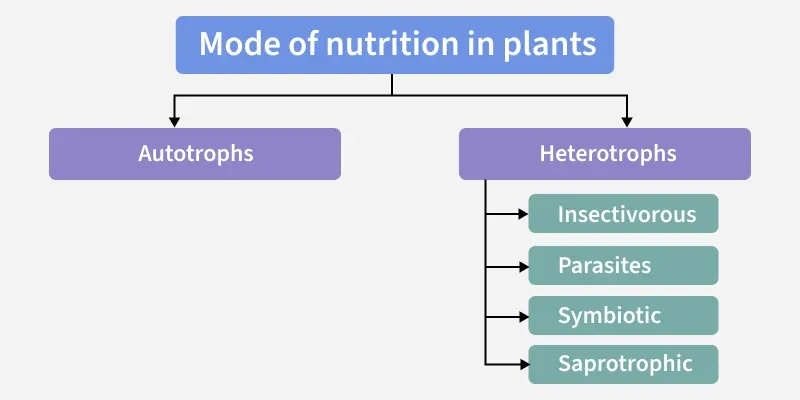
Mode of Nutrition in Plants
Nutrition is a crucial biochemical and physiological process through which an organism utilises food to sustain life. Nutrition gives nutrients to organisms, which are used to produce energy and build cellular structures. These resources mainly come from their surroundings and include minerals, carbon dioxide, water, and sunlight.
There are two modes of nutrition in plants, which are:
- **Autotrophic Nutrition: Plants have the unique ability to manufacture their food by converting readily available inorganic elements like sunlight, water, and carbon dioxide into organic ones. They are often known as primary producers, as they exhibit autotrophic nutrition.
- **Heterotrophic Nutrition: Heterotrophic nutrition is a mode of nutrition in which organisms cannot prepare their own food and depend on other organisms for their nutritional requirements. These organisms obtain organic substances such as carbohydrates, proteins, and fats from plants or other animals.
Autotrophic Nutrition in Plants
Autotrophs are living things that can make their own nourishment from inorganic resources and can survive by themselves entirely without the help of other living things. Because of this, autotrophs are referred to as "producers." For instance, there would be no herbivorous animals and no carnivorous creatures that consume herbivores if there were no plants.
Photosynthesis
Green plant leaves use a process called photosynthesis to turn sunlight energy into chemical energy by producing carbohydrates. Chlorophyll is a green pigment present in all the green parts of plants and is localised inside the chloroplast. It facilitates solar energy absorption. In the process of photosynthesis, food is prepared by using water and carbon dioxide in the presence of sunlight.
Steps of Photosynthesis
The steps of photosynthesis are:
- **Light Absorption: Chlorophyll in leaves captures light energy.
- **Water Splitting: Light energy is used to split water molecules, releasing oxygen.
- **Energy Transfer: Energy from light is converted into ATP and NADPH (energy carriers).
- **Carbon Fixation: CO2 is captured and converted into organic molecules.
- **Sugar Production: Using ATP and NADPH, glucose (sugar) is made from captured carbon.

Obtaining Various Components for Photosynthesis
To carry out photosynthesis, plants obtain various components from their surroundings, which are:
Plants obtain Carbon dioxide
- The leaf surface of plants consists of numerous small pores known as stomata.
- These pores are the entrance gate for carbon dioxide gas.
- A pair of guard cells surrounds each pore in the stomata.
- These stomatal pores open and shut and are controlled by the guard cells.
- The stomatal openings close when a plant doesn't require carbon dioxide and wants to conserve water.
Plants obtain Water
- The amount of water needed for photosynthesis is taken up by the roots of plants from the soil through the osmosis process.
- The xylem vessels of the plant carry the absorbed water upward to the leaves.
- Additionally, the plants require additional raw components, including nitrogen, phosphorus, iron, magnesium, etc. Plants from the soil take up these elements.
Heterotrophic Plant Nutrition
In this type of nutrition, Some heterotrophic plants lack chlorophyll and depend on other organisms; such plants may be parasitic. These plants are also known as parasites. The following are many heterotrophic plant species that are primarily categorised according to how they obtain their nutrition:
| Types of Nutrition | Description | Examples |
|---|---|---|
| Parasitic Nutrition | Some heterotrophic plants rely on food from other plants and animalsThe parasitic plant takes its nutrition and does not benefit its host in any way. | Cuscuta and Cassytha. |
| Insectivorous Nutrition | Some plants are referred to as carnivorous or heterotrophic plants as they intake insectivorous nutrition and have unique structural characteristics that enable them to capture insects.They release digestive fluids and break down the insects and extract their nutrition.These plants grow and flourish on mineral-deficient soil. | Pitcher plants and Venus flytrap |
| Saprophytic Nutrition | Saprophytic nutrition revolves around dead and rotten plants and animals, as they are the source of food for saprophytic plants.They basically release digestive secretions and break down the dead and rotting debris, and assimilate the nutrients. | Mushrooms and mould |
| Symbiotic Nutrition | Symbiotic nutrition refers to a close relationship between two distinct plants from two distinct categories, where they gain nutrients from each other. | The relationship between fungi and trees. |
Plant Nutrients
Plant nutrients are essential elements that plants absorb from the soil to support their growth, development, and overall health. These nutrients are classified into:
- **Macronutrients
- **Micronutrients
**Also Read: Difference Between Micronutrients and Macronutrients
**1. Macronutrients
Essential elements required in large quantities for plant growth. Macronutrients include:
- **Nitrogen (N): Vital for leaf and stem growth.
- **Phosphorus (P): Important for root development and energy transfer.
- **Potassium (K): Regulates water uptake and enzyme activation.
- **Calcium (Ca): Strengthens cell walls and influences cell division.
- **Magnesium (Mg): Central component of chlorophyll for photosynthesis.
- **Sulphur (S): Essential for protein synthesis.
2. Micronutrients
Essential elements needed in small quantities for plant development. Micronutrients include:
- **Iron (Fe): Necessary for chlorophyll synthesis and energy transfer.
- **Manganese (Mn): Involved in photosynthesis and enzyme activation.
- **Zinc (Zn): Important for hormone production and enzyme function.
- **Copper (Cu): Plays a role in photosynthesis and respiration.
- **Molybdenum (Mo): Helps in nitrogen fixation and enzyme function.
- **Boron (B): Vital for cell wall formation and reproductive growth.
- **Chlorine (Cl): Involved in osmosis and ionic balance.
Soil Nutrient Replenishment
If a plant is deficient in an essential nutrient, it will not be able to complete its life cycle. The plant fails to produce healthy roots, leaves, or flowers, and it won't be able to produce seeds for new plants. The plant will often die. Conversely, too much of a nutrient can harm or even kill plants.
- Excess nitrogen may cause a plant to grow more leaves, but little to no fruit, and too much manganese can turn leaves yellow and cause them to die.
- An excess of boron can also be fatal. Thus, a balanced nutrient cycle is necessary.
- Plants are directly linked to the soil and obtain their major nutrients from it.
- Replenishment of soil nutrients is essential for plant growth, as the nitrogen content of the soil declines after harvest.
- Specific bacteria transform this nitrogen into a form that plants can easily utilise.
- The root nodules of leguminous plants contain Rhizobium bacteria, which absorb atmospheric nitrogen gas and transform it into water-soluble nitrogen compounds for the plants' growth. In return, leguminous plants provide food and a habitat for Rhizobium bacteria, which cannot produce their own food. This mutually beneficial relationship is crucial for farmers as it reduces the need for soil fertilisation.