Leaves Morphology, Types & Modification (original) (raw)
Last Updated : 7 May, 2026
Leaves are the lateral appendages of the stem. The primary function of Leaves is to make glucose and produce oxygen by using sunlight, CO2 and H2O via the process known as photosynthesis. The structure of the leaf is composed of three parts, including the leaf base, lamina, and petiole. There are diverse types of Leaves present, which depend upon the type of plant species. Chlorophyll is present in leaves, which provides a green colour and participates in photosynthesis.
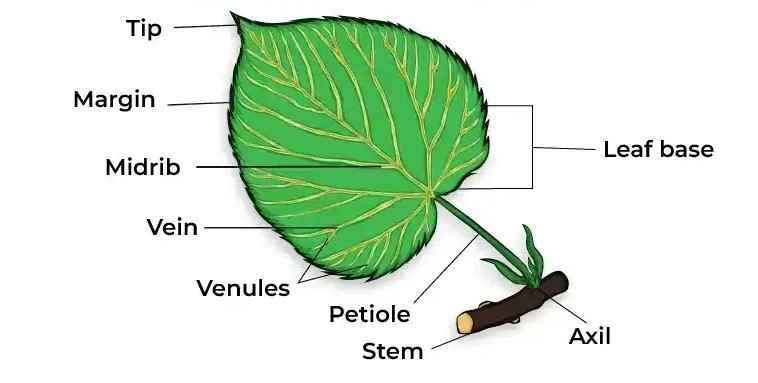
Leaves are green-colored, flat, thin lateral appendages of the stem. It bears a bud in its axil, which is borne at the node. It contains a photosynthetic pigment, i.e. chlorophyll, so that its colour is green. This photosynthetic pigment participates in the synthesis of organic food for the plant.
Structure of Leaves
Mainly, plants have leaf bases, petioles, and lamina; all these together form the main parts of the Leaves.
- **Leaf Base: The part at which the leaf attaches to the stem, leaf-like,is called the leaf base. It has two leaf-like structures, which are called stipules.
- **Petiole: It is a thin, long stalk that joins the leaf blade to the stem.
- Lamina: It is the green-coloured flat surface of the leaf, which is also known as the leaf blade. The surface of the lamina is divided into two, which are called the midrib. Lamina also consists of small, branched veins and veinlets.
Types of Leaves
Mainly, leaves are of two types: Simple and Compound Leaves. These are further divided based on shape, size, and arrangement of leaves on structures, the stem.
**1. Simple Leaves
When the main stem is linked to the petiole through a single lamina. Example Guava leaves
**2. Compound Leaves
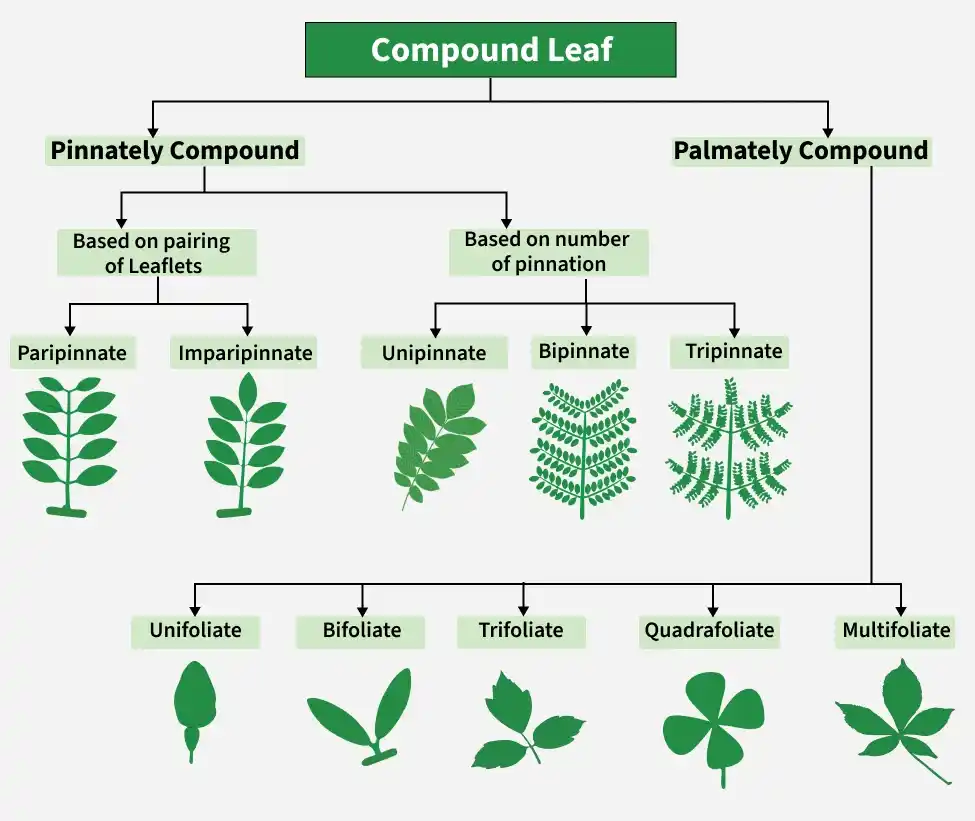
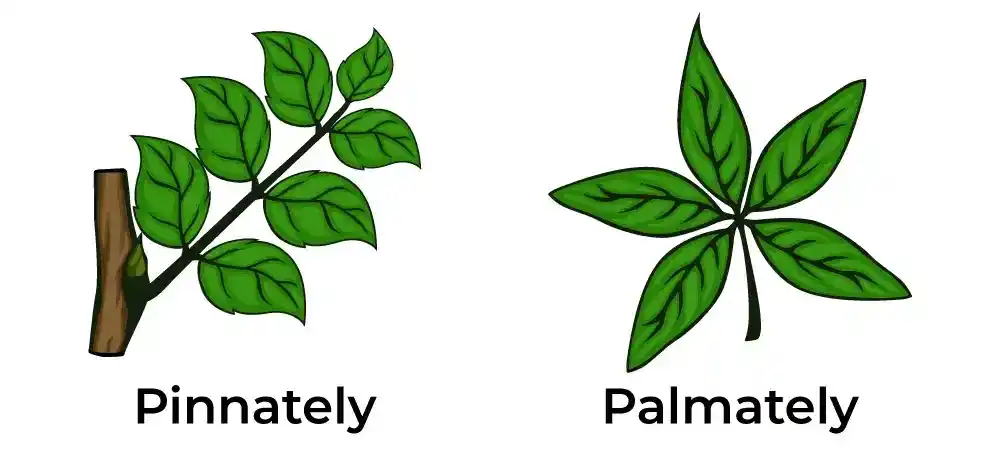
When the midrib is branched into many leaflets and connected through a single petiole. These Leaves are divided into two sub-types: Pinnately and palmately compound Leaves.
**Pinnately Compound Leaves
In this type of leaf, the midrib is divided into various leaflets, and these leaflets are connected by a common axis. These are further divided into the following types:
- **Unipinnate: Leaflets are present on each side of the axis.
- **Bipinnate: Leaflets are imported from the secondary axis, which are produced from the central axis.
- **Tripinnate: Leaflets are imported from the tertiary axis, which emerges from the secondary axis.
- **Parapinnate: In this type of leaflet, the terminal leaflet is absent.
- **Imparipinnate: The leaf that has an odd terminal leaflet.
**Palmately Compound Leaves
In Palmately Compound Leaves type of Leaves, the leaflet is attached to the petiole tip. These are further divided into the following types:
- **Unifoliate: These Leaves have a single leaflet.
- **Bifoliate: These consist of two leaflets.
- **Trifoliate: These consist of three leaflets, and these three leaflets arise from a single point.
- **Quadrifoliate: These consist of four leaflets, and all four leaflets arise from a single point.
- **Multifoliate: These leaves consist of more than four leaflets, and all leaflets arise from the same point.
Phyllotaxy
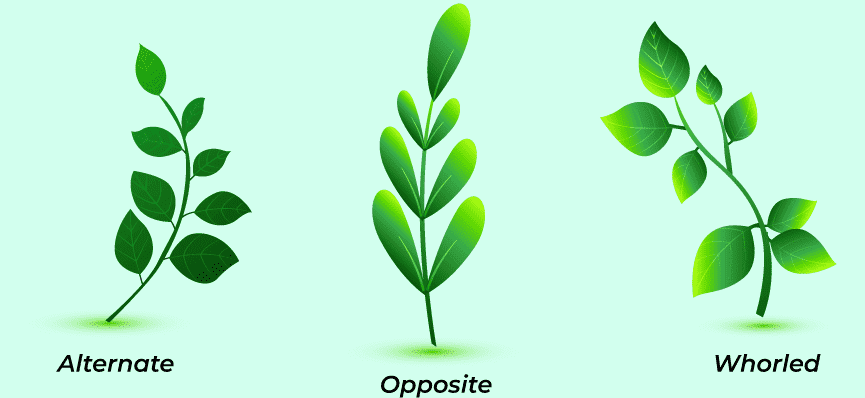
Leaf arrangement on a plant stem is known as phyllotaxy. It explains how Leaves are arranged and positioned with respect to one another along the stem.
Phyllotactic patterns that are frequently seen include:
- **Alternate: One leaf per node, arranged alternately (e.g., China rose)
- **Opposite: Two leaves per node, positioned opposite to each other (e.g., Calotropis)
- **Whorled: More than two leaves per node, arranged in a whorl (e.g., Nerium)
Venation
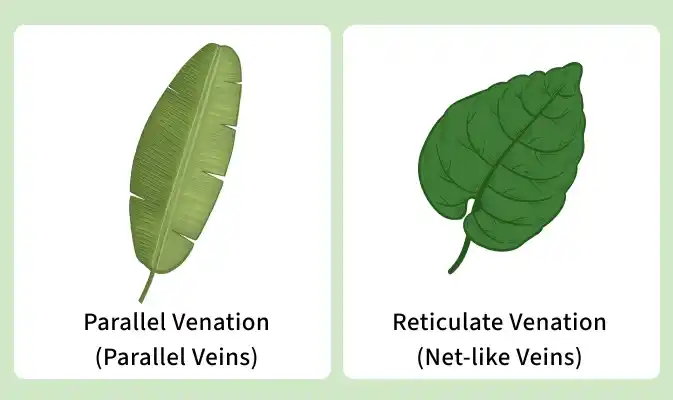
Veins and veinlets help in the transportation of water and minerals, and also provide the rigidity to the lamina. The arrangement of veins and veinlets is known as venation. Mainly, it is of two types:
- **Reticulate venation: In this type of venation, the arrangement of veinlets is random and forms a complex network. Example: Dicotyledonous plants.
- **Parallel venation: In this type of venation, the veinlets run parallel to one another. Example: Monocotyledonous plants.
Modification of Leaves
Mainly Leaves perform photosynthesis, but they also participate in different roles like storage of food, support, defence, etc.
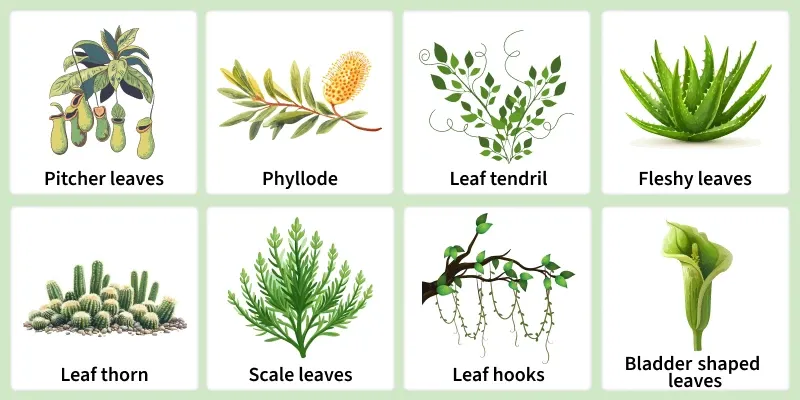
To perform these functions Leaves are modified into different forms like:
- **Tendrils: When Leaves are modified into wiry structures, then these are called as tendrils; they help the climbers to climb.
- **Thorns: When Leaves are converted into pointed structure and, these structures protect the plant from herbivores.
- **Phyllode: When the petiole is modified into extended green structures that carry out photosynthesis.
- **Fleshy leaves: Due to the storage of water and food, these Leaves are become fleshy.
- **Leaf Hooks: Leaves modified into hooks to help the plant climb and support itself, and are useful for climbing plants that need support.
- **Scale Leaves: Scale leaves are small, dry, thin, and membranous leaves and Protect buds or underground stems and reduce water loss.
- **Leaf bladders: Leaves of some aquatic plants are modified into leaf bladders, which trap the small insects.
- Leaf pitcher: Leaf lamina is modified into a lid which is called a pitcher, and this traps the insects and fulfill nitrogen requirement.
Functions of Leaves
Leaves participate in many functions, such as:
- **Photosynthesis: Leaves have green colour pigment, i.e. chlorophyll, which traps sunlight and forms glucose from carbon-dioxide and water. This process is called as photosynthesis.
- **Transpiration: Leaves remove the excess water through stomata in the form of water vapour and allow the water conduction from the roots.
- **Exchange of gases: Through stomata, exchange of gases takes place.
- **Storage of food: In some plants, modified Leaves are present, which participate in the storage of food.